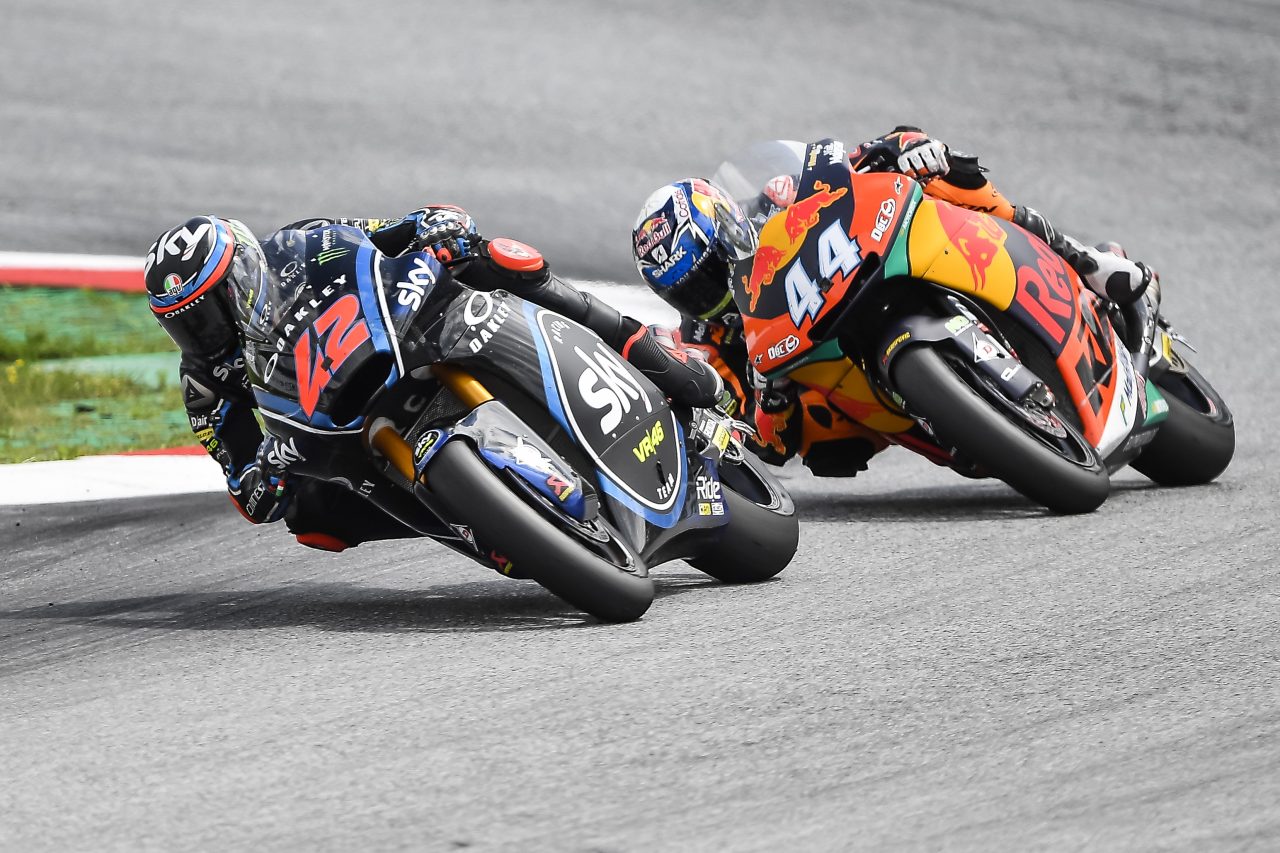
This weekend, the Moto2 World Championship rolls into Silverstone, one of the fastest tracks of the year, for the British Grand Prix, and Francesco Bagnaia is leading the title race from Miguel Oliveira by three points after the pair’s stunning battle last time out in Austria, a fight which lasted half the race and went down to the very final corner.
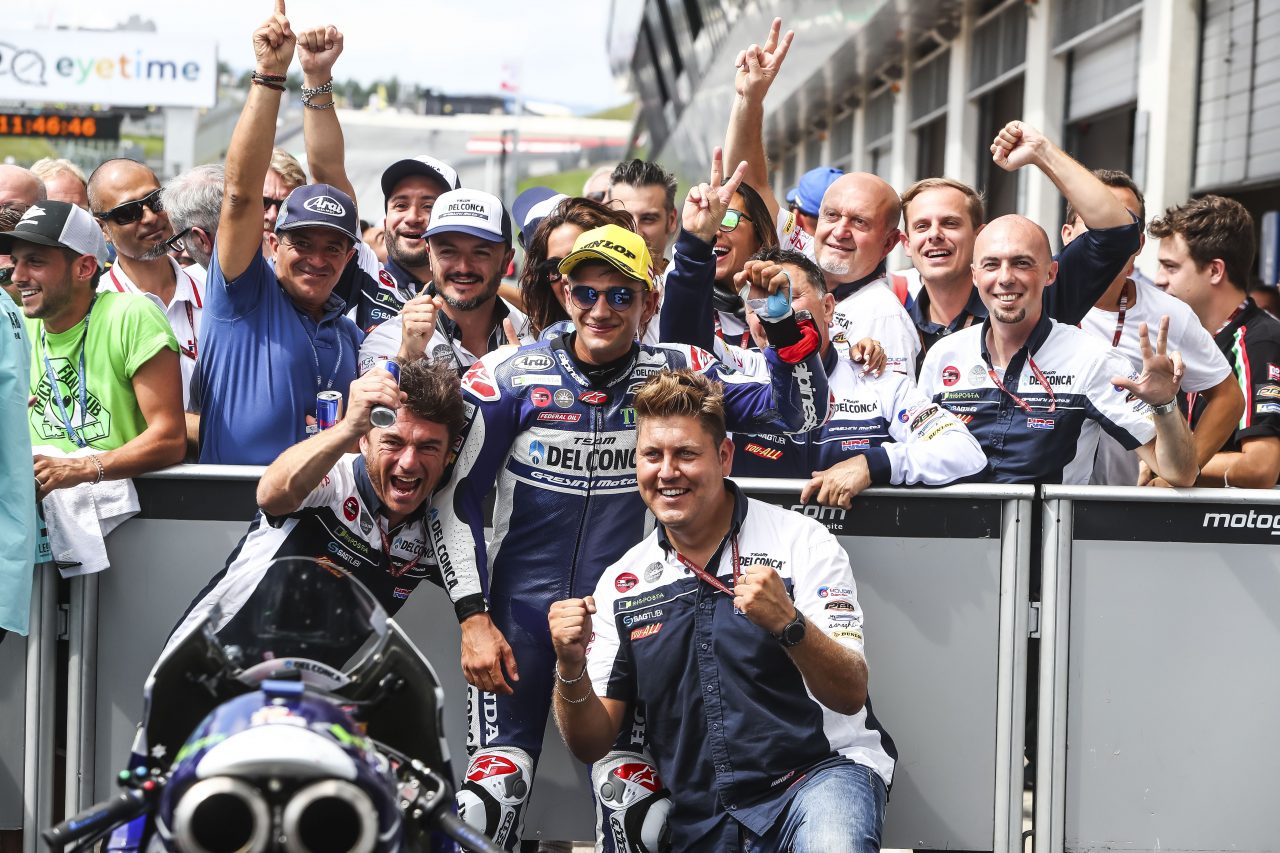
Bagnaia leading Oliveira at the Redbull Ring 2018. Image courtesy of HondaProRacing
Bagnaia came out on top in that battle, and will be hoping to do so again this weekend, at a circuit which he beat Oliveira last season by three positions and 0.9 seconds (Bagnaia coming home in fifth, whilst Oliveira crossed the line in eighth). Bagnaia was also very strong at Silverstone in Moto3, when riding for Mahindra, finishing second to eventual World Champion Brad Binder back in 2016. This race could prove crucial in the World Championship fight, with some good tracks – on paper – for the KTM coming up, and of course there will always be the memory in the back of the mind of Bagnaia that Oliveira and KTM won the final three races of last year back-to-back.
With that in mind, maybe this weekend is not so crucial for Miguel Oliveira. However, if he could go into the next races, which should be stronger for him and KTM, with a points lead, he would become the overwhelming championship favourite, and it would start to look extremely difficult for Bagnaia to overcome the Portuguese. However, Oliveira has never had a podium at Silverstone, having a best result of 4th back in 2014 when he was in the factory Mahindra team. He was, however, ‘best of the rest’, also on Mahindra, back in 2013, when he finished 20 seconds off the win for fifth place behind the dominant Spaniards of 2013 and their unbeatable KTMs. It could be an interesting fight this weekend between the two championship combatants.
Only Mattia Pasini will rock up on the Moto2 grid in Silverstone this weekend having stood on the podium last year at the British Grand Prix – he finished second, 0.724 seconds behind winner Takaaki Nakagami, who has since, of course, moved on to MotoGP. Pasini took his best result since his win in Argentina last time out in Austria and – for perhaps the first time in his career – erred on the side of caution when fighting for the podium with Alex Marquez and Luca Marini, and decided to not get involved in the battle so as to ensure his solid fourth-placed finish. Pasini will be hoping that Austria is a sign of things to come, and a return to form now would be well-timed, as the rumour recently has been that the Italian is contemplating retirement.
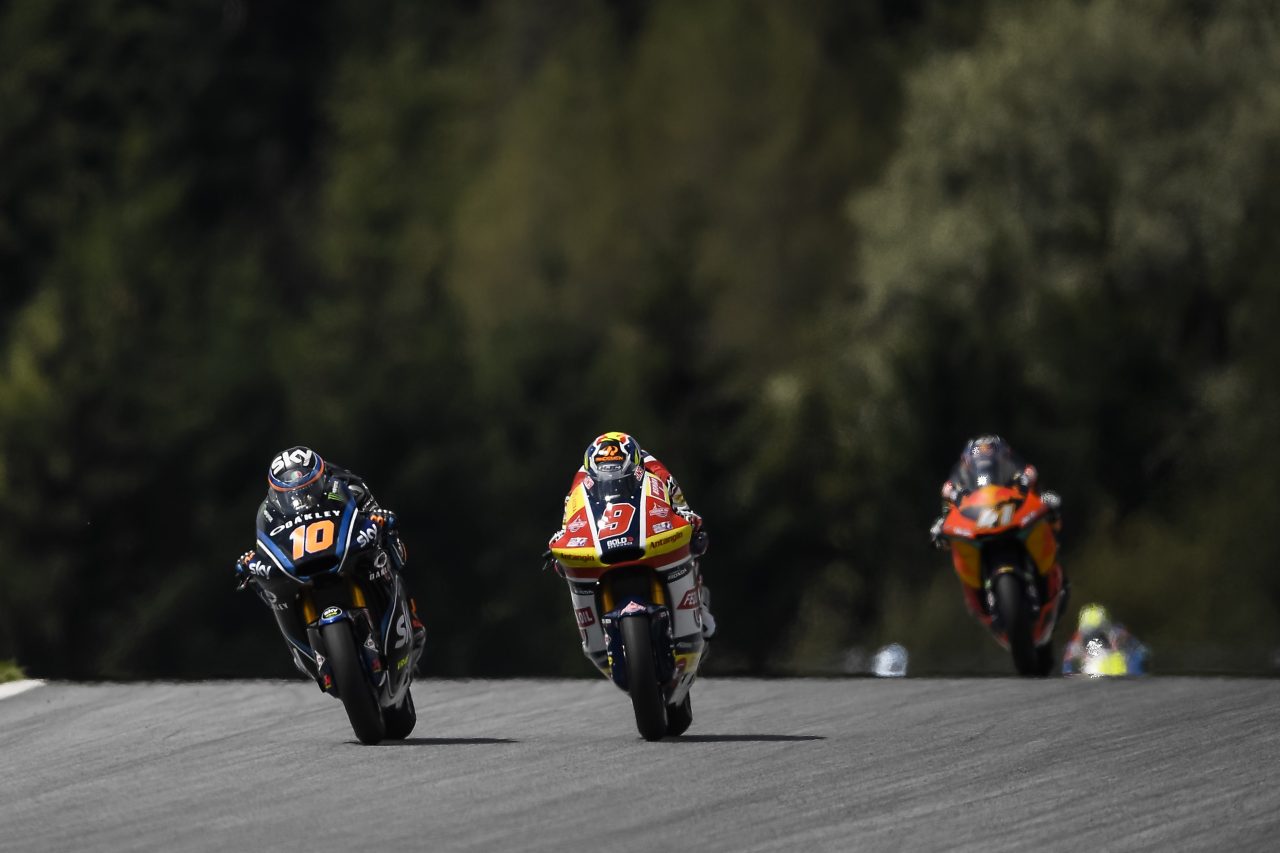
Luca Marini’s form over the past three race weekends has been exceptional, and entirely unexpected. Last time out in Austria, the lanky Italian took his third consecutive podium, and will be likely in the fight for the rostrum again this weekend. For Forward Racing last year, it was only 11th spot for the number 10, however Marini has proven on many occasions in the last weeks that his form from previous years is not necessarily indicative of what his potential is in 2018. His first win is surely not far away, and maybe it is even only a few days away.
Luca Marini and Jorge Navarro at the Redbull Ring 2018. Image courtesy of Honda Pro Racing
One man who will be aiming to make Marini wait a couple more weeks at least is Sam Lowes, who will be determined to win his home Grand Prix for the first time this weekend. Realistically, he should have won in 2016, but an incident with Johann Zarco in Brooklands left the Brit on the floor, and the Frenchman with a penalty to drop him out of the points. In fact, Lowes seems to have something of a curse in Silverstone when it comes to battles in the World Championship against his most fierce rivals; also in 2013 – year of his World Supersport championship triumph – he had a collision with Kenan Sofuoglu in The Loop, which also left Sam on the floor, denying him the victory. It has been a tough year so far for the number 22, but just a few days after he was confirmed to be heading back to the Gresini Moto2 team for 2019 – the very same team with which he fought for the Silverstone victory, and world title, in 2016 – maybe he can make amends for this difficult first eleven races of 2018 by standing on the top step.
Of course, Lowes is no the only British rider on the Moto2 grid. Danny Kent will of course be riding for Speed Up, and also hoping to make up for a difficult first half of the season as he looks for a 2019 ride.
But, also, Josh Owens is in attendance this weekend. It has not been easy for the British Supersport GP2 rider to get there, needing to raise £15,000 in the build up to the weekend to be able to afford the entry fee and equipment. Having had half a year’s experience on the Kalex in the British championship – in which he won the first British Supersport race in Thruxton – he should be somewhat comfortable with the bike, and the pace of the World Championship riders should only serve as a huge learning opportunity for the youngster.
Also, keep an eye out for Stefano Manzi this weekend. A quick flashback to the 2016 Moto3 race will remind you that Manzi came from 32nd on the grid to finish fourth on the Mahindra, and looking to last year you will find that he finished the race in 7th spot, ten seconds off the win. Typically this year, Manzi has been either on the floor, or doing something else reasonably spectacular, and this weekend could provide something of a shock result for the VR46 Academy rider.
Austria was one of those rare occasions, something you don’t often see. In this case, it was a lights-to-flag victory for Marco Bezzecchi, the second of his career, and his second of the season.
Bezzecchi capitalised on Jorge Martin’s broken radius well to be able to extend hi championship advantage to 12 points, and with eight rounds to go he is still right there in the championship fight, despite his low number of wins. The key to Bezzecchi’s success has been consistency. Admittedly, his consistency has been relative to him finishing compared with the three DNFs. However, when Bezzecchi has finished – that’s eight times so far this season – he has finished on the podium on all but one occasion, and the one time he failed to make the podium in those eight races was in Brno, where he recovered from a poor weekend to come home sixth on the Sunday. Like Luca Marini in Moto2, Bezzecchi this year has erased the importance of previous years’ form in tracks. For example, his best finish last year was fourteenth, bar a podium in Japan. On that basis, it might not be reading too much into his 19th place at the British Grand Prix last year, but maybe this will be the weekend which we look back on and determine as the point where Bezzecchi lost the 2018 Moto3 World Championship.
That said, the KTM should suit the fast Silverstone layout quite well. Should its pilots be able to negotiate the eighteen corners adequately, the power of the Austrian 250cc single should be able to keep them in the game down the long straights: Hangar and Wellington. Furthermore, with Jorge Martin still recovering from his broken radius from Brno, this could even prove to be another prime opportunity for Bezzecchi to take advantage in the championship.
Silverstone could even prove to be quite the disaster for Martin, with the bumps – supposedly made worse by the resurfacing which took place over the winter – perhaps bringing Martin’s injury renewed problems. That said, the softer Honda chassis you would expect to deal with the bumps better than the stiffer KTM frame. A softer frame might not help Martin directly, at least not with his radius, but the more rigid KTM could be significantly hindered by the surface condition, which could make Bezzecchi, not Martin, the one on a damage limitation job.
Jorge Martin with his injured left hand. Image courtesy of Honda Pro Racing
Regardless of whether any of the above proves true, Bezzecchi could be on the defensive anyway, such was Martin’s pace in Austria. The Spaniard should have recovered more since the previous race, and as such could once more be the speed benchmark this weekend. Also, unlike Bezzecchi, Martin had a great result in Silverstone last year, when he finished third, a tenth off the win. A couple of places better this year could just put the “J” of Jorge on the championship trophy.
It was Aron Canet who took the win last year, in an Estrella Galicia 1-2 as Enea Bastianini finished second. The pair will still be considering themselves in the mix for the championship, but right now they are very much minor ingredients, sitting 40 and 41 points off the championship lead respectively, and with a lot of work to do to get properly back in the fight. Canet, for a start, could do with picking up where he left off last year in Silverstone, as he is still without a win in 2018, and had a very disappointing race in Austria to boot.
Bastianini faces a different issue, that of finding speed in the first laps. Bastianini’s recovery in Austria was quite spectacular, arriving with his teammate, Lorenzo Dalla Porta, in the final two laps to fight for the podium, and eventually finishing second despite a poor start. If he can find some speed in the early stages and if things go his way, Bastianini can definitely still fight for the title, it’s just that those are two fairly large ‘ifs’.
Fabio Di Giannantonio had a nightmare in Austria, seemingly with no pace at all. He was reasonably fast in the middle of the race, but struggled a lot at the end, and a late dive on John McPhee for seventh punted the pair of them out of the top ten. It was not the way the Italian would have liked to respond to his debut Grand Prix victory, and now at a 38-point deficit to Bezzecchi, he too has work to do in the championship, and Silverstone could prove a critical round for the #21.
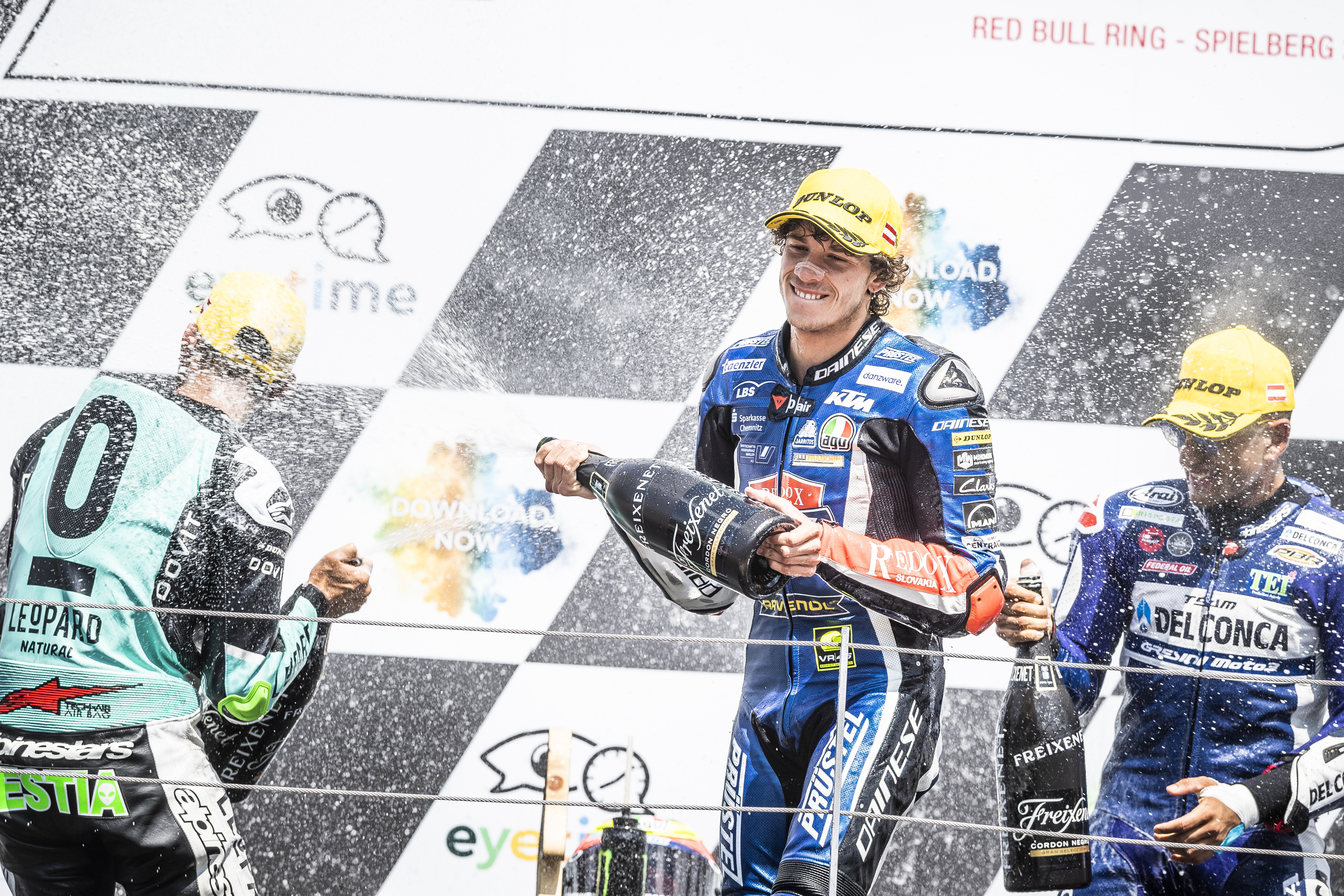
Marco Bezzecchi, Enea Bastianini and Jorge Martin on the Podium, Red Bull Ring, Spielberg 2018. Image courtesy of Philip Platzer/KTM
John McPhee, having been taken out of the top ten by Diggia in Austria following a brilliant fight back through the pack from stone last on the grid to eighth. McPhee is coming into this weekend with perhaps his best ever chance to win his home Grand Prix and after the disappointment of that Austrian race, he will be intent on returning to his pre-summer break form, when he was regularly contending for the podium between Mugello and Germany.
McPhee is not alone in riding his home Grand Prix this weekend in the lightweight class, as Tom Booth-Amos and Jake Archer are both wildcarding. Booth-Amos has had a tricky year, stepping up to the Moto3 Junior World Championship. He has had good speed, but crashes and injuries have hampered his season massively. On the positive side, he is riding this weekend as a third Leopard Racing entry, in the reigning World Champion team – it simply could not get any better for the Brit this weekend.
Archer, on the other hand, is riding his RS Racing City Lifting KTM which he races in the British Motostar Championship, which he is currently leading.
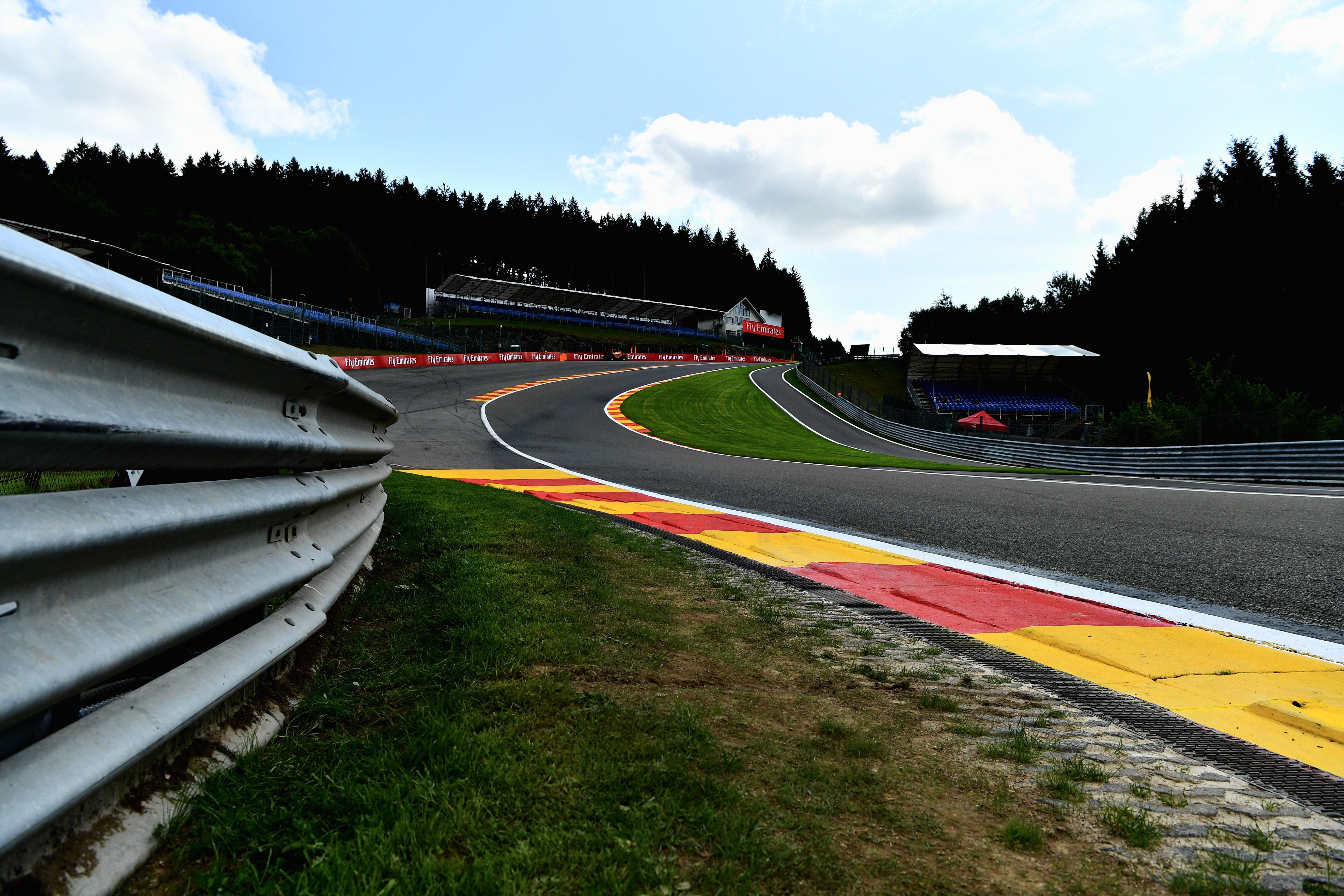
152 kilometres outside the Belgian capital of Brussels in the middle of the Ardennes Forest sits one of the most beautiful and historic circuits in Formula One: Spa-Francorchamps.
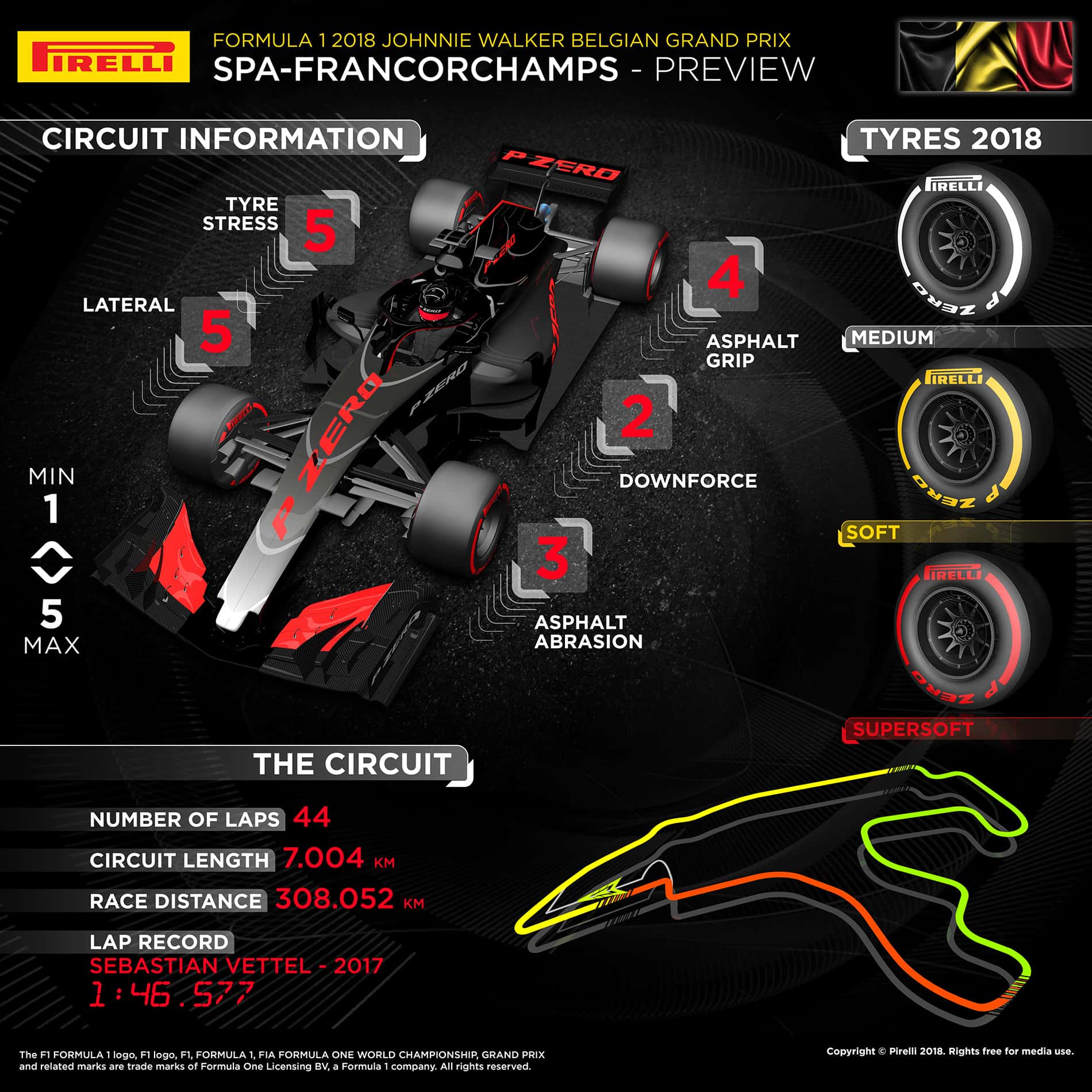
Spa has been home to the Belgian Grand Prix since 1925 and it is the longest track on the calendar at just over seven kilometres. For this reason, the race is only 44 laps long.
Though the track has changed considerably over the years – there were a lot more high-speed and adrenaline-filled corners before – one thing which has always been there is the brilliant Eau Rouge.
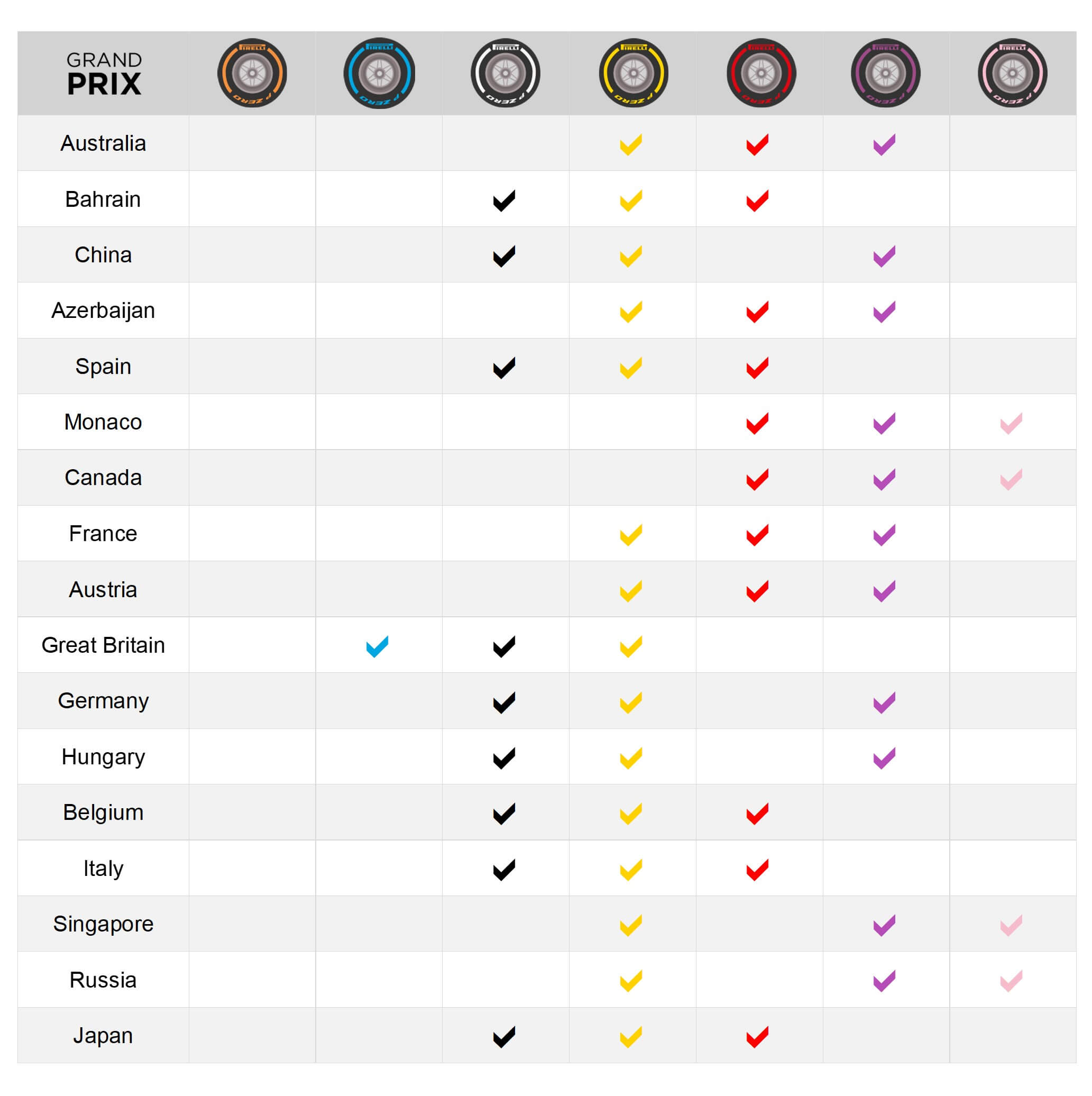
Stats and tyre selection for spa. Image courtesy of Pirelli Media
Spa did not appear on the calendar in 2006 due to radical changes to both the circuit and surrounding infrastructure, including a change to turn one and the addition of the bus-stop chicane.
The area’s unpredictable weather has given us some fantastic races over the years, most notably in 2010, 2008, and of course the crazy race in 1998, which saw an almighty multi-car pile-up at the start, and a crash between Michael Schumacher and David Coulthard which led to a heated confrontation in the pits afterwards.
Speaking of Schumacher, he is the most successful driver at Spa with six wins, and Ferrari are the most successful team. That being said, Mercedes have won the last three races at Spa, courtesy of Lewis Hamilton in 2015 and 2017, and Nico Rosberg in 2016.
What’s happened in the summer break? Quite a lot, really. First of all, Daniel Ricciardo announced he is leaving Red Bull at the end of the season and joining Renault for 2019. The biggest news of the summer, however, came from Fernando Alonso. The Spaniard announced that he will be leaving F1 at the end of the season after a frustrating three-and-a-half years with McLaren. His compatriot Carlos Sainz, currently at Renault, will take his seat after being displaced at the French manufacturer by the inbound Ricciardo.
The favourites for Spa? Well, that is a tough one. Ferrari and Mercedes will be very well matched, with the power gains Ferrari have made this season coupled with the tight middle sector being more suited to Mercedes making this a seemingly very competitive weekend.
Tyre Selection upto Japan. Image courtesy of Pirelli Media
That is exactly what Sebastian Vettel will need. the German lost the win at his home race in Germany after crashing on a damp track, while champion Lewis Hamilton, who started fourteenth, took the win along with the championship lead. Hamilton’s win in Hungary gave him a 24-point lead in the championship coming into the last nine races, which means Vettel needs to hit the ground running upon F1’s return.
This will be the home race of McLaren’s Stoffel Vandoorne, and expect plenty of Dutch support for Max Verstappen of Red Bull as well, who retired from last year’s race with an engine issue.
Fernando Alonso is well acquainted with the track in 2018 already, having won there for Toyota in WEC earlier on in the year, although it’s safe to say a win is not quite on the cards for him this weekend.
What is also safe to say is that we are all very happy to see the return of Formula One after a four week break that has felt like an age, as the championship battle between Lewis Hamilton and Sebastan Vettel resumes.
Featured image courtesy of Getty Images / Red Bull Content Pool
Check out the latest Mobil 1 The Grid feature, in which Max Verstappen and Daniel Ricciardo look ahead to the Belgian and Italian Grands Prix, and highlight their special connections with both events.
The Austrian Grand Prix weekend was a complete disaster for Yamaha, there is no other word. Both on the track and off it, Yamaha’s weekend at the last Grand Prix was nothing short of embarrassing. Hampered by a mechanical in the only dry free practice, FP1, Valentino Rossi failed to make Q2 directly from free practice, and could only manage fourteenth on the grid, complaining that the soft tyre was too soft for the Yamaha. Meanwhile, Maverick Vinales was only eleventh on the grid, suffering with sensor problems. This Saturday slump led the MotoGP project leader, Kouji Tsuya, to apologise to both the manufacturer’s factory riders for the poor performance of the bike, promising improvements are on the way in two upcoming tests.
One of those tests – in Misano – has already been and gone. We will only find out whether there was any progress on Friday, but for the sake of the manufacturer, you would hope that there have been some positive findings.
So, we know the situation, some have described this as “rock bottom” for Yamaha. They sit second in the riders championship with Valentino Rossi, third in the manufacturers’ standings, 53 points from the Honda at the top; and third in the teams’ championship with twelve points between the Movistar team and the Repsol Honda outfit. The numbers don’t seem so bad, and that is because the M1, despite many contrary opinions, has improved in some areas this year, and this has allowed it to be strong in some circuits. However, the neglection of the core issue with the bike means that in the places where the M1 was weak last year, it is weaker this year, because everyone else has moved on. So, whilst the balance of the bike has improved compared to last year, and the M1 is back to being the smooth, high-corner-speed bike we know it as, the electronics have not progressed – or not progressed enough – which in this era of MotoGP is the most critical part.
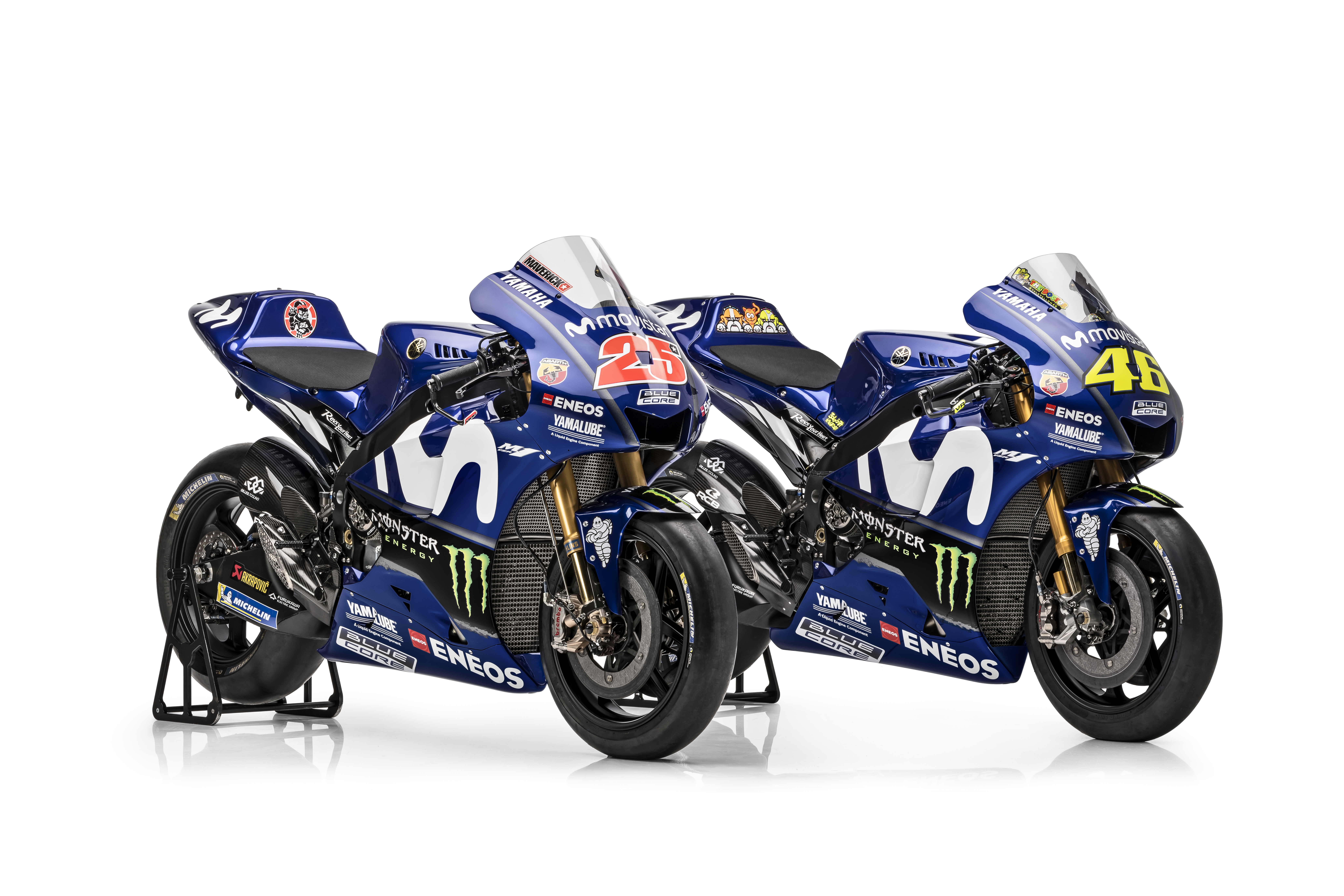
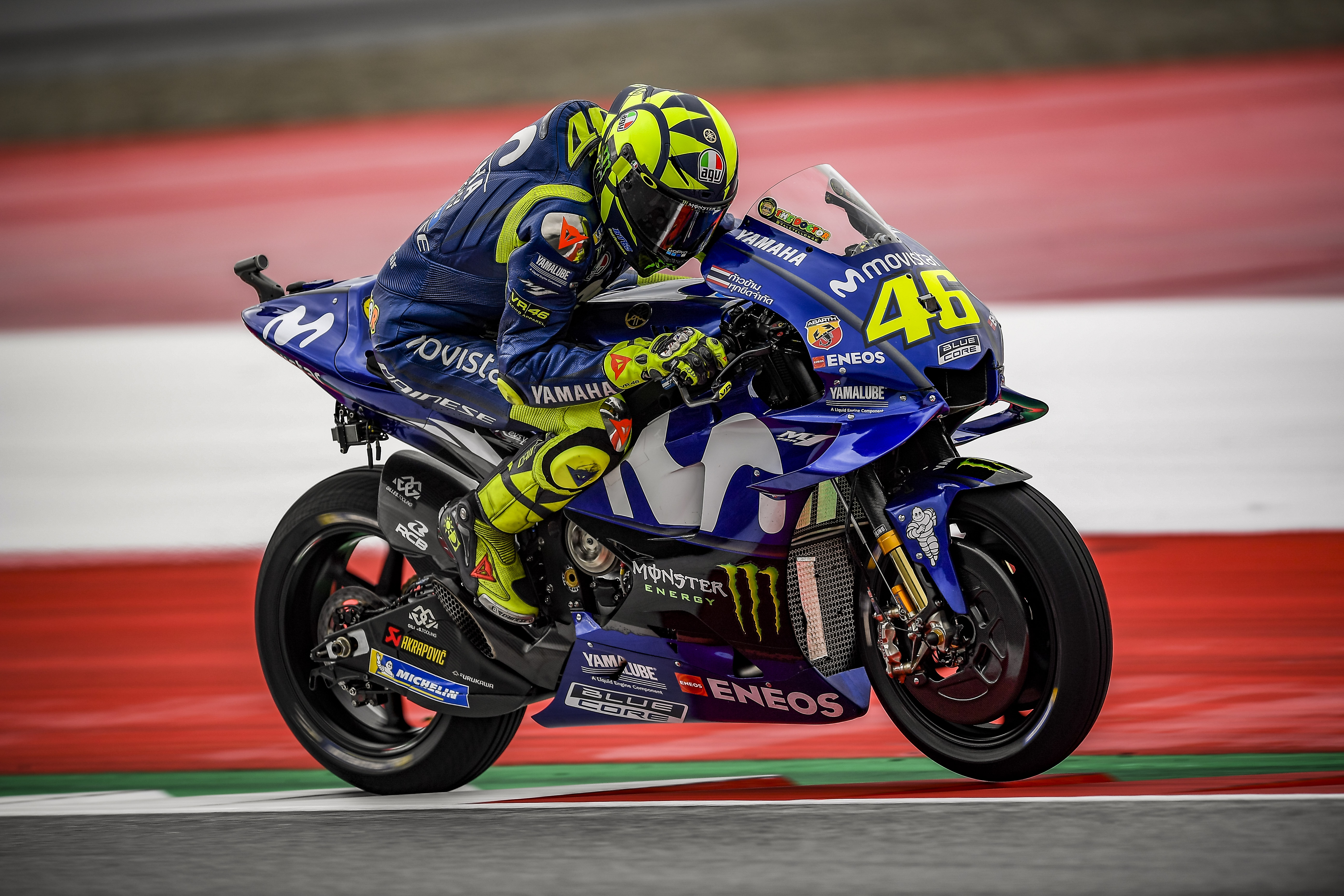
Rossi on the 2018 YZR-M1. Image courtesy of Yamaha Motor Racing
As Rossi mentioned before Austria, the Red Bull Ring is the M1’s worst circuit, the slow speed corners followed by long straights is the worst combination for it, because it can’t use its corner speed, and its acceleration issues are emphasised. So it is likely that in the coming weekends the M1 will seem in a good way again, but that won’t mean that the issues are solved, just that they are masked by the circuit layout.
But where did this start? We know the situation Yamaha are in at the moment – their worst moment since 1998 – but where did this path start? Why are they in this hole?
It’s possible to trace the root of their issues back to 2015. The M1 was the best bike in 2015, no doubt about it. The bike was the best out of the box in Qatar for the first race, and the developments Yamaha brought to the bike throughout the year almost always worked. But there was one issue, a familiar one: rear tyre wear. Yamaha were able to get around this three years ago because they had the luxury of factory electronics, designed specifically for the M1, and understood perfectly by the engineers in Iwata.
With the introduction of the universal, spec ECU in 2016, though, Yamaha became complacent. They heard “controlled electronics” and took that as gospel, putting less effort than their competitors – notably Honda and Ducati – into developing and understanding the Magneti Marelli software. Whilst their two biggest rivals went out and poached engineers from Marelli themselves, and the likes of Suzuki sent their own engineers to Italy to learn the functions of the controlled software, Yamaha didn’t act, and worked on the new system themselves, with no external assistance.
Instead of focusing on electronics, Yamaha looked at the chassis, the motor and the aerodynamics of the M1. The first item they introduced to combat the tyre wear issues was a new chassis, at the post-race Valencia test at the end of 2015. It didn’t work, neither Jorge Lorenzo nor Valentino Rossi liked the update, which had the fuel tank mounted further back in the bike, with the fuel going into the bike in the tail section, behind the seat. So, the 2016 chassis was essentially the 2015 chassis, with some slightly bigger wings on the front. However, the 2015 chassis was by far the best on the grid in 2015, meaning that in the first half of 2016, the Yamaha was still the best machine out there, and was only missing the championship lead through reliability (Rossi’s blow up in the Mugello race – and Lorenzo’s in warm up the same day – were supposedly due to a mapping problem on the electronics which allowed the bike to over-rev over the crest, with disastrous consequences) and rider error.
From the halfway point of the 2016 season, though, when Honda and Ducati started to see the fruits of their labour with regards to the electronics, Yamaha started to fall back, unable to make the tyre last the distance. The first time it really became apparent was in Aragon, where Rossi led the early stages, but was hunted down by Marquez with ease once the tyres started to drop slightly. This set the tone for the rest of the season, with Yamaha not winning until Valencia of that year, and even then Lorenzo was closed down hand over fist by Marc Marquez in the final laps of the race.
Maverick Vinales. Image courtesy of Yamaha Motor Racing
The degradation issues with the rear that the M1 was suffering with in the second half of 2016 prompted Yamaha to go full revolution – in MotoGP terms – with the 2017 bike. Initially, it looked like they had got it right. Rossi was struggling a lot through free practices, but was able to find something for Sunday, whilst Vinales looked almost unbeatable in the first portion of the season – only denied a sweep of the first three races by a crash in Texas, and even that handed Rossi the championship lead. Everything looked good for Yamaha as the championship entered the European season, but it was in Jerez, where Vinales finished sixth and Rossi only tenth, that it started to decline for the Movistar team. Another poor result in Barcelona (Rossi 8th, Vinales 10th) showed the extent of Yamaha’s misdirection, especially as Rossi had won in both Jerez and Barcelona the previous year, and there had been no changes to either circuits.
New chassis’ arrived for the pair to test in the post-race test in Montmelo 2017, supposedly the 2017 chassis with some 2016 bits (stiffness ratios, for example) and Rossi felt that one in particular was an improvement. Supposedly Vinales preferred the original 2017 design, but he was forced into using the one that Rossi had chosen, a decision which haunted Vinales’ mind for the rest of the season.
Rossi won the next race, and it seemed all was well once again, but wet weather nightmares, and poor dry pace regardless, in Sachsenring proved otherwise. Another string of poor results in the second half of 2017, and a terrible weekend in Valencia, sent the team to do what they had been avoiding for half a season, and they switched overnight to the 2016 chassis. No setup time meant that they had no pace in the race, and it was another disastrous result for the factory team, made no better by the fact that Johann Zarco on the Tech 3 Yamaha was fighting for the victory against Dani Pedrosa.
The post-race Valencia test in 2017 saw all manner of different combinations in both the factory Yamaha garage, and the Tech 3 pit, as they tried to find a direction for 2018. Ultimately, they reverted to the 2016 design for their base, but once more over the winter there was a lack of investment in the electronic side, and from the first tests of the 2018 preseason, it was clear that the M1 was still a way off being able to win a race.
Now, though, it is clear that the problem lies not only in the electronic side of the Yamaha, but in other areas too.
A new engine was introduced over the winter, liked by both riders and thus homologated. Furthermore, it is believed both Honda and Ducati has had continued development over the last months, whilst Yamaha has remained stagnant in this area.
The engine, though, is perhaps the most immediate issue. Fundamentally, Yamaha messed up with the design of this year’s engine, and the crankshaft is too light, meaning the engine is too aggressive. It is the same thing which caused Honda so many problems in 2015 and ’16, and the most critical problem Suzuki faced last year. The biggest problem for Yamaha is that they cannot change the engine until the winter, for now they have to make do with what they have, and what they have is not good enough.
On the organisational side, this could prove just as fatal as any mechanical or electronic issue with the M1. A full overhaul of the management and inner workings of the Iwata manufacturer could produce instability lasting for months and even years, putting them out of contention for titles for as long as that instability lasts. Without stability and progressive evolution inside the team, or the whole Yamaha MotoGP department, it becomes difficult to work correctly and make progress with the bike, because the new people have to fit together in the new system, and that takes time, especially when it is a reactionary move – and in this case, it would be most certainly reactionary on Yamaha’s part. That said, staying as they are resigns them to stagnation; to progress, they have to change the way they work, and just like with the engine, they have no choice.
A third issue appeared after Brno. A Ducati engineer explained that the key to the Michelin tyres is to use the drive grip, the centre of the tyre. They said that one of the reasons Yamaha are struggling at the moment, could be that they spend so much time on the side of the tyre. This is because the style of the Yamaha is to run a lot of corner speed, and to utilise the edge grip of the tyre. The problem is that this increases wheelspin, and thus tyre wear. This is especially worrying for Yamaha, because it means that they could face redesigning the entire motorcycle, completely changing their philosophy to comply with the demands of the Michelin.
Whilst this would be one of a number of things that stand between Yamaha and wining again, personally I hope this is not one that will be fleshed out. One of the biggest appeals of motorcycle racing is the diversity and variety, both in riding styles and design philosophies. If Yamaha were to go away from their traditional ‘corner speed’ bikes for the sake of tyres, it would be a shame, because it would essentially mean that to win, there is only one way, and that is not MotoGP, it is not MotoGP to me, anyway.
Neglecting the latest point, Yamaha still have a lot of work to do before they arrive at a Grand Prix in a state where they can win again. Starting with the engine, of which a 2019 spec should be in their final test day of 2018 in Aragon, after Silverstone, there are many aspects on which the engineers back in Japan have to work upon, and really it is doubtful that they will even be able to win consistently, if at all, next year. However, the (belated) announcement of a Yamaha European test team for next year shows they are on the right track, and are intent on solving their issues in the longer term.
For now, though; I tweeted on the day of the French Grand Prix that “If it (a Yamaha win) won’t happen today then it won’ t happen at all in 2018”, and right now that prediction seems fairly on the money.
British Superbike race one got underway in Cadwell Park after a delay for rain. Fortunately, the precipitation ceased and we got underway in the dry, Leon Haslam making the holsehot from the middle of the front row, passing pole sitter Bradley Ray into turn one, whilst Jake Dixon held position in third place.
Largely, the positions remained unchanged in the first lap, but on lap two, Ray passed Haslam for the lead, and even began to pull away at the front. That was, until Chrissy Rouse fell at the Hall Bends, and had to be taken away in the ambulance. This saw a safety car period which took us up to lap nine, so we essentially had a ten-lap race to the flag.
Bradley Ray. Image courtesy of Suzuki racing
Ray made a superb restart, and began stretching the pack again, initially only dragging Haslam with him. Eventually, Glenn Irwin and Dixon behind managed to match the leading pair, and came back into contention, as Tommy Bridewell found some pace too, setting what was at the time the fastest lap of the race.
Whilst Irwin was able to match the pace of the two leaders, he was unable to do anything about passing Haslam, and in fact he seemed to be slightly holding up Dixon behind, although the RAF Regular and Reserves Kawasaki was slightly slow in a straight line, so passing was tough for the number 27.
Finally, though, after a failed attempt two laps previous, Haslam passed Ray in Park corner on the third-last lap, and simultaneously Dixon slid through on Irwin.
Haslam’s pass was unintentional. It looked like a proper motocross block pass, standing the Suzuki rider up as he went through, but in reality Haslam’s Kawasaki had yet another with the engine blipping, so he ran on a little, passing Ray only to avoid hitting him. It certainly worked, although the time the pair lost in the move meant that the chasers, now led by Dixon, were right on the back of them again.
Dixon then tried to pass Ray in the first part of Charlie’s on the next lap, but got it wrong, ran wide and dropped back to fifth spot.
The next lap was a stunning recovery from Dixon, passing Bridewell in Park and then having a late lunge on Irwin in the hairpin to reclaim that final podium spot. As he mentioned after the race, there is little point for a person in Dixon’s position to finish fourth, because he needs podium points.
Whilst that was happening, though, Ray was unable to have a go at Haslam, who was strong on the brakes, and so Haslam took his eighth Cadwell Park win in the British Superbike Championship.
It was a superb ride from Haslam, riding around problems to take the victory. Also, his strongest point of the race was going to be at the end, as he had appeared to have next-to-no drop off on used tyres across this weekend, so the safety car did not really work to his favour. With that in mind, the field should be worried for the second outing.
Second place represented a solid return to the podium for Brad Ray, his first rostrum finish since race one at Brands Indy. He certainly seems to have gotten over his front end woes from earlier in the season, and should be consistently back in the frame for race wins in the next races.
Whilst the race win slipped away from Dixon, the sixteen points for third place were enough for him to secure his spot in the Showdown, meaning he can now focus 100% on podium points from this moment on.
Fourth place went to Glenn Irwin, who had enough to stick with the leaders, but just not enough to make a pass, and he was ahead of the Moto Rapido Ducati of Tommy Bridewell who was very impressive, as he continues his superb adaptation to the Panigale.
Christian Iddon took sixth place, ahead of Peter Hickman, who might have expected better from race one at what is one of his best circuits on the calendar, and where he took his first BSB win back in 2014. Perhaps the problems lie simply in the kidney infection he picked up in Thruxton, and is still affecting him this weekend.
Tarran Mackenzie had a strong ride for McAMS Yamaha in his first BSB race at Cadwell, finishing eighth, and as top Yamaha – the first R1 in a line of three with James Ellison and Josh Brookes directly behind the rookie. It was a disappointing race for Brookes, and his frustration was clear as he put a tough move on Jason O’Halloran at the Hall Bends, forcing his compatriot off the track, and costing the #22 another two positions. Anyway, a lot to improve upon for Brookes in race two.
Richard Cooper and Luke Mossey. Image courtesy of Suzuki racing
Richard Cooper took eleventh place, ahead of a no doubt disappointed Luke Mossey who was twelfth. O’Halloran finally took thirteenth spot, ahead of Laverty who ran off track at Park and ended up fourteenth. Tom Neave took the final point, his first in BSB.
Gino Rea was sixteenth, ahead of Fraser Rogers, Sylvain Barrier, Shaun Winfield and Aaron Zanotti who was the final finisher in 20th.
Neither Mason Law, nor Andrew Irwin started the race. Law broke his thumb and damaged his neck in warm up, whilst Irwin suffered terminal engine issues on the sighting lap.
Martin Jessopp and Chrissy Rouse failed to finish. Rouse helped Jessopp off at the hairpin on the first lap, whilst the Suzuki rider went down alone later on, and brought out the safety car as he had to be taken to the medical centre via ambulance.
The only other retirement was Danny Buchan, who lost the front at the foot of the mountain on lap three.
After winning race one with the fastest lap, Leon Haslam placed himself in prime position to take a third career Cadwell Park double for race two, which he started from pole.
He didn’t make the holeshot, though, that achievement went to Bradley Ray, as Haslam’s start was hampered by the ‘Pocket Rocket’ seemingly losing his balance whilst sat on the grid, so he slightly missed the start. Still, he managed to get in to turn one in second place, just ahead of Jake Dixon, who started from sixth.
Immediately, the front three started to pull away, led by Ray, and the Suzuki rider wasn’t headed until lap twelve, when Haslam slid through on the inside at Park, and was immediately followed by Dixon who made a superb move to the inside in the middle of Chris Curve.
Bradley Ray and Leon Haslam. Image courtesy of Suzuki racing
Pretty much from this moment on, Ray started dropping back, and the final seven laps were between Haslam and Dixon for the victory. For the most part, Haslam shadowed Dixon after the #27 passed him at Park on lap 13, but chose the same corner to reclaim the lead from his training partner on the penultimate lap.
Dixon tried to come back on the next lap, once again at Park corner, but Haslam defended aggressively, manoeuvring his Kawasaki to the inside of the track to block Dixon’s attempt. Dixon tried anyway, but the outstretched leg of Haslam meant Jake had no choice but to release the brake and run off into the gravel, allowing Haslam an easy enough final lap to the flag, as well as letting Ray back into second place.
Much has been made of this ‘incident’ since the conclusion of the race, and it’s fair to say that neither Jake Dixon nor his team are happy with Haslam’s move. However, Haslam’s style is to throw his leg in almost every corner, especially the right handers, and ultimately Leon did nothing wrong. He probably thought that Jake would have gone back to the outside, considering Haslam’s line, or that the RAF Regular and Reserves Kawasaki rider would have backed out in some way. As it is, I can see the point of Dixon, ultimately this moment cost him the chance to fight until the end for the win, and cost him two podium points, but in reality Haslam did nothing wrong.
The win for Haslam marked his third double win in Cadwell Park, two years after his most recent maximum score in the Lincolnshire track. It also strengthened his advantage at the top of the championship, and critically in the podium points standings, where his advantage is now more than one race win. A controversial ride, but a strong one from Haslam, and the points he gained could be crucial for the championship.
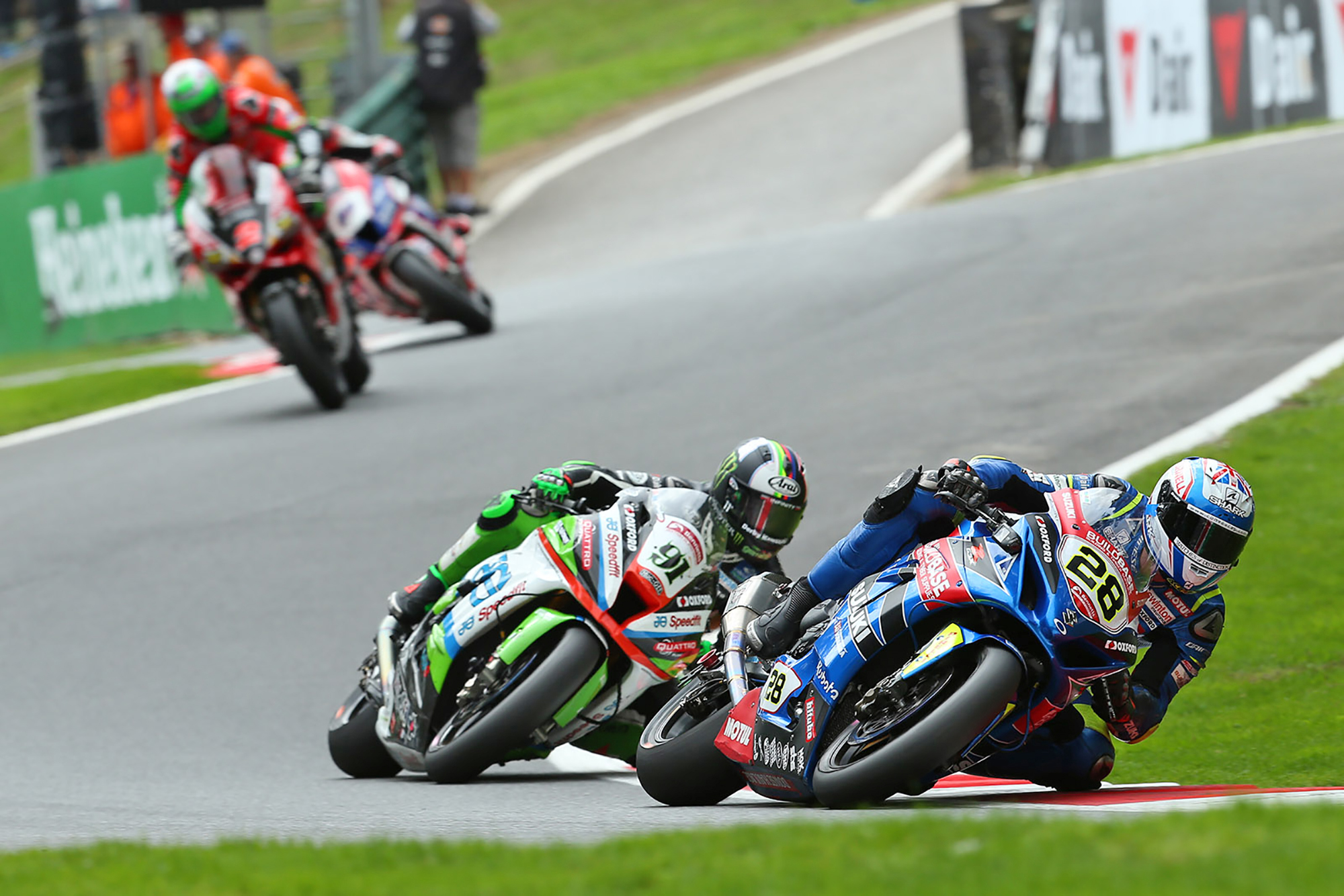
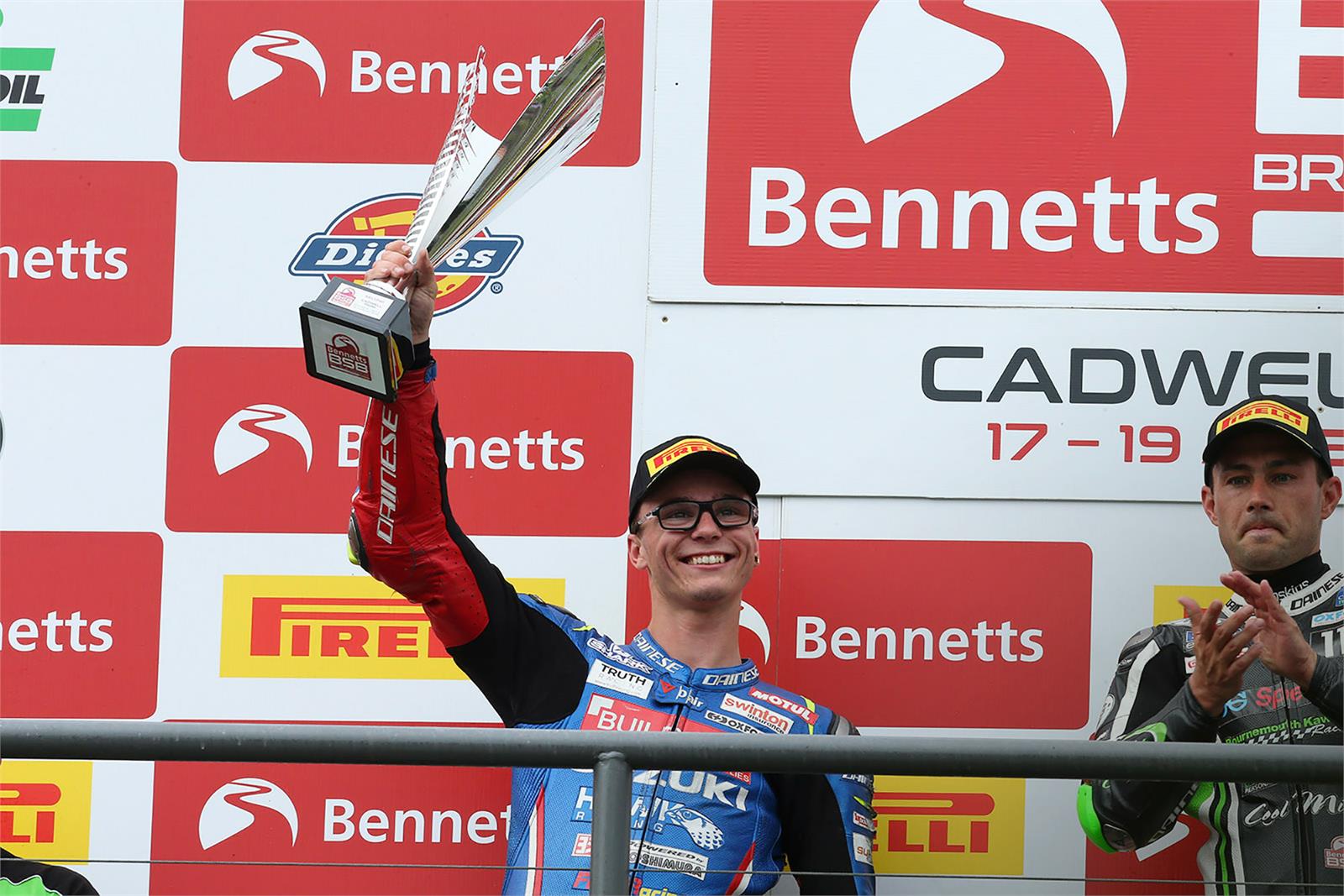
Another second place for Bradley Ray means that Cadwell was his best scoring round since he doubled up in Donington Park at the beginning of the season, walking away with forty championship points and six crucial podium credits. He has three races in Silverstone to keep hold of his top 6 spot, and it looks as though it will be a fairly straightforward target for the #28 to achieve.
Bradley Ray taking taking 2nd in races 1 and two. Images courtesy of Suzuki racing
Of course, Dixon was disappointed to miss out on the victory, but nonetheless he left Cadwell Park with two podiums, and still in the championship hunt. He must look now to Silverstone as a round which he must take advantage of. That triple header could provide the opportunity for Jake to enter the Showdown in real contention.
Peter Hickman and Glenn Irwin were both valiant in fourth and fifth places respectively; Hickman suffering with the kidney infection he picked up back in Thruxton as well as contending with the after effects of a fortnight of little-to-no rest; whilst Irwin was struggling with a shoulder injury he picked up in Friday practice. Considering this, both did brilliant jobs to score solid points, and help their Showdown cases.
Christian Iddon repeated his race one result with sixth spot. In theory, Silverstone should suit the BMW better than the twisty Cadwell Park, and Iddon will be hoping to capitalise on that to fire himself into the Showdown.
Michael Laverty came home in seventh, ahead of Danny Buchan who made a solid recovery ride from a poor grid slot caused by his race one crash, and thus keeping his Showdown hopes alive.
Richard Cooper came home in ninth spot, whilst Luke Mossey rounded out the top ten to end a somewhat disappointing weekend after such a promising Thruxton meeting.
Eleventh went to Jason O’Halloran, who was ten seconds ahead of his very impressive temporary teammate, Tom Neave, who took twelfth place in just his fourth British Superbike race.
Meanwhile, Martin Jessopp took thirteenth, ahead of Sylvain Barrier and Shaun Winfield who rounded out the points, and was the final finisher in fifteenth.
James Ellison failed to start the race. He was pulled off the grid before the warm up lap, then sent back out, at which point his R1 started smoking. He lined up on the grid, but was pulled straight off again when the race started.
Tommy Bridewell was the first DNF, crashing out on lap six, one lap after he set the fastest lap of the race (later bested by Dixon). It was a shame for Bridewell. He made a bd start from the middle of the front row, but charged through from tenth for fourth by lap six. He was chasing down the leaders when he crashed, which he admitted was his fault. Still, the number 46 is positive ahead of the rest of the season, where he will hope to get better acquainted with the Panigale, a bike which he is already greatly enjoying.
One lap after Bridewell went down, Andrew Irwin dropped out of the race at Charlie’s, and a couple of corners later, Gino Rea’s OMG Racing Suzuki expired.
Tarran Mackenzie then dropped out on the McAMS Yamaha after nine laps, before Aaron Zanotti stopped. It got worse for McAMS on lap 12, when Josh Brookes’ decent ride was brought to a halt by mechanical problems after climbing up into the top five. Finally, Fraser Rogers retred three laps from the flag.
It was a somewhat straightforward qualifying session for British Superbikes in Cadwell Park, the eighth round of the 2018 season. The people who you would expect to be fast, were, and vice versa.
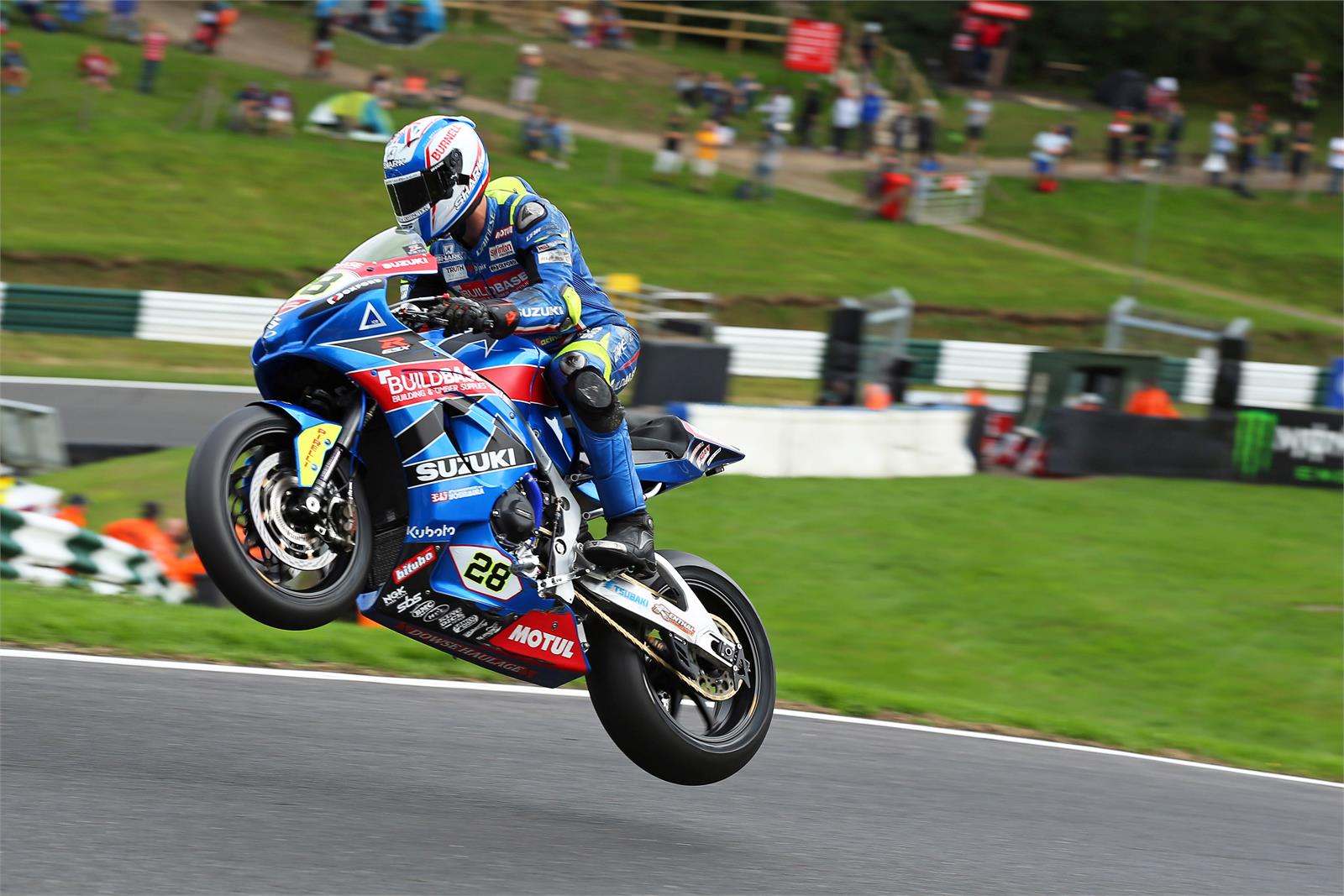
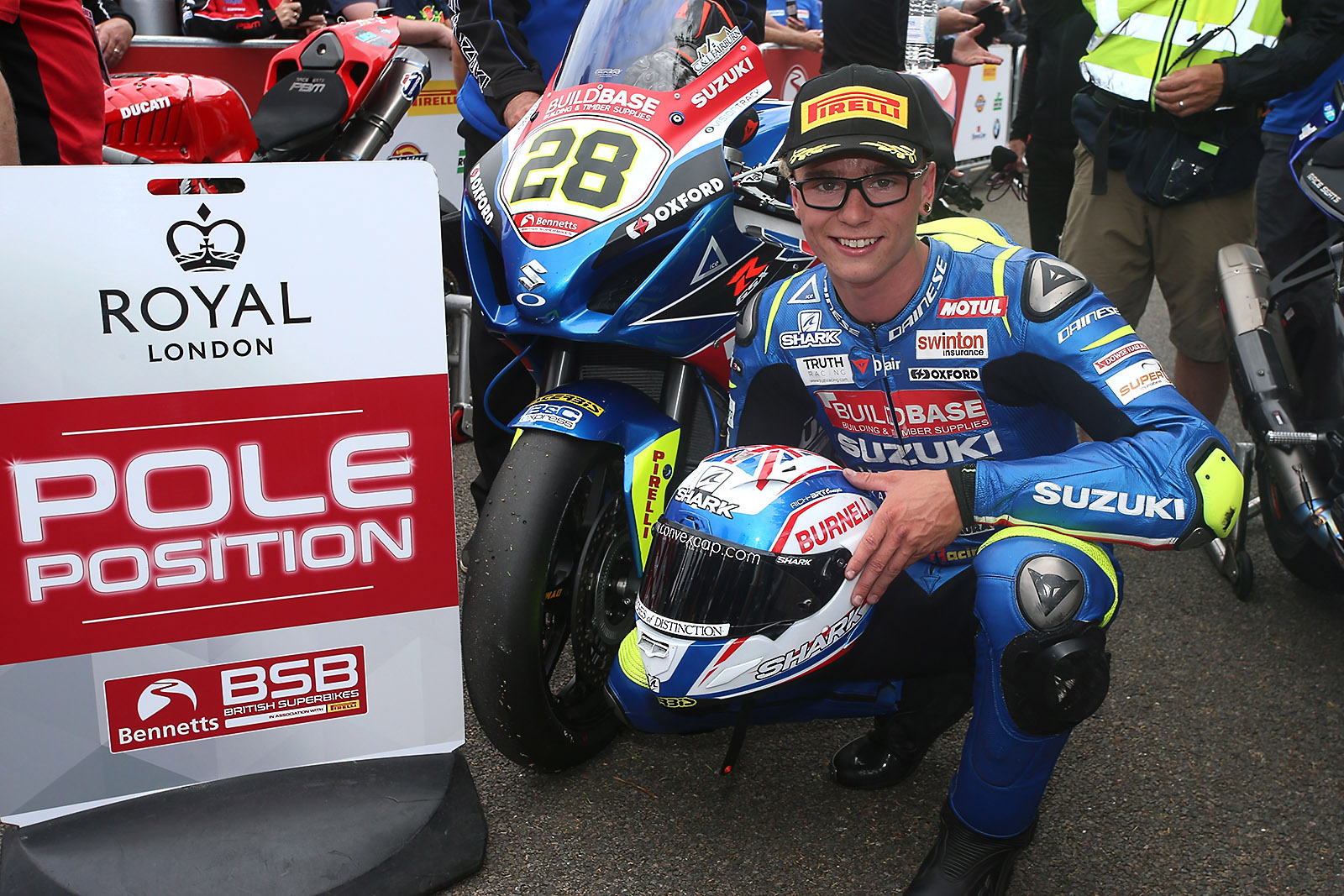
Finally, it was Bradley Ray who took pole position, the second of his career, his second of the season, and first since Brands Hatch Indy back in April. Ray claimed to have found solutions for his front end woes in Thruxton, and they bore fruit today, and he will be hoping that that continues tomorrow as he seeks to solidify his place in the Showdown.
Bradley Ray on pole. Image courtesy of Suzuki racing.
Leon Haslam has shown supreme pace all weekend, and looked odds on for pole position, and whilst he lost out in the end to Ray’s Suzuki, it seems that the JG Speedfit Kawasaki rider has been focusing solely on race pace. So, whilst he was matched in qualifying, he could have the speed and consistency to get away in tomorrow’s races.
The front row of the grid is rounded out by Jake Dixon, despite some health issues through the weekend. If anyone can go with Haslam tomorrow, it is probably Dixon.
Glenn Irwin will be fourth on sunday’s grid , and seems to be back to top form after a difficult Thruxton. In the same vein, Irwin will be hoping to return to the podium tomorrow, especially in view of his Showdown and championship hopes.
In the middle of the second row for the first race will be Tommy Bridewell, who continues his impressive adaptation to the Ducati. Of course, Cadwell Park was the scene of Bridewell’s first BSB win, back in 2014, so the planets seem to be fairly well aligned for a big result for the number 46.
Danny Buchan has been strong all weekend, despite a crash on Friday. He took sixth on the grid, and will be in the hunt for the top positions, as will Peter Hickman who qualified eighth, on row three between Christian Iddon (7th) and Josh Brookes (9th). Brookes, in comparison, has struggled this weekend – just like last season – and it looks like it will be a day of damage limitation for the Australian.
Luke Mossey and his side of the JG Speedfit Kawasaki team made a critical error in Q2. Whilst the rest of the grid came in for a new tyre in the middle of the session, Mossey did not make a second run with a fresh rear slick. As a result, Mossey was knocked out of qualifying at the second stage, and despite some decent-looking race pace, he will have to start from 10th.
Tarran Mackenzie, like teammate Brookes, has not had such a strong weekend in Cadwell as in previous meetings, making their relative lack of pace seem like a McAMS Yamaha problem, or even just a straight Yamaha problem when you consider the results of the other R1s. Mackenzie, like the other Yamaha riders, will be hoping for a step forward tomorrow, but barring that it looks like it could be a long day for the rookie.
Row four is rounded out by Jason O’Halloran who, as you might imagine at the calendar’s most physical circuit, is struggling with his ankle injury. It’s going to be a tough couple of races for the Honda rider tomorrow, but he needs to make it work if he is to remain in contention for the Showdown.
Continuing the struggling Yamaha theme, James Ellison could only manage P13, ahead of Richard Cooper and Michael Laverty who join him on row five.
Meanwhile, Andrew Irwin joins Martin Jessopp and Gino Rea on the sixth row, and Mason Law, Chrissy Rouse and Sylvain Barrier make up row seven.
Tom Neave will line up 25th in race one tomorrow, ahead of Shaun Winfield and Fraser Rogers on row eight, whilst Aaron Zanotti is the only rider on the ninth row, back in 25th spot.
Santino Ferrucci is set to return to the IndyCar paddock for the last two rounds of the season at Portland and Sonoma, four months after making his debut at the Duel in Detroit. This announcement has been met with a rather confused reaction, primarily because of the events of the British F2 races at Silverstone, but we’ll get onto that later…
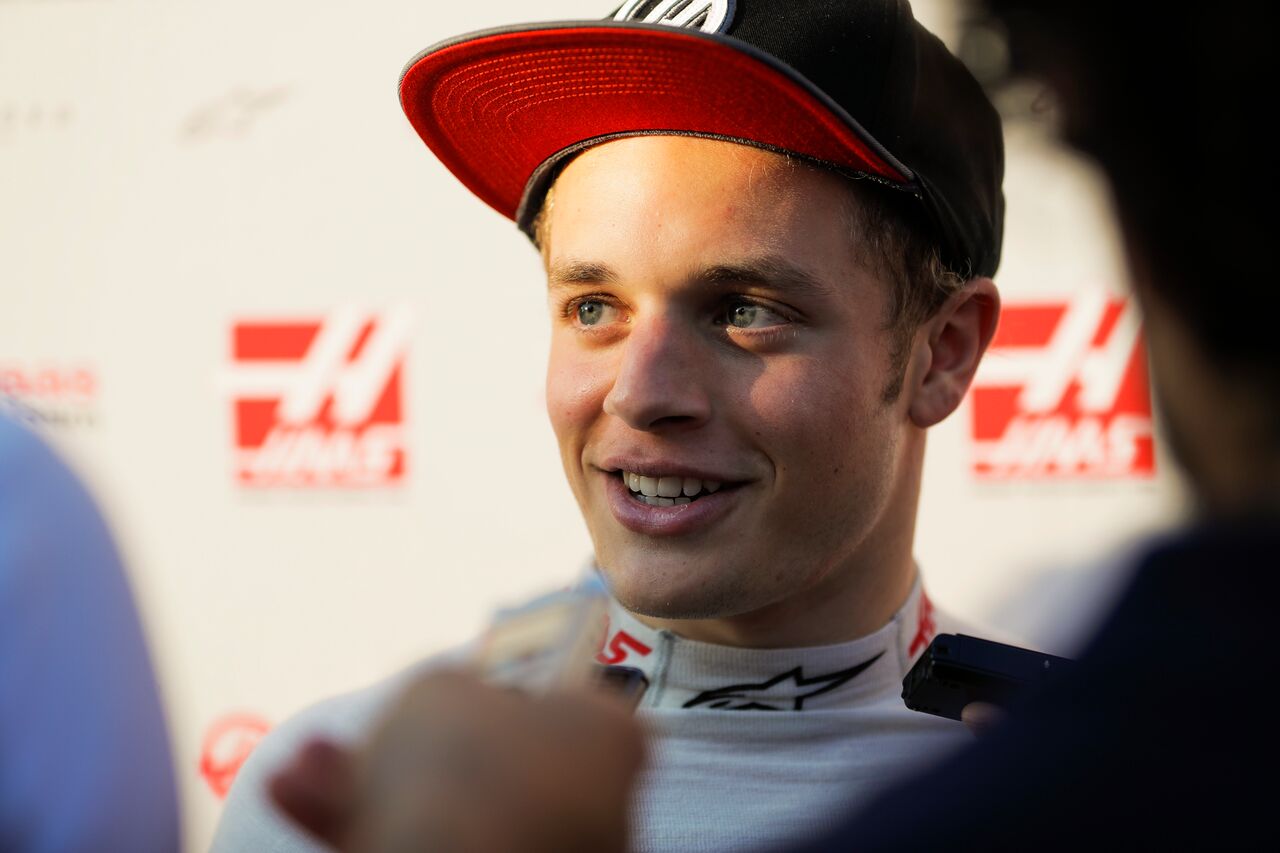
Santino Ferrucci. Image courtesy of Haas f1
First things first, Dale Coyne turned to Ferrucci because of his performances at the two races in Detroit earlier in the season. On the face of it, the results don’t seem that great with 22nd and 20th place finishes in the respective races, but there’s more to it than that. In Race 1, the American was hit from behind by Charlie Kimball and ended in the barriers while, after initially running well in Race 2, he spun on pit exit and it was a recovery drive from there.
The impressive part of Ferrucci’s weekend was that he was often out-pacing his vastly experienced teammate, Sebastien Bourdais. After putting in strong performances in both practice sessions, Ferrucci qualified just behind his teammate for Race 1, starting eighteenth, but then went onto out-qualify Bourdais by three places for Race 2, starting thirteenth. So, while he failed to deliver in the races, Ferrucci showed excellent pace all weekend.
Judging by just this, there would be very little questioning of the decision by Dale Coyne – he has the pace, he just needs to string a race together. However, there’s a lot more to the Ferrucci case than just his performances at Detroit…
Many people, myself included, thought that Ferrucci had hit self-destruct for his racing career after his conduct during the F2 weekend at Silverstone earlier this year. He pushed his Trident teammate, Arjun Maini, off the track in Race 1 and received a 5-second penalty before deliberately crashing into Maini on the cool-down lap of Race 2. Subsequently, Ferrucci was called to the stewards to explain his actions but did not attend and was therefore excluded from the Race 2 results.
He ended up being banned for the following two F2 events – Hungary and Belgium – after driving his car between the paddock and pitlane while holding his phone, as well as for the previously mentioned incidents. There were also rumours of racist remarks towards Maini, but these reports are unconfirmed and were not addressed by the stewards.
Unsurprisingly, Trident fired Ferrucci and he seems to have been let go by Haas, who he was a junior driver for – or though there has been no official announcement.
This seemed to be game over for Ferrucci’s career, but Dale Coyne have thrown him a life-line by putting aside his actions at Silverstone – which were very briefly mentioned in the press release – and going on just his Detroit performances.
Ferrucci will pilot the #39 as a third car for Dale Coyne, alongside teammates Bourdais and Pietro Fittipaldi, for the last two IndyCar races of the 2018 season. He will also test at Portland during the open IndyCar test on the Thursday, a day before the weekend officially gets going.
This announcement has been met by various amusing GIFs from fellow drivers along with a lot of questioning from fans and journalists. The team know what went on at Silverstone but, for whatever reason, they have decided to give him another chance based on his performance at Detroit.
Ferrucci will take that chance with open arms, no matter what everyone else thinks, and his performances at Portland and Sonoma will decide whether he’s in the market for a 2019 IndyCar drive or not.
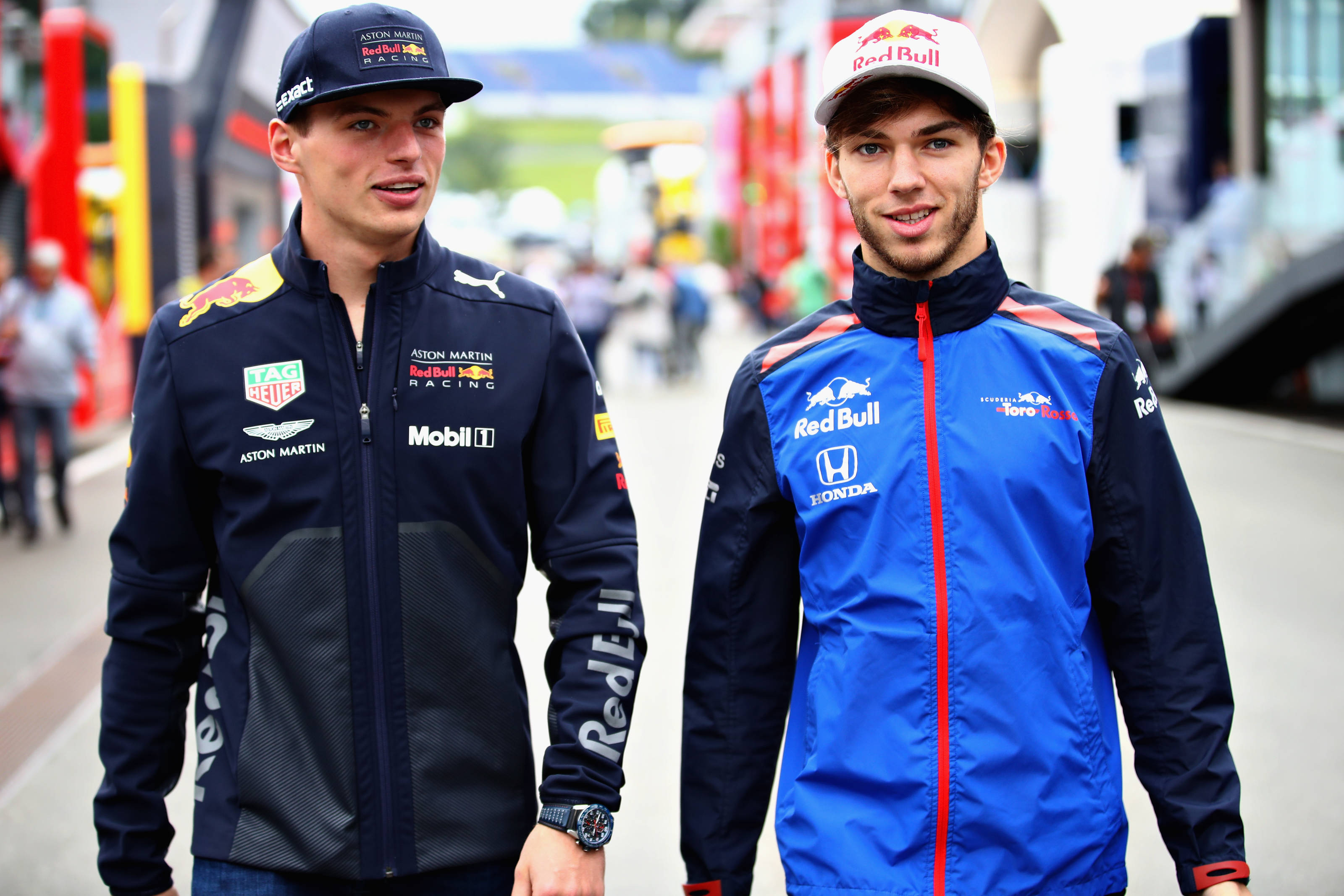
Red Bull has confirmed that Pierre Gasly will join the team for 2019, stepping up from Toro Rosso to replace the outgoing Daniel Ricciardo.
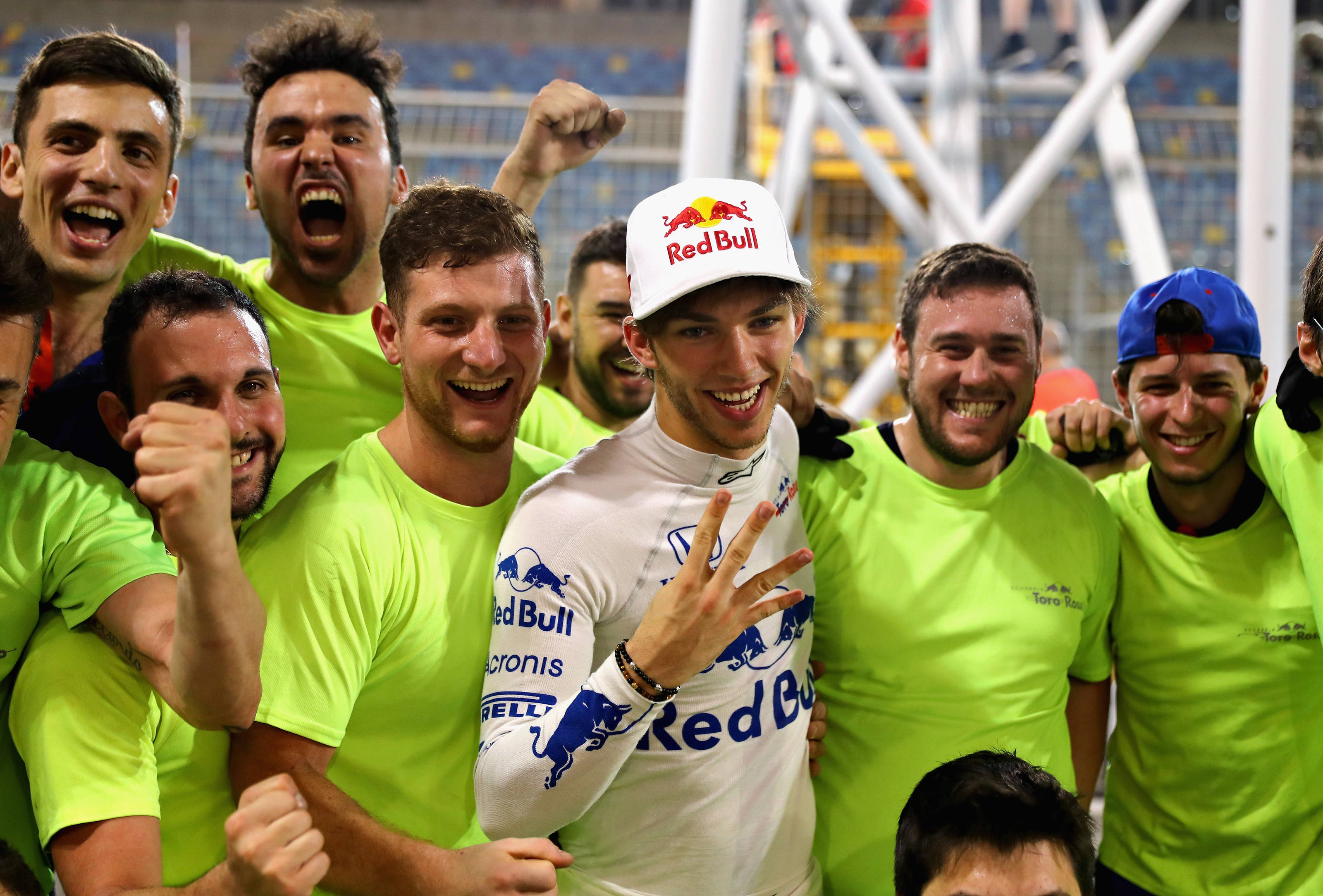
Gasly will join the senior Red Bull team for his second full season in Formula One, having made a late season debut with Toro Rosso at the 2017 Malaysian Grand Prix. Since then Gasly has recorded three top ten finishes, with his best being fourth place at this year’s Bahrain Grand Prix, and contributed all but two of Toro Rosso’s 28 points.
It’s believed that these performances (as well as his experience of Honda power at Toro Rosso and in his 2017 Super Formula campaign) made Gasly the favourite to take Ricciardo’s vacant seat even before fellow Red Bull junior Carlos Sainz removed himself from the market by signing with McLaren.
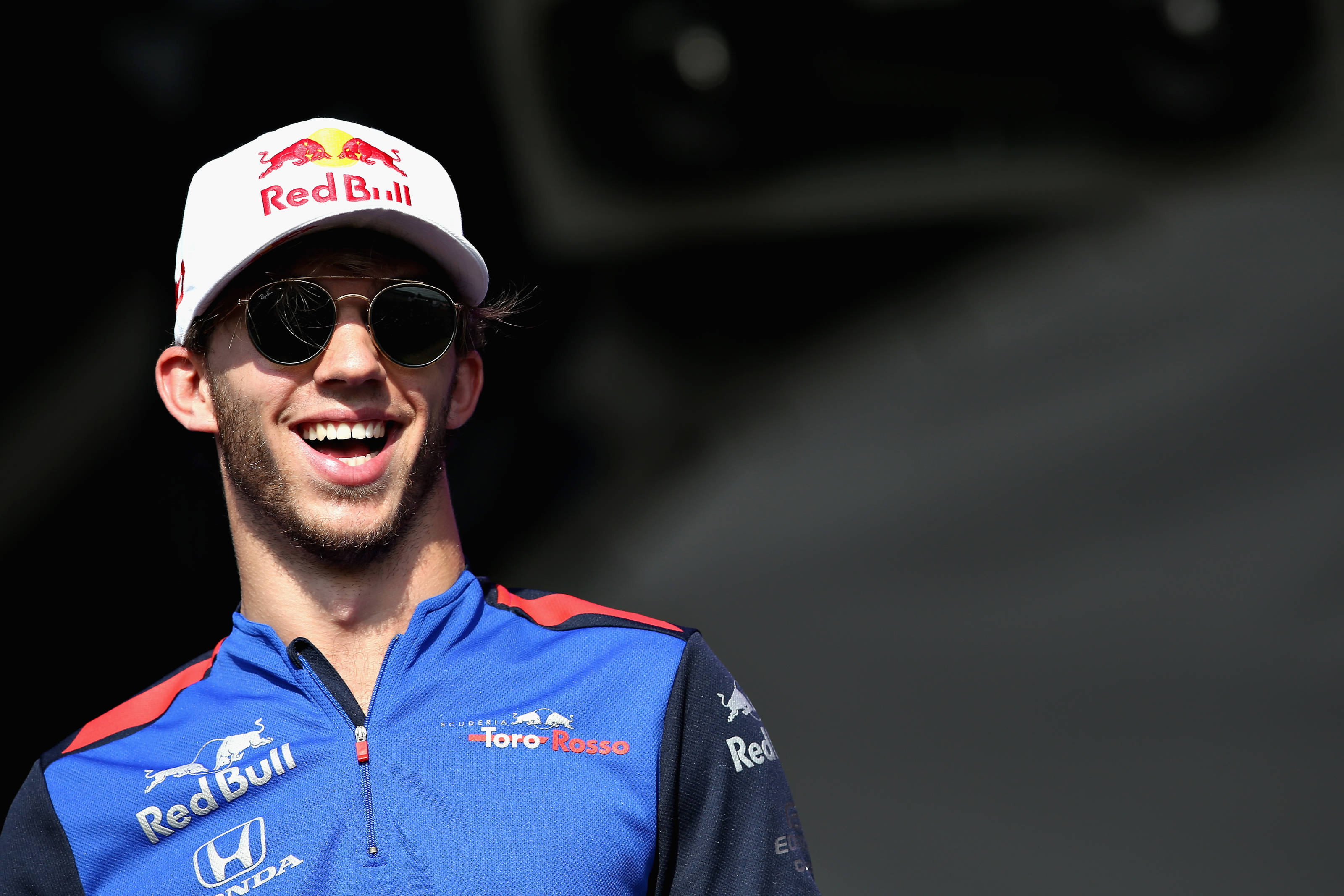
Mark Thompson, Getty Images / Red Bull Content Pool
“To be awarded a drive at Aston Martin Red Bull Racing from 2019 is a dream come true for me,” Gasly said. “It has been my goal to race for this team since I joined the Red Bull Junior Driver Programme in 2013, and this incredible opportunity is another step forward in my ambition to win Grands Prix and compete for World Championships.
“I wish to thank Franz Tost and everyone at Toro Rosso for giving me the golden opportunity of a drive in Formula One. My focus now is to do everything I can to give them a season to celebrate.”
Red Bull team principal Christian Horner said: “Since Pierre stepped into a Formula One seat he has proved the undoubted talent that Red Bull has nurtured since his early career. His stellar performances this year, in only his first full season in Formula One, have only enhanced his reputation as one of the most exciting young drivers in motorsport.”
Mark Thompson, Getty Images / Red Bull Content Pool