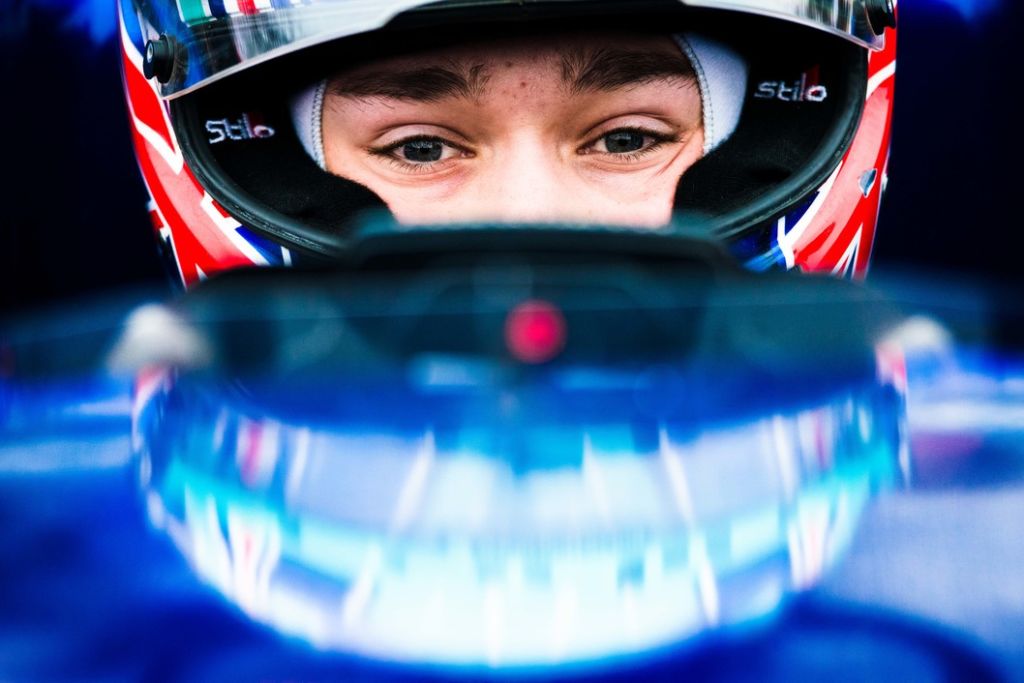
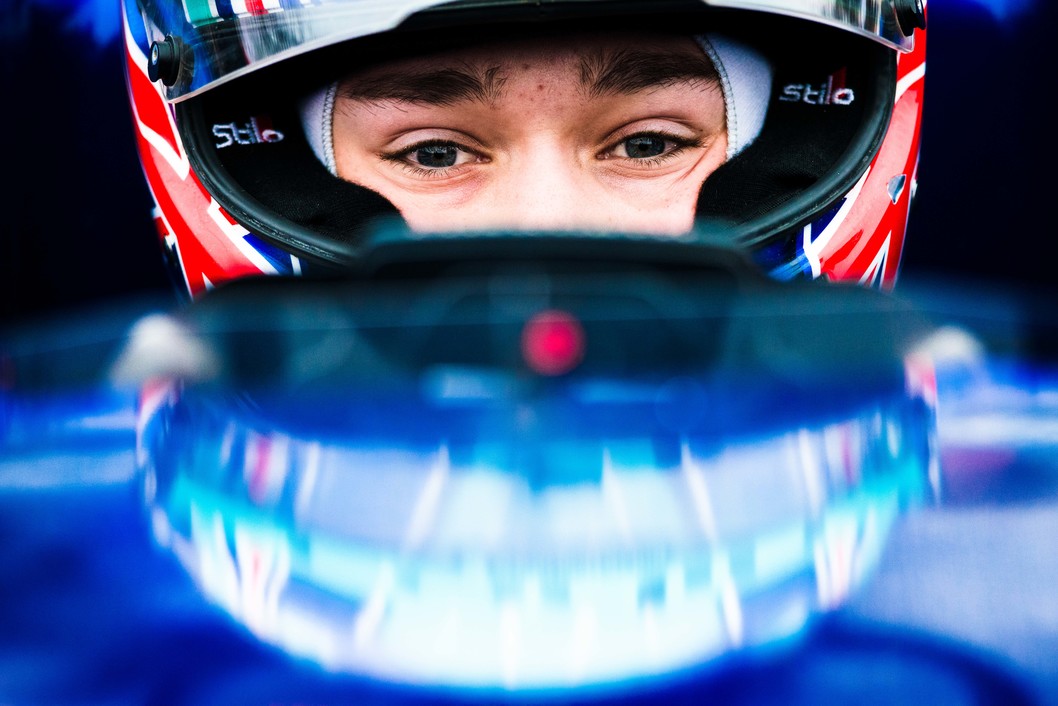
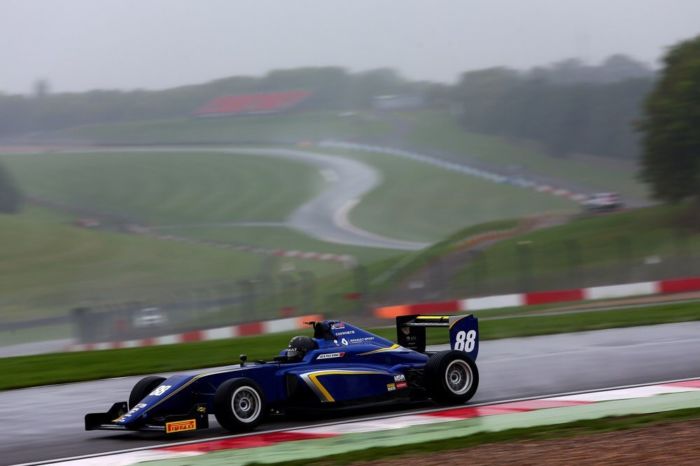
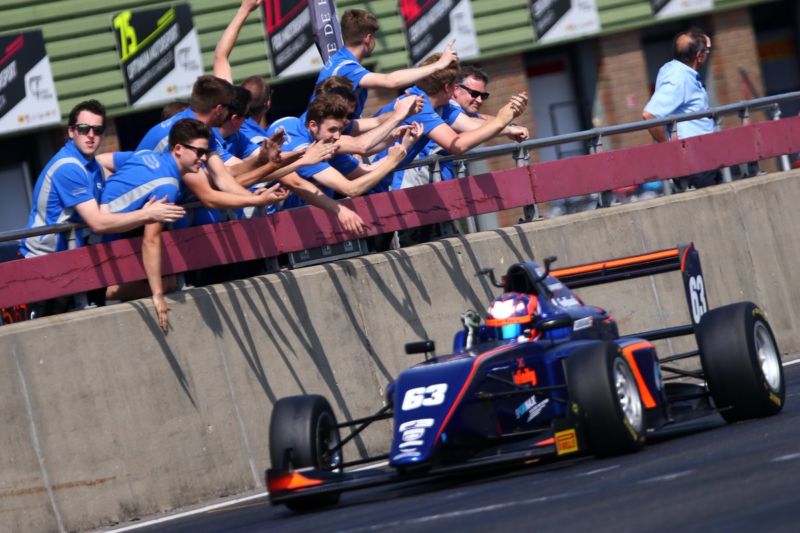
Billy Monger says he wants to be judged as a racing driver only after missing out on two British F3 victories on his return to Donington Park.
Monger had qualified on pole position for Saurdays wet Race One before a lock up saw him slip back into sixth.
He would go on to recover to fourth, before setting the fastest lap in Race Two to earn pole for the final race of the day.
Another lock up when leading from teammate Nicolai Kjaergaard cost him three places, before fellow Carlin driver Jamie Caroline broke his suspension to leave Monger third.
Despite podiums and good pace on his first return to the scene of his life-changing accident a year ago, Monger was not satisfied.
“It could have been more,” the 19-year-old began.
“I’ve been the fastest driver in all conditions this weekend, fastest in the wet on Thursday, qualifying pole on Saturday and the fastest lap earlier.
“It’s such a frustrating time as a driver when you know that the speed you have is quicker than anyone else and a couple of mistakes cost you the results you deserve.”
Monger made no excuses for not converting those poles into victories.
“I have only myself to blame. In race one, I locked up and went on the grass and it was the same again today, I was in the lead and locked up early on at the chicane and cost myself three positions.
“As a racing driver, which is what I want to be seen as, the performances in the races this weekend were not up to the standards that I need to be hitting. I have to accept that and make sure I come back at Silverstone stronger.”
Monger is looking forward to the British F3 Championship’s return to Silverstone in three weeks’ time, where he was also quick back in June.
“Obviously coming back to Donington was a bit of a challenge as everyone knows, but my performances weren’t good enough in the race. I know that I’m capable of putting it on pole position, I’ve had two this weekend so I want to keep them coming and get the results I deserve in the races.”
With a lot of the build-up to this weekend centring on Monger’s accident last year, he insists that once he got back into the car that previous events weren’t on his mind.
“This weekend I haven’t thought about it at all. Obviously that’s a good thing. I’ve shown (that it hasn’t affected me) in the way that I have driven this weekend with the speed I’ve had.
“But for a few mistakes, we should have had two wins. I’ll have to take that on the chin and not get too down about it, I have work to do at Silverstone.”
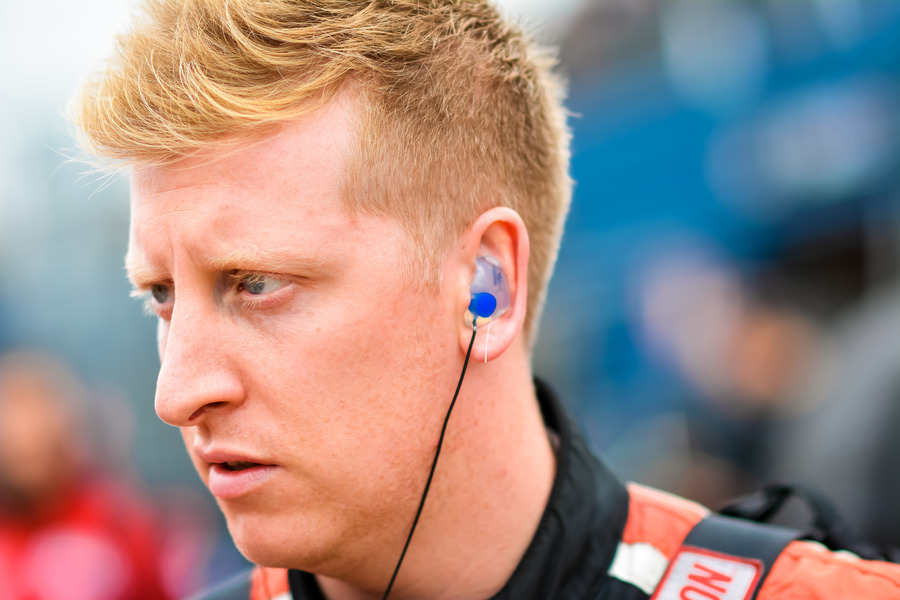
Adam Morgan started out with Ciceley Motorsport eight years ago with his father at home in their garage.
Since then the man from Blackburn has seen his team grow from a small British Touring Car Championship privateer operation into one of the main protagonists in both the main and independent championship races.
Now a professional team, Ciceley Motorsport are looking to expand from BTCC into other categories.
On the team’s entry into the final British GT round at Donington Park, Morgan wasn’t getting carried away.
“We are using this weekend as a bit of a toe in the water to see what it is all about. This is a test session, we want to get to the end, have a good pit-stop and prove to the paddock that we can do what we set out to do.”
The Ciceley operation has grown immeasurably in the last seven years, with more GT races planned over the winter.
“We started in 2010, it was me and my dad in a garage at home. Over the last seven years we have grown so that we operate three Touring Cars, a GT4 car and this winter we’re doing the Gulf 24H and Dubai 24H as well.
“What has turned from a dad and lad hobby has gone to a fully professional racing team.We are very lucky and we both work our socks off and we love it. It’s a dream come true, it’s my full time job and I couldn’t have asked for anything more. Not many people get to turn round and say ‘I’m a racing driver’.”
Alongside Morgan, Ciceley run Tom Oliphant’s Mercedes while Aiden Moffat’s Laser Tools Mercedes is prepared by the team.
Morgan does not want this weekend to be a fleeting British GT series visit, but is unsure whether or not Ciceley will compete on both fronts next season.
“Hopefully this is another project for us next year. Whether we can do a full British GT programme alongside the Touring Car programme, we’ll have to see. We’d like to raise some awareness and get some interest after this event, and we’ll see what happens.”
Morgan is determined that the Ciceley Motorsport tale has another chapter in the BTCC, with 2018 being their strongest season yet as they seek to beat a number of established names.
“Our main objective is to win the British Touring Car Championship, that is our goal and our ambition. We’re getting closer and closer every year, I’m joint fourth in the championship though unfortunately we’re mathematically out of the running to win it but if everything goes well we can come away from Brands with third overall and second independent. For us, that would be a big achievement and next year we’ll come back even stronger again.”
Nicolai Kjaergaard took another victory in race three at Donington Park to spark new life into the British F3 championship, with three races left at Silverstone in three weeks’ time.
Kjaergaard’s second victory completed a clean sweep for Carlin after Sun Yue Yang’s reverse grid race two win in another race that was punctuated by a long safety car period.
Krish Mahadik capped a strong weekend with another podium in second to move to fourth in the championship standings, while polesitter Billy Monger was a disappointed third after a mistake from the lead dropped him back.
Jamie Caroline broke his suspension when running second behind Kjaergaard, apparently on a kerb, to effectively cut the race to a four lap sprint.
Little changed as Kjaergaard stroked it home to complete his objective of “postponing” the championship, while Monger couldn’t make inroads on a resolute Mahadik.
Championship leader Lundqvist was only 11th, meaning the gap that was 111 points going into the weekend is now just 50 points after a challenging Donington Park experience.
Tom Gamble, who was stripped of second place in race two because of issues with nuts and bolts in his engine, suffered more engine problems and could only manage 17th after contact with Kush Maini earned him a 5.5s penalty. Maini meanwhile had a miserable 18th birthday weekend with a DNF in race two and 16th in race three.
Caroline would later be disqualified for failure to comply with double waved yellow flags.
Jack Mitchell was crowned British GT4 champion after a nail-biting finale at the Donington Decider.
Along with Dean MacDonald, eighth place meant he beat Century Motorsport BMW teammates Ben Green and Ben Tuck, who were fifth, by a single point, and with the Tolman McLaren duo of Michael O’Brien a further point behind after a second place finish.
Finlay Hutchison and Daniel McKay took Equipe Verschuur McLaren’s first victory of the British GT season after plenty of near misses in 2018, with Tolman’s Joe Osborne and David Pattison completing an all McLaren 570s podium.
HHC’s Patrik Matthiesen suffered early trouble when he went off on the first lap and had to pit to clear his car of grass and debris, but that was one of few flashpoints in the GT4 class in the early throes of the race.
A serene opening stint was brought to life when the Academy Motorsport Aston Martin of Tom Wood suffered an engine failure and dropped oil all over the circuit, meaning that McKay took a detour at Redgate when he lost grip.
That brought the safety car out for the only time in the race, shortly before pitstops.
Pit stops were to prove a key part of this race, as the #4 McLaren gained plenty to climb to second while the lead, while both Century Motorsport BMWs now driven by Tuck and Mitchell were among those to be given a 10s stop/go as a result of pit infringements.
Tuck was able to recover to fifth after leaving the pits seventh, while Mitchell was ninth at after his penalty. He managed to pass the Invictus Jaguar of Jsson Wolfe to secure the title by a solitary point.
Optimum Motorsport Aston Martin are celebrating tonight after Jonny Adam and Flick Haigh won the overall British GT championship with fourth place at the Donington Decider.
Phil Keen and Jon Minshaw, who needed to win and hope that Haigh and Adam finished lower than seventh to win the championship, won the race after Nicki Thiim in the #11 TF Sport Aston was given a late time penalty to finish second.
The first stint of the race was dominated by Minshaw, who twice built a gap over teammate Sam De Haan in the other Barwell Lamborghini.
De Haan was a capable rear gunner as he tried to slow the whole field down to leave Haigh, who had a 20s success penalty after victory last time out at Brands Hatch, in danger of falling outside the top six.
That plan unravelled when Mark Farmer in the #11 Aston Martin passed De Haan, before Andrew Howard in the #99 Beechdean Aston Martin and Chris Bunscombe in the RJN Nissan collided and cost themselves time, before Iain Loggie in the #7 Bentley also fell by the wayside.
Rick Parfitt climbed from last to second in possibly his last stint in British GT by the time he handed the #1 Bentley over to Ryan Ratcliffe, and Ratcliffe was to become a spoiler for Adam in the second stint of the race.
Adam had left the pits in fifth, behind Ratcliffe, and the two scrapped for 15 minutes before Yelmer Buurman in the ERC Mercedes overtook the pair of them in a matter of corners.
Adam took advantage of Buurman’s move on Ratcliffe to finally breach the Welshman’s aggressive defences and cruise to a trouble-free third British GT crown.
Nicki Thiim took ten seconds out of Keen in the Lamborghini before forcing his way past late on, but the win was taken away from him when he fell foul of track limits.
In the heart of the Spanish desert, the destiny of the 2018 MotoGP World Championship has become a little closer to being decided this afternoon, after a thrilling grand prix at Aragon Motorland.
It was an explosive start from the lights as Jorge Lorenzo (Ducati) crashed out at the first corner. The pole-sitter ran in hot under braking and brutally high-sided out of the grand prix, completely wrecking his championship hopes. The Spaniard has looked strong all weekend, particularly over the long runs during Friday practice, and was considered the pre-race favourite. It is the first time that Lorenzo has crashed out in two consecutive races was in 2011, at Malaysia and Valencia.
Andrea Dovizioso (Ducati) therefore inherited the early race leader with Marquez (Repsol Honda) behind. Marquez had gambled pre-race by electing to run a soft slick rear tyre. Once settled into their rhythm, the two pushed on hard enough to comfortably clear their nearest pursuers, but still being slow enough to not burn out their tyres either. Once the rear tyre loses grip around Aragon and starts spinning, it’s generally game over for the rider.
Dovizioso and Marquez diced with each other throughout the race. The pair, reigniting memories of last season’s thrilling championship duel, put on a masterclass in racecraft this afternoon. The overtakes were hard won, and every last inch of tarmac would be used in the process. But each move was clean. Make no mistake, these are two riders at the very pinnacle of their trade.
Defying the recent convention of the long left-handed final corner being the prime overtaking spot, this contest was at its hottest through the highly technical corners of the opening sector. The Ducati would storm ahead through the sweeping right-hander at turn 2, whilst the Honda would have the edge through the fast left-hander at turn 5. All of which resulting in the two, more often than not, being locked next to each other as they dropped through the corkscrew section.
Marquez was finally able to break free after setting a scorching time on the penultimate lap. Having forced his way back into the lead at turn 12, the Spaniard used every ounce of rubber left on his tyres to prize himself away from his closest championship challenger. Such was the equality of performance between the Honda and the Ducati, the slender advantage of just 0.3 seconds was ultimately enough of a buffer.
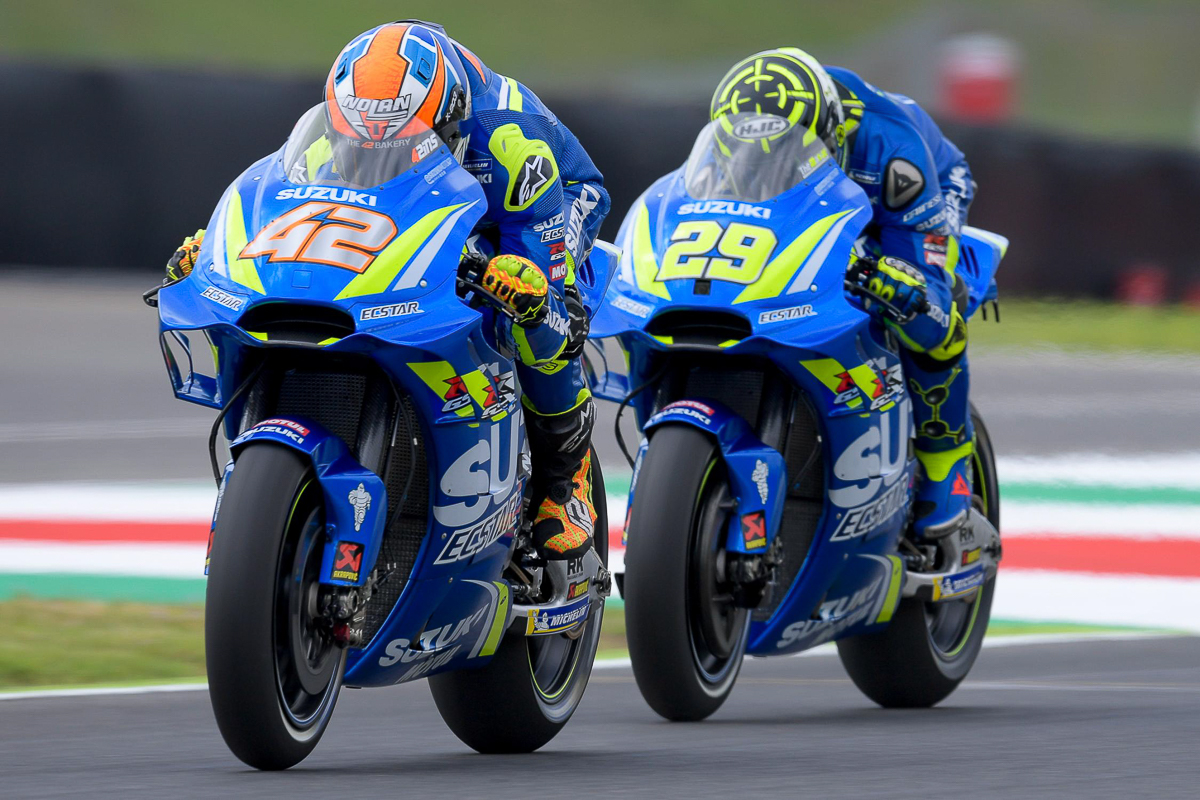
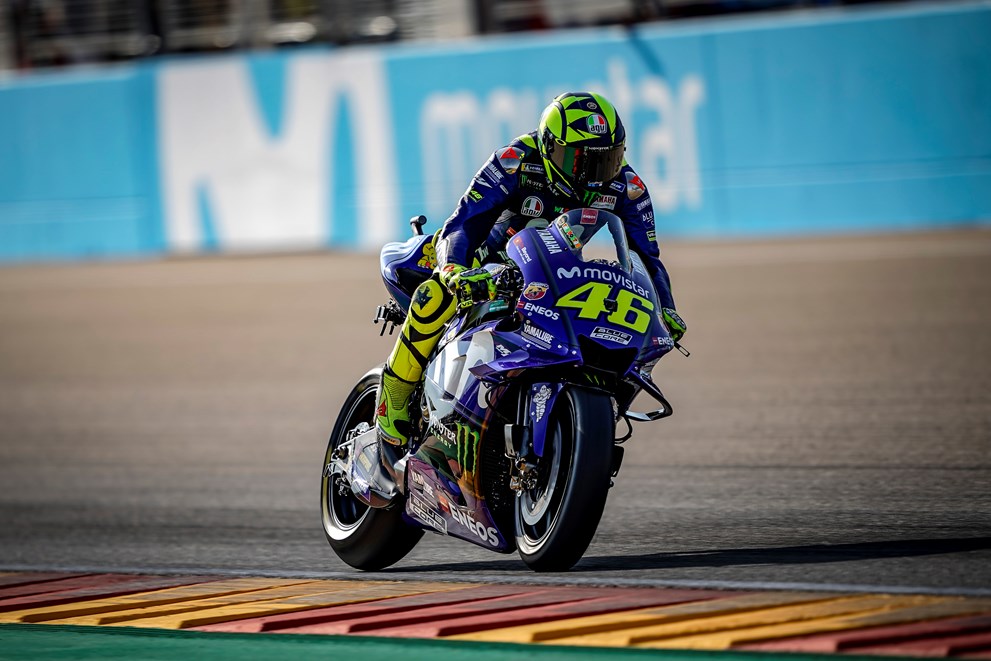
Hunting in pairs – Alex Rins (#42) and Andrea Iannone (#29) gave Team Ecstar Suzuki their best finish of the year.
Team Ecstar Suzuki firmly enjoyed their day in the sun as Alex Rins and Andrea Iannone engaged in an equally thrilling battle for the final podium spot. The pair nearly came to blows early on, as Iannone forced his teammate to the edge of the track down at turn 12. Once the early race nerves had abated, the duo showed a remarkable turn of pace to always keep the race leaders within touching distance. The duo regularly traded places across the 23 laps sometimes cleanly – sometimes considerably less so. The gestures made to Dorna’s world feed cameras by team boss Davide Brivio aptly summed up the drama.
Dani Pedrosa (Repsol Honda) and Aleix Espargaro (Gresini Aprilia) both enjoyed a timely return to form this afternoon. The duo, although never in contention for the podium, spent the race locked together scrapping over fifth and sixth places. On this occasion, it was Pedrosa who took the bragging rights. Nevertheless, sixth place is the best result for Aprilia so far this season. To say 2018 has been a slog for the Noale factory team would be an understatement, but today is proof that progress with the RS-GP is being made.
Yamaha’s woes continued today. Valentino Rossi (P8) and Maverick Vinales (P10) was all that the factory team could manage. For Rossi, the result however should be classed as a recovery job well done, having started the race from the sixth row of the grid, in P18. Coming into this round it was clear to everyone that it would be difficult weekend for the factory team. However after testing here a few weeks ago which was reportedly very positive for the team, overall the Aragon GP will go down as yet another dark chapter in their Annus Horribilis.
The European leg of the season has now been concluded. In two weeks’ time the MotoGP circus will make its debut at the Buriram circuit, Thailand.
You never say never in this sport, especially in grand prix racing, but with a lead of 72 points over his rivals, it is now very hard to see anyone other than Marc Marquez from being crowned 2018 world champion.
Sun Yue Yang was the eventual winner of a race two that saw a red flag and championship leader Linus Lundqvist involved in a race-ending accident at the subsequent restart.
Yang was the beneficiary from a full reverse grid to start from pole position but in the initial staging of the race he lost his lead as the electric Tom Gamble leapt from sixth into the lead.
The Chinese driver was handed a reprieve when Manuel Maldonado brought the red flag out for an incident at McLean’s on lap one, resulting in a full race restart.
A ten-minute delay ensued, and Yang made no mistake with his second start to lead away despite another Gamble rocket.
The same cannot be said for Arvin Esmaeili. The Swede’s Douglas car was spun across the circuit and fired onto the racing line for the first corner, and the ensuing chaos claimed four victims.
Alongside Esmaeili Jusuf Owega was hit, while Kush Maini’s rear suspension was damaged and Linus Lundqvist continued his bad weekend when he was collected in the same accident.
If Lundqvist outscored Nicolai Kjaergaard by five points he would have won the British F3 title with a weekend to spare, instead after a disappointing Saturday he has lost 32 points this weekend to his nearest rival, meaning he now cannot confirm the title until Silverstone in three weeks’ time.
That brought the Safety Car out for five laps and by the time it peeled into the pits there were only five minutes of racing left.
Gamble had enough time to depose Double R’s Pavan Ravishankar from second on the penultimate lap but couldn’t make an impact on Yang.
Yesterday’s polesitter Billy Monger will start from pole position after taking the fastest lap over the first two races. Nicolai Kjaergaard was 12th after being held up by the second-first lap antics, although he will start third due to his quickest lap.
Qualifying for the 2018 MotoGP Grand Prix of Aragon got underway under glorious Spanish sun, giving almost ideal conditions for racing motorcycles, with forty-five degrees of track temperature, next-to-no cloud cover and essentially negligible wind.
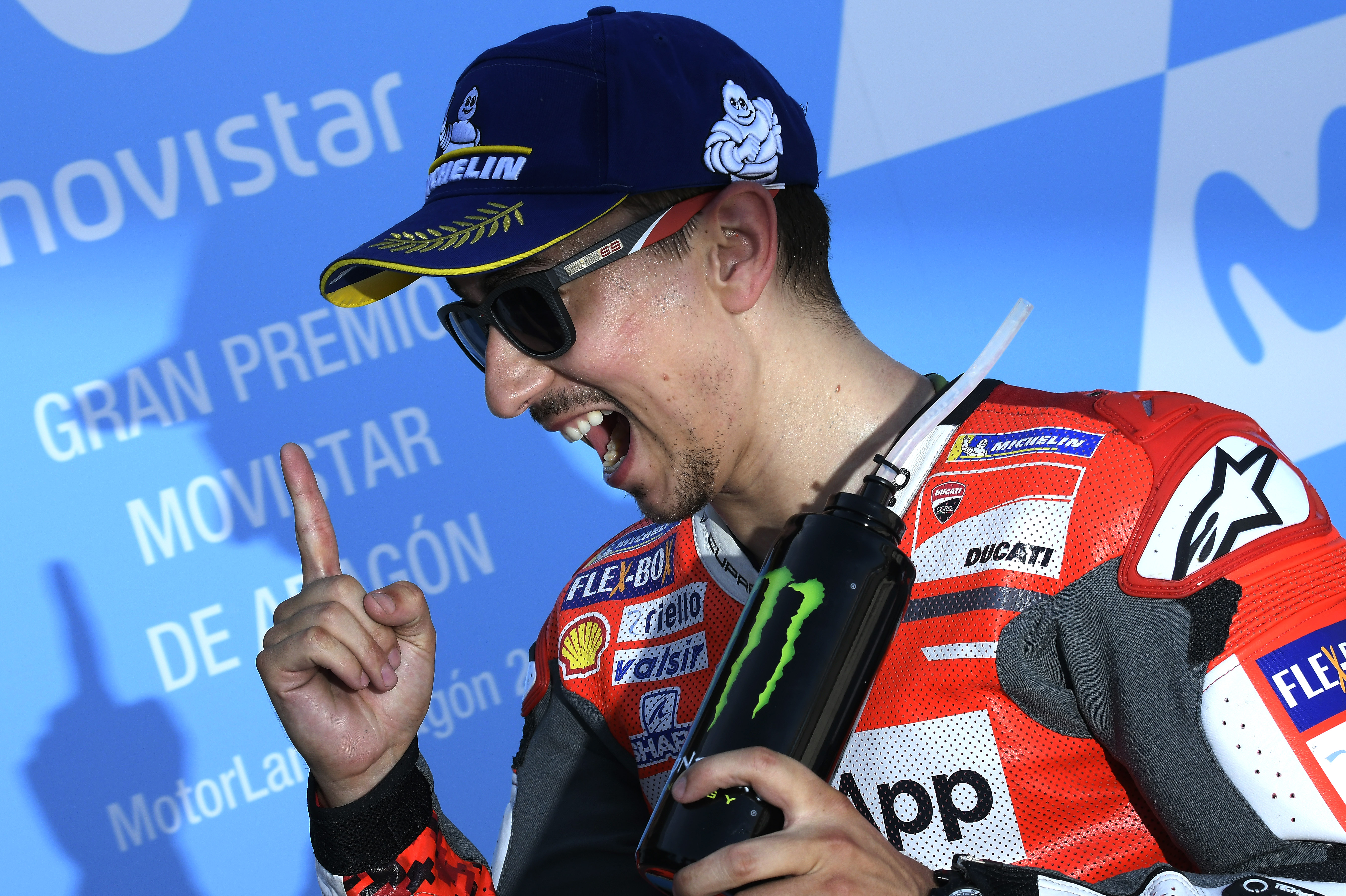
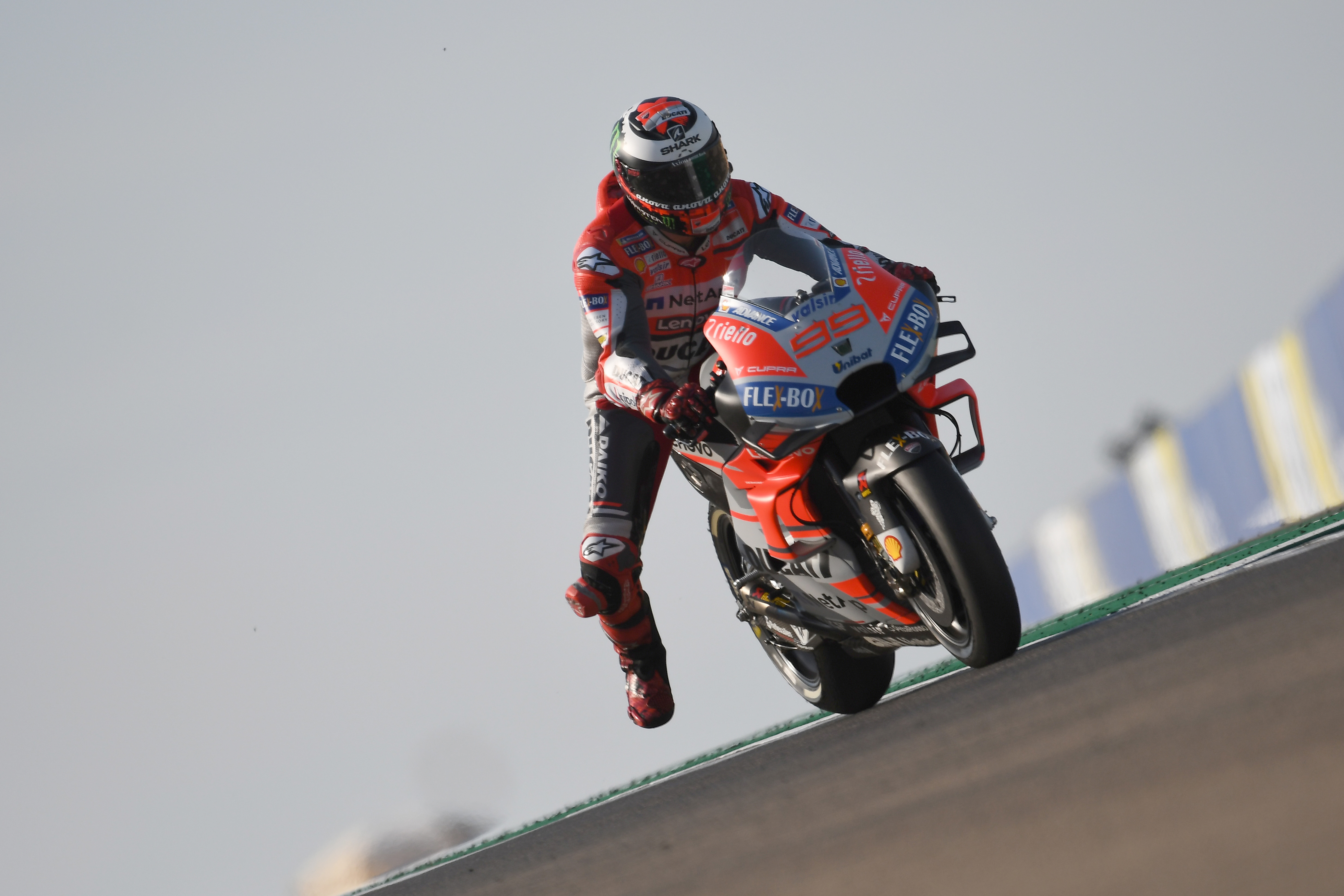
And once Q2 rolled around, it was Jorge Lorenzo who took pole position. Whilst the other riders got caught up in the waiting game of “who blinks first”. Lorenzo found himself some good space on the track, and he set about going quickly. After his first run, he had one tenth to find compared to Marc Marquez’s provisional pole time from the first run, so he knew his third consecutive pole position was well within reach, and despite his teammate Andrea Dovizioso setting provisional pole moments before the Spaniard crossed the line, Lorenzo was indeed the rider to reign supreme on Saturday. Added to that is his race pace, from which you can deduce that Jorge Lorenzo has a reasonable opportunity to take his fourth win of 2018 tomorrow.
Jorge Lorenzo takes Pole at Aragon GP. Image courtesy of Ducati
But perhaps the rider with the best chance to win tomorrow is the one starting from the middle of the front row, Lorenzo’s Ducati teammate, Andrea Dovizioso. His final lap was far from perfect, as he had some traffic throughout, and faced the disturbance of having to bail out of his first lap of run two, also for traffic, before it even began. In addition to this, Dovizioso went into his final attempt at pole position knowing that Marc Marquez was somewhere behind him, as they had been trying to get behind each other for the two laps previous. But Dovizioso was able to put that out of his mind, and take second on the grid, knowing that he could have had pole, had he had some decent track position, and that he has an incredibly strong race pace for tomorrow.
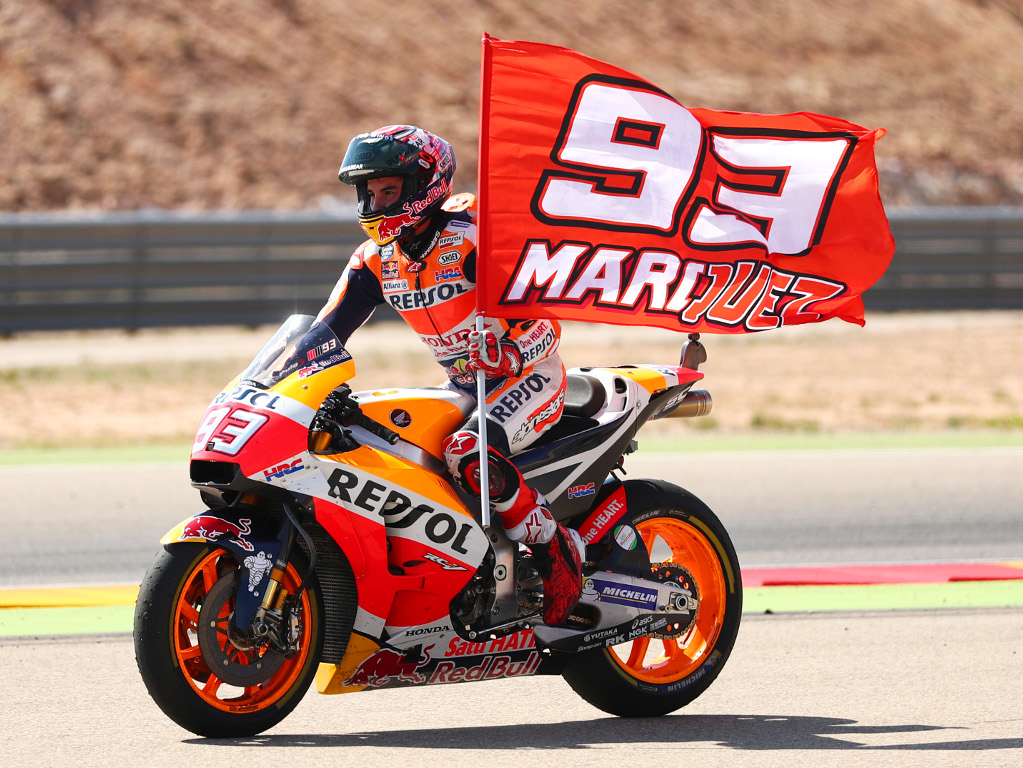
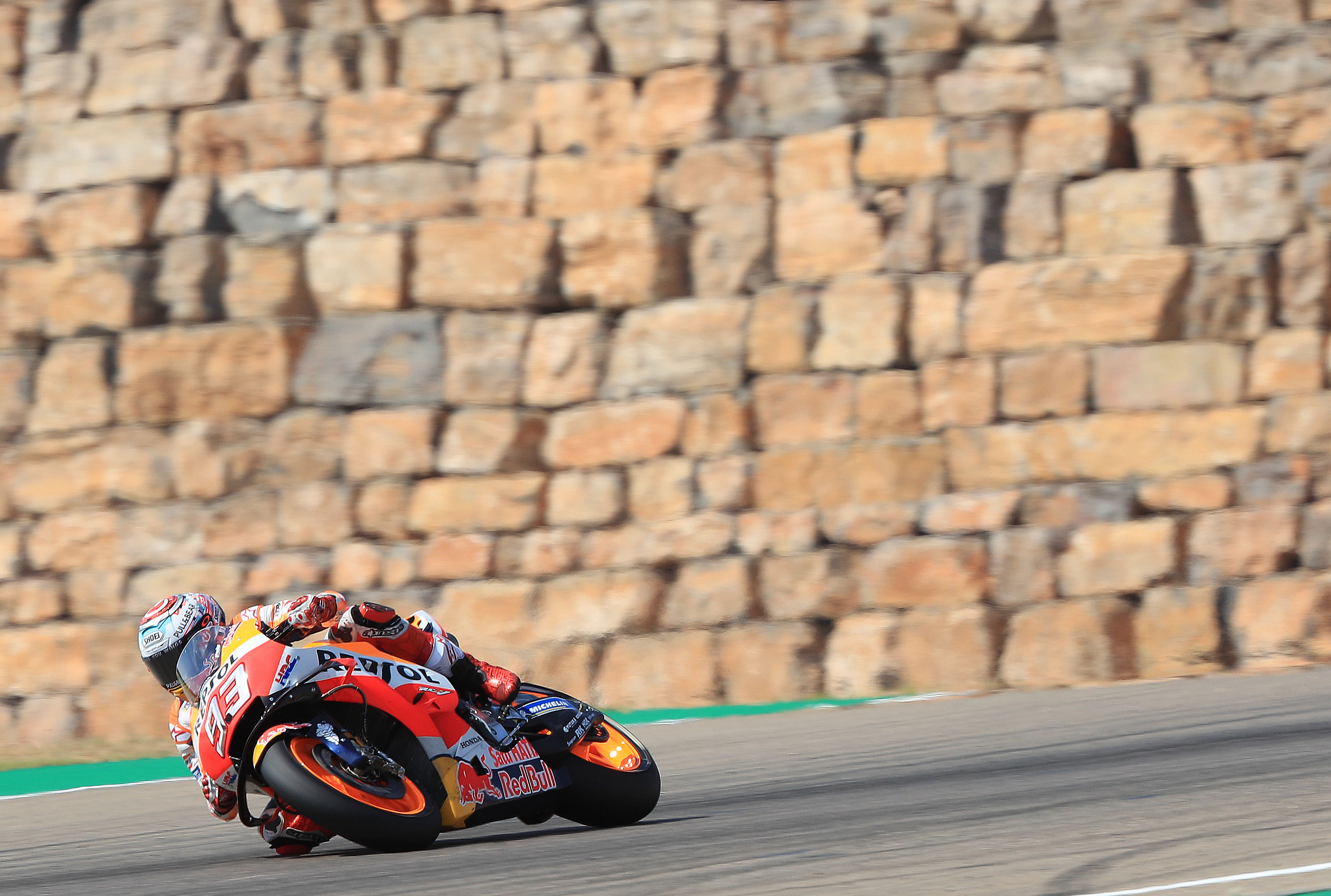
Marc Marquez missed out on pole, like Dovizioso, for traffic. The Spaniard ran wide in turn eight on his final lap in Q2, but somehow gained time doing so (that is a mystery which sums up Marquez quite perfectly), only to lose half a second in turn twelve where he was distracted by traffic ahead do him, who were scattered across the width of the circuit. That was the verdict of Cal Crutchlow, anyway, who crashed due to this scattered traffic moments after Marquez and Dovizioso passed through it. Ultimately it was third for Marquez, and staying with the Ducatis tomorrow seems as though it will prove a difficult, if not impossible task. That said, Marc has not won since the Sachsenring, and in his home circuit will be desperate to end Ducati’s winning streak. Expect something quite spectacular from the #93 tomorrow.
Marc Marquez at Aragon GP. Image courtesy of Gold & Goose/Red Bull Content Pool
Despite his crash, Crutchlow did enough earlier in the session to take fourth on the grid, as the ‘best of the rest’ behind those riders who are almost 2018’s ‘aliens’. Like Marquez, Crutchlow will have a tough time hanging with the Ducatis tomorrow, his weekend made no easier by the fact that the hardest of the three front tyre compounds is too soft for his style with the Honda.
It was a decent qualifying for Andrea Iannone, who was clearly excited to be back in Q2 after missing out for the first time in 2018 back in Misano. He took fifth place, lapping only 0.288 seconds slower than Lorenzo’s pole time, but with that being said, it would be a surprise to see the Italian fighting for the podium tomorrow – the Suzuki, at least in his hands, simply does not have the tyre life.
Dani Pedrosa is getting somewhere close to being ‘back’. Despite his ongoing corner speed issues, Pedrosa took sixth on the grid today, after advancing to Q2 directly from FP3 for the first time since he announced his retirement. If things go his way, he could see his first podium of 2018 tomorrow, the soft front tyre compounds mean that he has some good confidence with the front, and that is helped by the high track temperatures the riders are experiencing this weekend.
The race tomorrow looks like it could be a difficult one for Danilo Petrucci, who qualified seventh, and is likely to struggle with tyre wear. He is one of the riders who stresses the tyre the most, because he rides the Ducati, with a lot of power, and he also has a lot of weight. Everyone is struggling a bit for tyre life this weekend, Davide Tardozzi in fact thinks tomorrow’s Grand Prix could be similar to that of Brno, with a large period of tyre saving in the first part of the race, before pins are pulled in the final laps.
The middle of the third row belongs to Alvaro Bautista, who impressed again for the Angel Nieto Team, and qualified ahead of Alex Rins who was ninth and completed the third row.
The top ten was rounded out by Jack Miller, which was something of a surprise because he had looked stronger than that through free practice. Maverick Vinales and Takaaki Nakagami – both of whom came through Q1 – completed the fourth row.
Eleventh might seem like a disaster for the factory Yamaha of Vinales, but with Johann Zarco in fourteenth and Valentino Rossi in eighteenth, it looks like he was getting the most and more out of the M1, whose manufacturer seems to be in absolute crisis this weekend. If Austria was ‘rock bottom’, then Aragon is proving positively subterranean.
Valentino Rossi coming 18th for the Aragon GP grid. Image courtesy of Yamaha.
That said, for all the flack Yamaha have taken in the past two years, Valentino Rossi has to take some blame for his performance today. His perpetual positivity seems to have run its course. The day started badly with a crash in FP3, and in Q1 he posted only one competitive lap time, otherwise being distracted by his want to get a tow, specifically from his teammate.
Rossi was out-qualified by Franco Morbidelli on last year’s Honda, Johann Zarco on last year’s Yamaha, Aleix Espargaro on an Aprilia which is worse than last year’s, Bradley Smith on an under-developed KTM and Karel Abraham on a 2016 Ducati in Q1. Perhaps the worst part is that tomorrow could yet be worse still.
In nineteenth place was Hafizh Syahrin, 0.3 off Rossi, ahead of Tom Luthi and Scott Redding who completed row seven.
Only two riders will be on row eight tomorrow, because Pol Espargaro further damaged his already-broken collarbone. This means that Xavier Simeon and Jordi Torres (replacing Tito Rabat) are the only riders on the back row of the grid.
Nicolai Kjaergaard took the spoils in British F3’s Saturday race at Donington Park for Carlin Motorsport, while teammate and polesitter Billy Monger hit strife early in the race.
Jamie Caroline was second ahead of Double R’s Krish Mahadik, while Monger battled back to claim fourth from Kush Maini and Ayrton Simmons.
Manuel Maldonado was seventh ahead of series leader Linus Lundqvist, who climbed from a lowly 14th on the grid.
Kjaergaard says that all he can do is keep taking points away from Lundqvist, starting with Race two tomorrow and praised the speed of his Carlin team.
“It is certainly the best I can do, the start went to plan and we led from start to finish. We have shown all weekend we have the pace, it was mega in the race with me and Caroline (Jamie) being really fast compared to the field. That shows how good the Carlin car is and it’s promising for Sunday.
The race was run in greasy conditions with the elements having been changeable all weekend, tomorrow’s forecast is similarly as uncertain. That does not faze the Dane
“We’ll see how the track conditions are tomorrow but we have shown that we are fast in the dry and the wet. If it is wet then it will make race two really interesting. We’ll see what happens in Race Two but I am aiming for another win tomorrow.
“It was a drying track so it was hard to know where to go. You had to keep going and keep pushing as there was more and more grip throughout the session. That was the difficult part because when you’re leading you don’t want to push too hard and go off so you have feel your way forward, whereas Jamie had a bit of a gauge because he could see where I was and whether there was more grip or not.”
With Lundqvist having held a seemingly unassailable 111-point lead coming into the weekend, Kjaergaard has cut the deficit by 22 points to 89 and hasn’t given up on the title with five rounds to go.
“We can only keep going like this and hopefully Linus won’t be too close to us, so let’s see how far we can push the championship. I want to at least postpone it until Silverstone.”
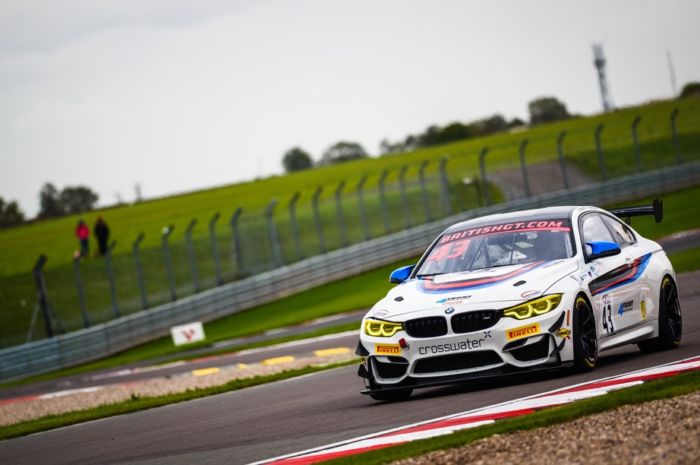
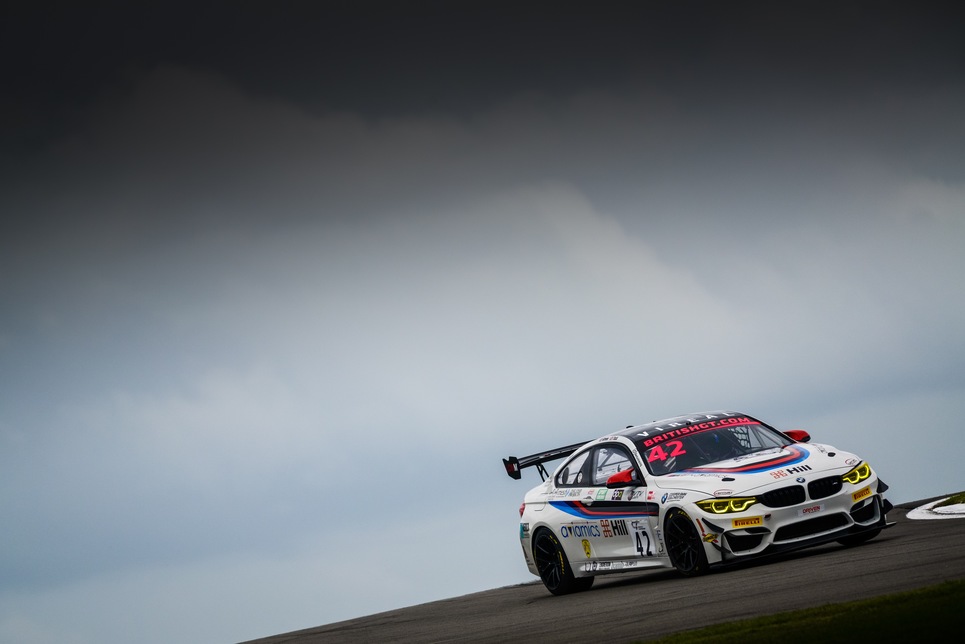
Century Motorsport’s Ben Tuck and Ben Green have taken British GT4 pole ahead of tomorrow’s championship decider.
A session-long battle with the Equipe Verschuur McLaren of Finlay Hutchison and Daniel McKay ended with the #42 crew applying maximum championship pressure on teammate and leader Jack Mitchell and co-driver Dean MacDonald, who were only seventh.
Ben Barnicoat and Adam Balon were third in the #72 Balfe McLaren 570s, Barnicoat setting the second-fastest GT4 time in the final session.
Will Moore and Matt Nicoll-Jones are fourth and have an outside chance of the title should they convert that into a win and their rivals fall by the wayside. The Academy Motorsport duo are fifth, 31 points behind Mitchell.
One of those rivals are Michael O’Brien and Charlie Fagg in the #4 Tolman Motorsport McLaren. They line up sixth for the race tomorrow and have a similarly outside chance, 28 points back in fourth place in the standings.
The team third in the standings are the #55 duo of Callum Pointon and Patrik Matthiesen in the HHC Motorsport Ginetta. They are 13.5 points behind Mitchell, but have work to do to overhaul him.
Elsewhere, British Touring Car Championship race winner Adam Morgan was fastest in the Ciceley Racing #25 Mercedes during the second part of GT4 qualifying, sharing with amateur David Fairbrother.