The British F3 series heads to Brands Hatch this weekend with a clear championship leader, while a fight for second place is hotly contested between three drivers.
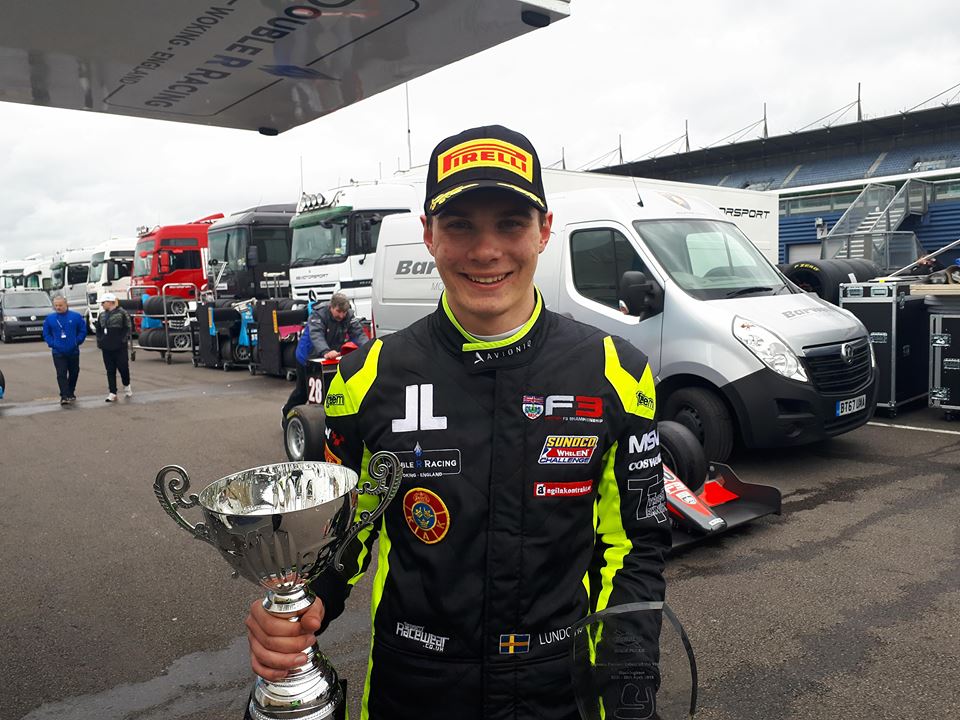
Two wins at the Spa-Francorchamps overseas round has given Linus Lundqvist a 120-point lead over Denmark’s Nicolai Kjaergaard – the Swede has a small mathematical chance of wrapping the title up by Sunday.
Kjaergaard is trailed in second place by Kush Maini (27 point) and Tom Gamble (31) in what is now a race for best of the rest, although has taken only one podium and two retirements from the last six rounds after a difficult two meetings.
If Lundqvist was dominant in Belgium, Gamble was the main threat to the 19-year-old with two second places and a retirement, while also taking pole position to lead the Jack Cavill Pole Position Cup for 2018.
The Nottinghamshire teenager must rue the engine issue that stunted his progress from Sunday at Rockingham to the Sunday at Silverstone, before he was allowed to change it.
Like Kjaergaard, Maini is another one to have started brightly but fallen by the wayside as the season wore on. An impressive Silverstone meeting where he could have won two races, he lost 60 points to Lundqvist to effectively end his championship hopes.
Meanwhile, Jamie Caroline won from eighth in race two at Spa on his first F3 weekend, while Billy Monger will be looking to make the podium as he did last time out, debuting the unique “leggy” celebration inspired by Daniel Ricciardo’s “shooey”.
Kirsh Mahadik will be looking to repeat his victory here last year in the F3 series, while Ayrton Simmons will compete in only his second weekend in the series alongside his British F4 commitments.
With Brands Hatch the setting for many a classic race over the years, a new batch of younger driver will be hoping to make their own piece of history this weekend.
Without doubt the biggest safety advancement in Formula One over its 68-year history is the introduction of the monocoque.
The monocoque combines the driver’s survival cell, cockpit and forms an integral part of the chassis, with the engine and suspension among the compartments bolted to it.
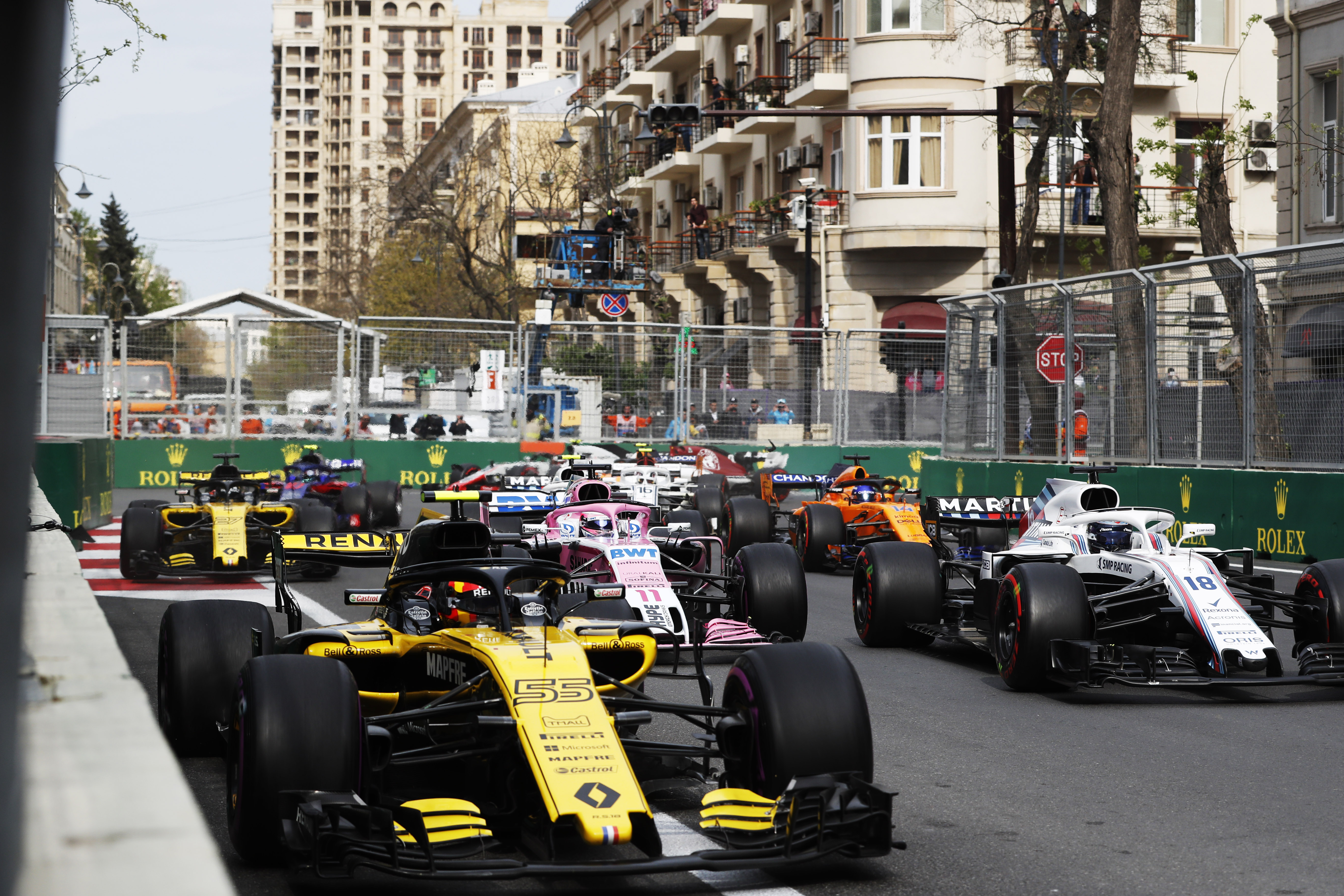
Despite it not being common-place until the 1980s, the first example of this device appeared in the 1960s/ An aluminum alloy monocoque chassis was first used in the 1962 Lotus 25 Formula 1 entry, while McLaren was the first to use carbon-fibre-reinforced polymers to construct the monocoque of the 1981 McLaren MP4/1, this being the device and construction the world of motorsport is used to.
For safety reasons, no fuel, oil or water lines may pass through the cockpit and the driver must be able to get out within five seconds without having to remove anything except seatbelts and steering wheel (which he must be able to refit within another five seconds). F1 seat belts comprise a six-point harness, which the driver can undo in one movement. They have been compulsory since 1972.
The monocoque must be mainly constructed of carbon fibre, with up to 60 layers of it in places to absorb the energy of heavy impact accidents largely due to the high-speed nature of accidents in modern day Formula One. There is also a roll-over hoop behind the driver’s head, made of metal or composite materials while the survival cell’s flanks are protected by a 6mm layer of carbon and Zylon, a material used to make bullet-proof vests. The updates to this in recent years include the HALO device, designed to prevent foreign objects entering the cockpit and striking the drivers head.
The width of the cockpit must be 50 centimetres at the steering wheel and 30 centimetres at the pedals, the modern day monocoque often compared to driving in a bath tub as a result.
The driver’s seat is a single plastic cast and is tailored to each driver according to their exact shape and size to provide maximum protection. Since 1999, the seat has been detachable for it to be possible to remove the driver and seat as one after an accident, decreasing the chances of spinal injuries.
The system is now synonymous with the open-wheel racing community and has saved the lives of many a driver, famously Robert Kubica at the 2007 Canadian Grand Prix and Mark Webber at the 2010 European Grand Prix.
The monocoque started out life in Formula One as an aerodynamic device designed to increase efficiency, making the car narrower. The development of this system has led to Formula One and the wider racing community now being as safe as it ever has been, and the motorsport community continues to strive for improvements.
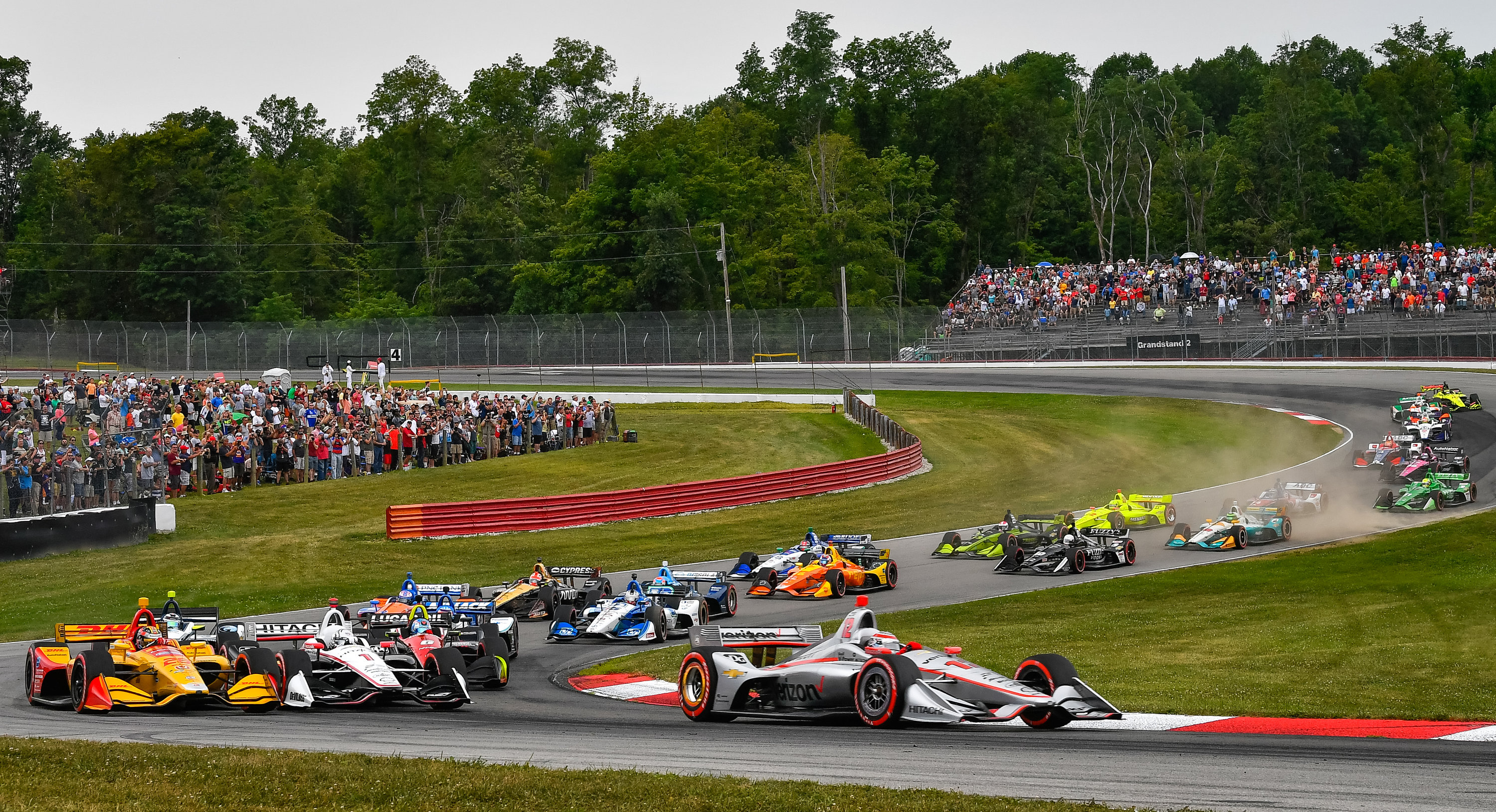
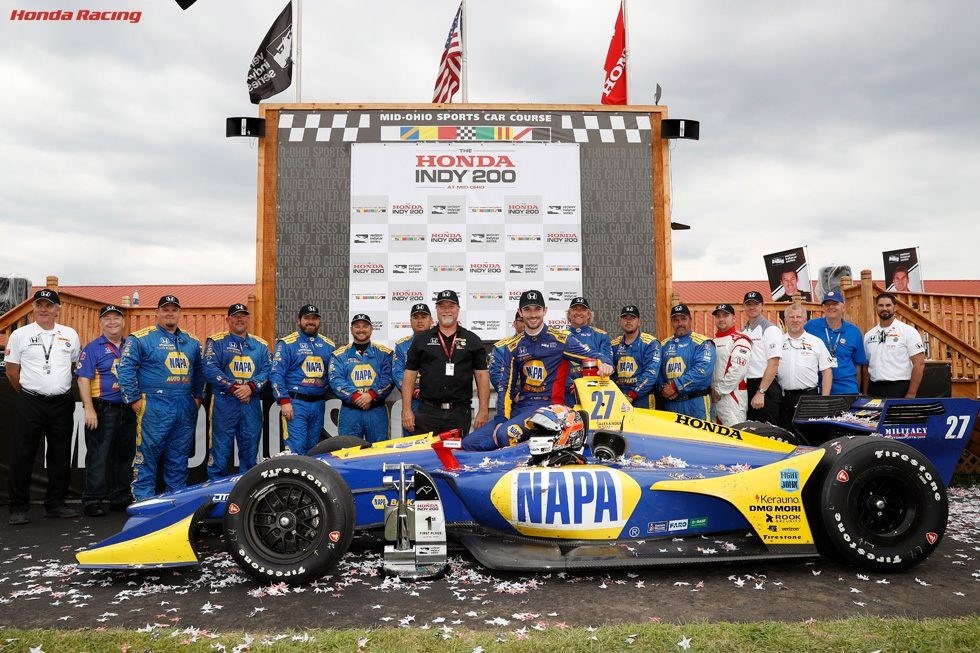
The #27 Andretti team and Alexander Rossi left the rest of the IndyCar paddock scratching their heads and looking for answers after they completed what should’ve been the impossible – the two-stop at Mid-Ohio. To highlight the unusual nature of this, Rossi was the only driver in the 24-car field to even attempt the two-stop strategy, everyone else stuck to the book with the three-stop.
Rossi’s win was far from certain for the first half of the race with his strategy looking outlandish and impossible at best but, as we all should’ve known, Rossi’s the master of making an unreasonable strategy work… just think back to his sensational Indy 500 win! Many were writing the pole-sitter off as he stayed out way later than anyone else for his first stop with most thinking that this was going to be Robert Wickens’ long-awaited first win.
However, it soon became clear that Rossi’s strategy call wasn’t stupid at all, in fact it was a masterstroke, leaving him untouchable with a 20 second lead. His only real mistake of the day came after the chequered flag when he tried, and failed, to do a donut. He got the spin going alright but then dropped off the edge of the track and got himself stuck with his front wheels off the ground… not the best way to end what was otherwise a near-perfect race.
Second on the road was Rossi’s season-long rival Wickens who felt that his race could’ve been so much more without the intervention of traffic. After Rossi’s final stop, Wickens found himself caught amongst a gaggle of lapped cars and ended up losing over a second a lap, meaning he was unable to make any impression on Rossi’s lead. This was primarily because blue flags in IndyCar carry no weight; they are simply there to warn a driver that there are leaders behind, but they have no obligation to let them past. Still, it was another good result for the rookie who has established himself as an IndyCar front-runner.
The same could not be said for Wickens’ Schmidt Peterson teammate, James Hinchcliffe, who crashed in qualifying and was unable to recover during the race. The strategy didn’t work out for Hinchcliffe and, to add to that, he had a slow stop which meant he came out behind Zach Veach and was then unable to pass. The #5 SPM driver trailed home in fourteenth with yet another race to forget.
Max Chilton joined Hinchcliffe in the ‘race to forgot’ club. He qualified in sixth which was an all-time best for Carlin but contact with Takuma Sato in the opening laps earnt him a drive-thru penalty which was topped off with a very long stop as a result of damage from that incident. It was just one of those days for the British driver…
Will Power, driver of the #12 Verizon Team Penske IndyCar Chevrolet V6, races to a 3rd place finish Sunday, July 29, 2018 during the Verizon IndyCar Series Honda Indy 200 at MId-Ohio Sports Car Course in Lexington, Ohio. Power sits in 4th place in the drivers championship with four races remaining. (Photo by Scott R. LePage/LAT for Chevy Racing)
Meanwhile, Will Power took third as he continues to struggle in keeping his title hopes alive. Power, like everyone else, got caught out by Rossi’s risky strategy while he also got jumped by Wickens who pitted earlier than the #12 Penske driver. Despite trying to put on a late challenge, Power was unable to regain the place he lost to Wickens, leaving him in third but with a reduced 87-point gap to championship leader Scott Dixon.
Power’s Penske teammate, Josef Newgarden, finished between him and Dixon on track but he was hoping for so much more after Dixon’s poor qualifying. Newgarden only ended up gaining two points on Dixon, despite the fact the latter qualified in ninth after being caught out by Hinchcliffe’s crash in qualifying. Dixon himself ran a fairly good race with damage limitation being the name of the game; his lead is down by 24 points with Rossi stealing a march, but it could’ve been a whole lot worse.
The star of the race, other than Rossi, was undoubtedly Sebastien Bourdais who, after starting dead last, made 20 passes to finish in a sensational sixth place. This was made all the more impressive by the fact that there were no cautions to close the field up during the race, Bourdais did it all on merit. The Frenchman overtook more drivers than can be mentioned with the majority of the overtakes happening in risky places and around the outside – he was unstoppable all race and proved to everyone what he could’ve done had he not crashed in qualifying.
Alexander Rossi wins the Indycar 2018: Round Thirteen – Mid-Ohio Image courtesy of hondanews.eu
Another driver to note was Bourdais’ returning teammate, Pietro Fittipaldi, who was competing in his first race back since his horrific leg-breaking crash at the top of Eau Rouge during the WEC round at Spa. Fittipaldi is still walking with a cane, could hardly get into the car, had to have a brace on his leg and had to have numerous adjustments to the pedals – any normal person just wouldn’t race but Fittipaldi’s a racing driver, so race he did! The Brazilian finished second-to-last but that didn’t really matter, he finished and gained valuable experience while he was at it.
That rounds out the IndyCar action at Mid-Ohio with a well-deserved two weekends off for the IndyCar paddock ahead before they return at the ‘Tricky Triangle’ of Pocono.
There are several car features in modern day Formula One which have significantly improved protection for the drivers over the years, and these features have been developed over the years through thorough research and testing. Here are some key features to protect F1 drivers during a crash:
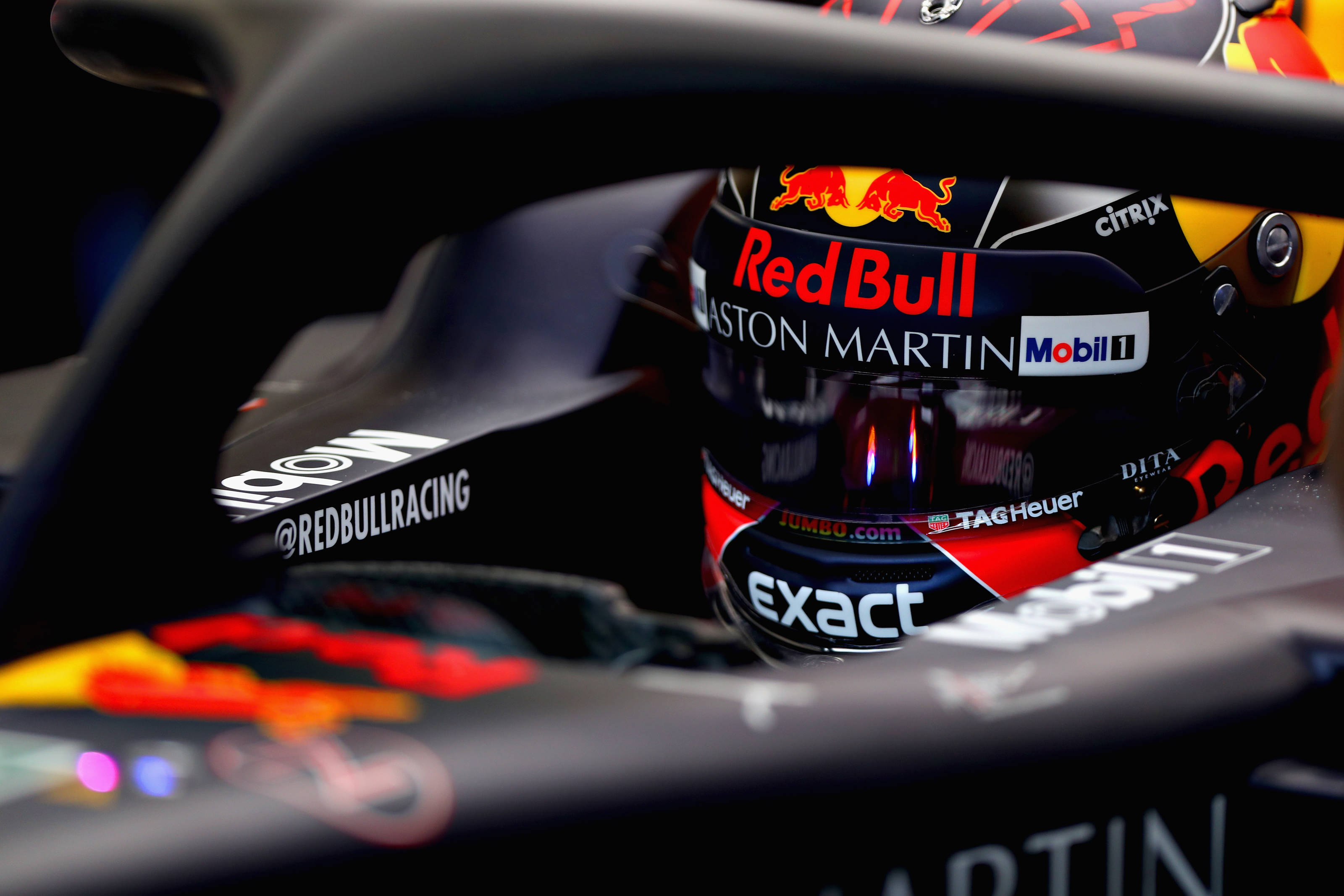
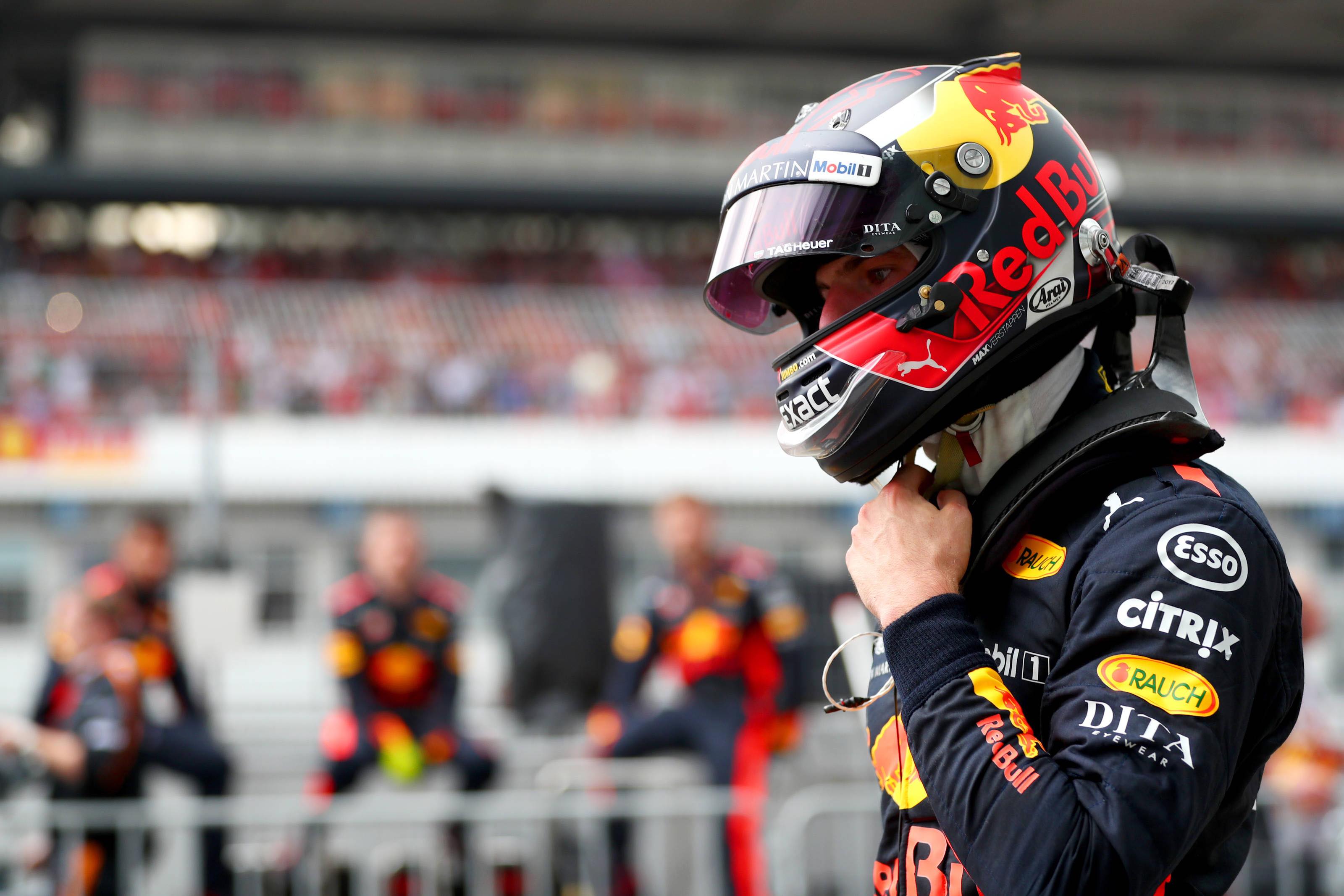
Dan Istitene, Getty Images / Red Bull Content Pool
Monocoques:
The first Monocoque was introduced to Formula One in 1962, and it was made entirely of aluminium. This went a little way towards protecting the driver, but the cars were still dangerous, because the material simply isn’t the most efficient way to protect a racing driver during a crash.
In 1982 the first ever carbon monocoque was produced, and over the years carbon composites have been developed thanks to devoted research from experts.
During a crash, the monocoque, which is tight to the driver in the cockpit, will absorb a lot of pressure from the impact, reducing the stress put on the driver’s body during a heavy impact.
Monocoques for F1 cars actually used to be made by plane manufacturers, but these days all F1 teams are expected to make their own monocoque.
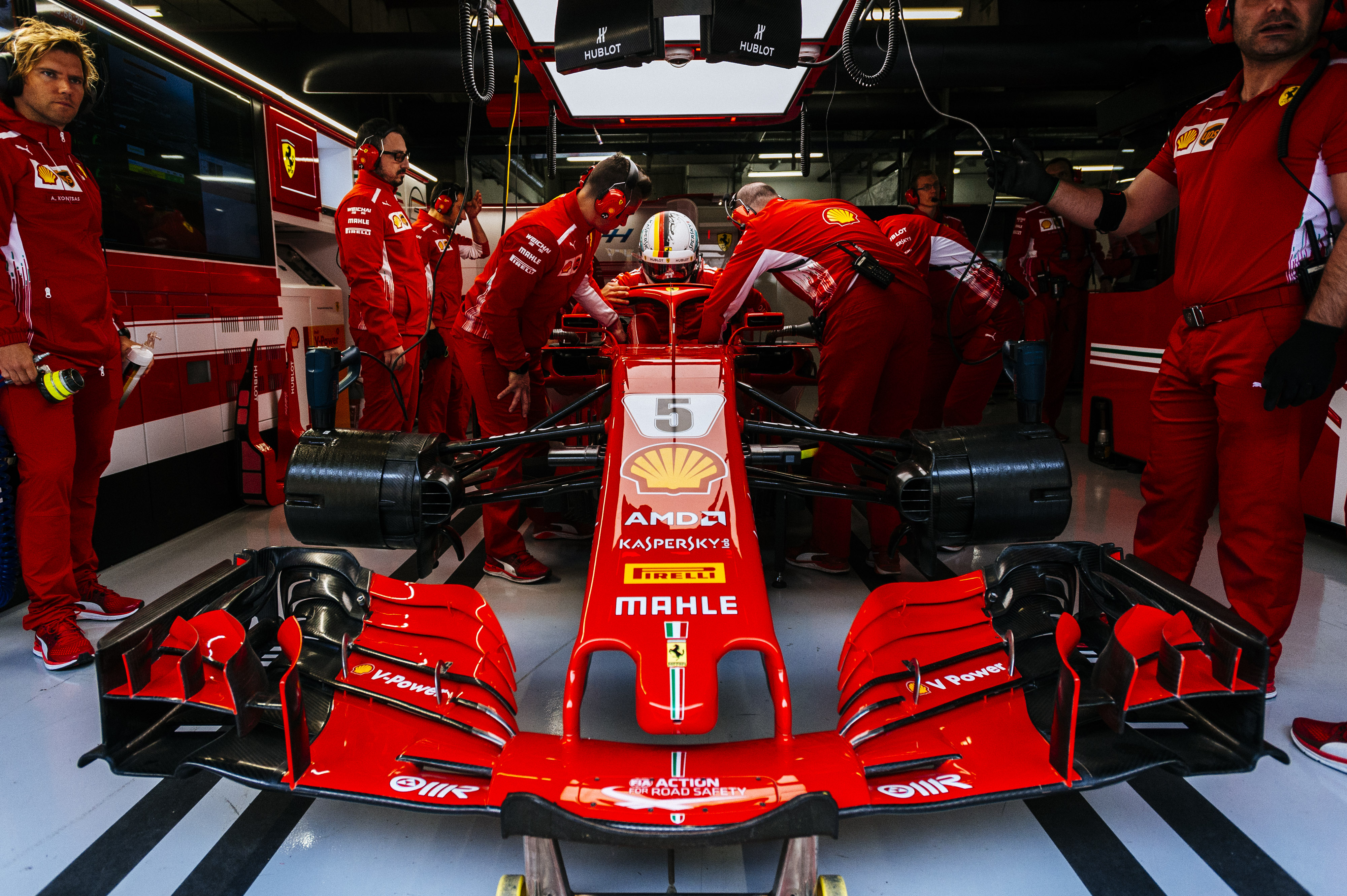
Ferrari Media
Front nose:
A head-on crash is one of the most dangerous in F1, because it means a lot of exposure to the driver’s body on impact with a wall or another car.
The front wing is designed to shatter on impact. This is scientifically proven to cause a constant reduction in speed after the crash, which helps to limit shocks to the driver from a heavy impact—instead the crash feels more cushioned, with the majority of the pressure from the impact being absorbed by the car.
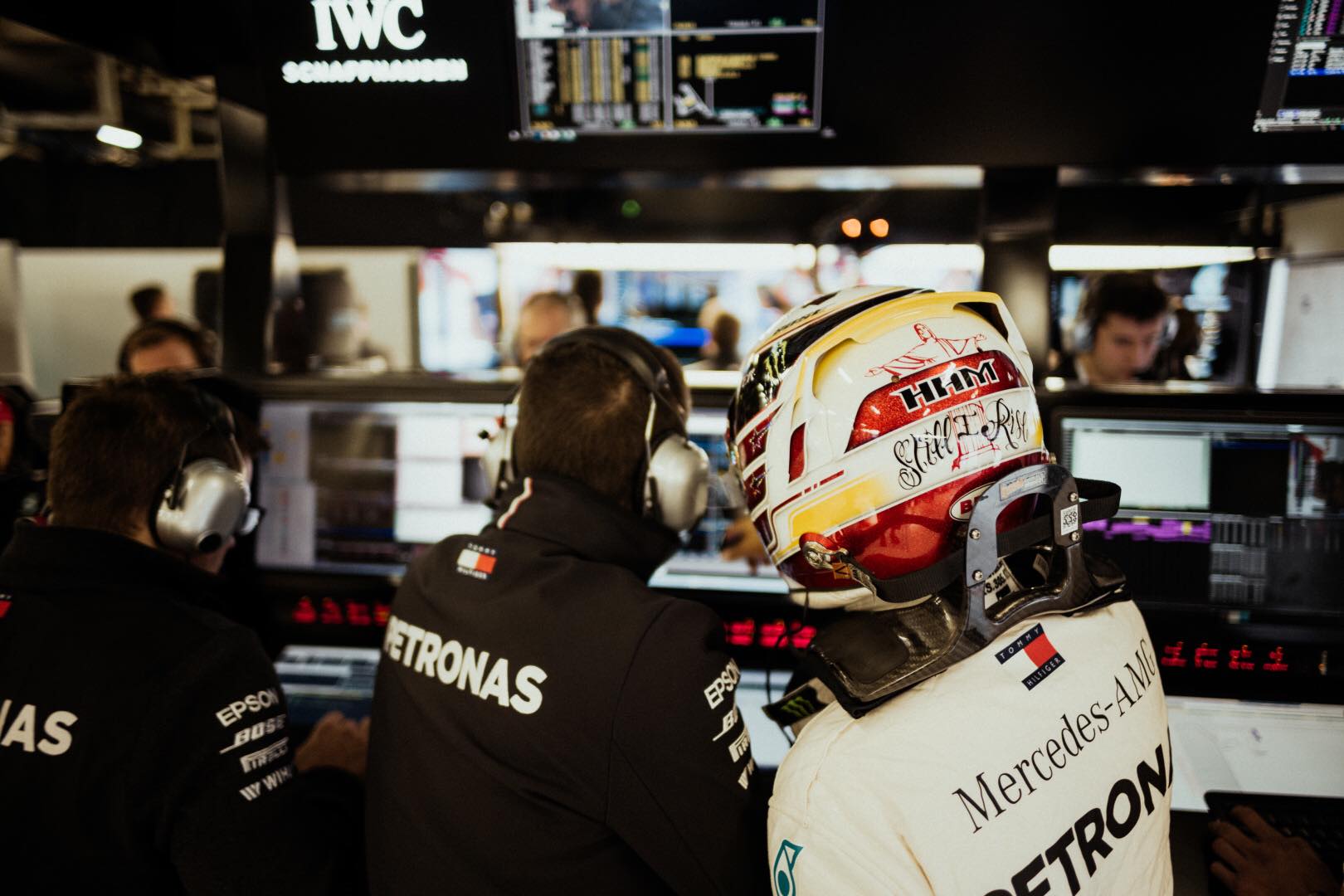
Steve Etherington / Mercedes AMG
HANS device:
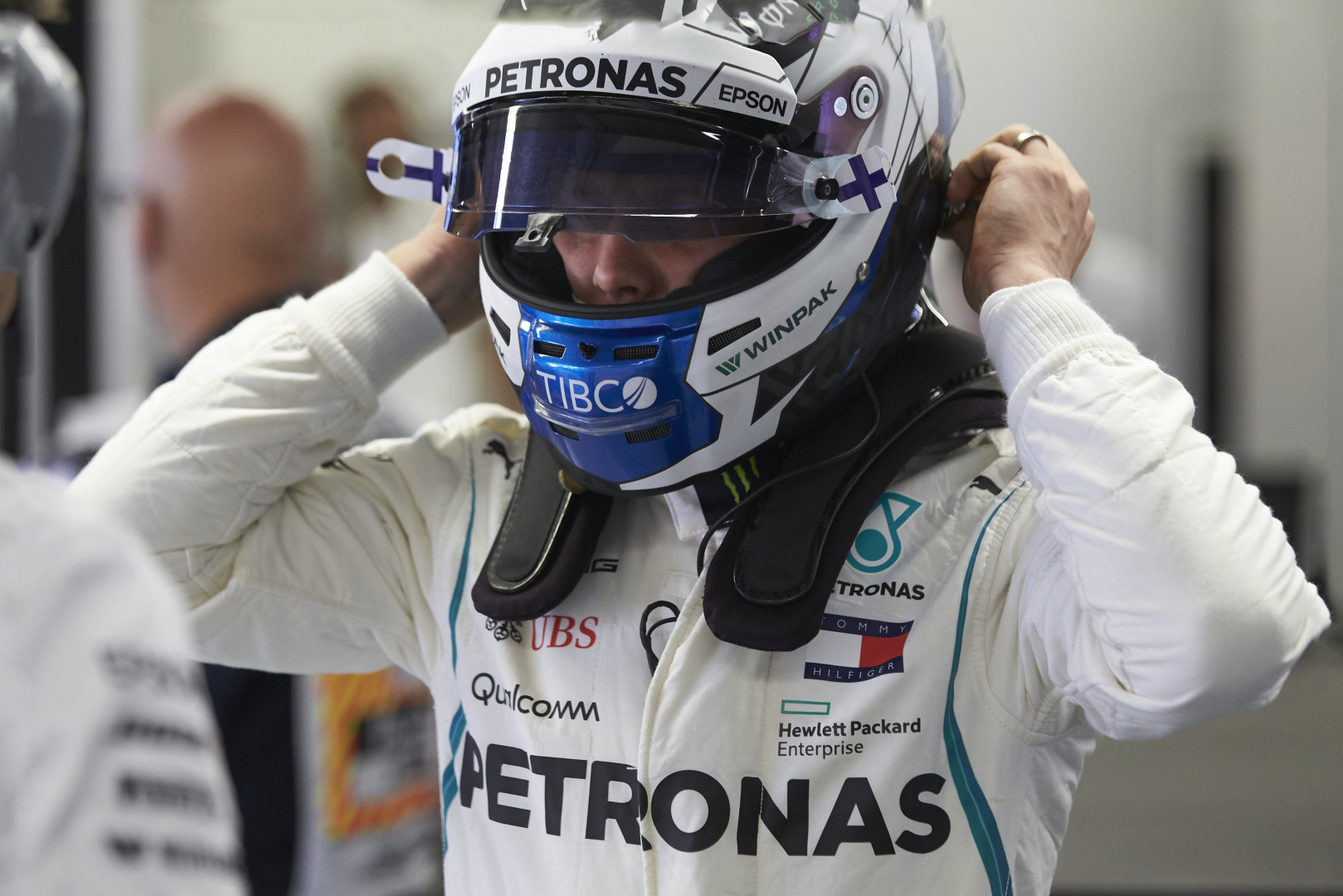
The HANS (Head and Neck Support) device is used for the driver’s neck and shoulders. It limits their movement within the car so that they are less exposed and more protected, not just during crashes, but also during high levels of G-Force.
The HANS device goes over the shoulders and round the neck, clipping onto the driver’s crash helmet.
Steven Tee / McLaren
Head rest:
The head rest is the object you see drivers taking off from around their heads when they get out of an open-wheel race car.
The head rest does a similar job to the HANS device, except it is designed to provide more protection to the head. It limits movement of the head during high levels of G-Force or a crash, and ensure that not too much strain is put upon the head and neck. If the head is not able to move as much, then the neck will also be more still, reducing the risk of a serious neck injury. Head rests are also used to absorb the pressure during a crash.
In the past, we have seen head-rests come loose: for example in Baku 2017 when Lewis Hamilton lost the lead because it was not put on properly by the team. It also came off during Kevin Magnussen’s Eau Rouge crash in 2016, which could have been very serious because Magnussen’s head will have had mass exposure and his neck will have suffered a lot of strain because of the unabsorbed impact.
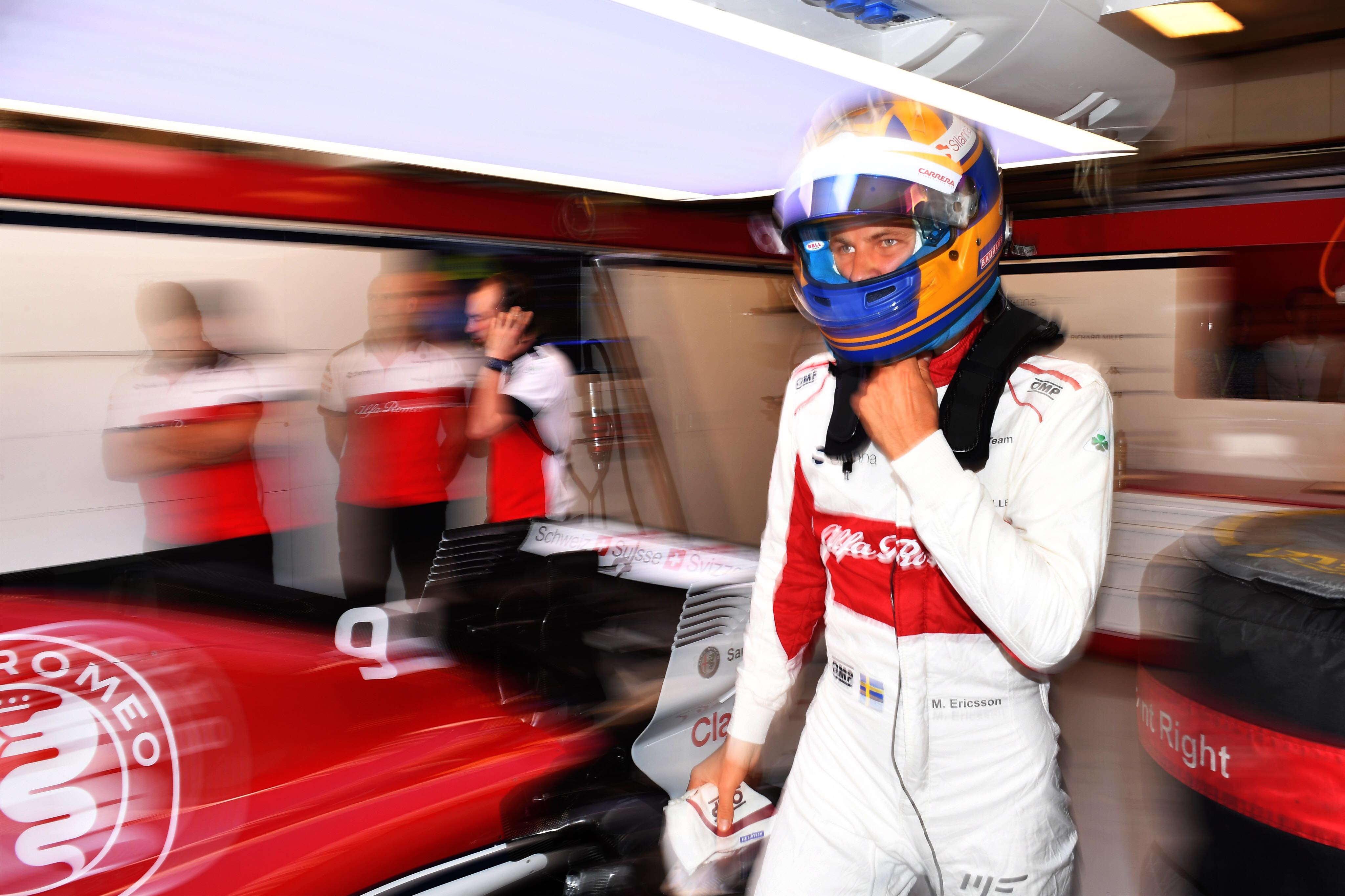
Alfa Romeo Sauber F1 Team
The Halo:
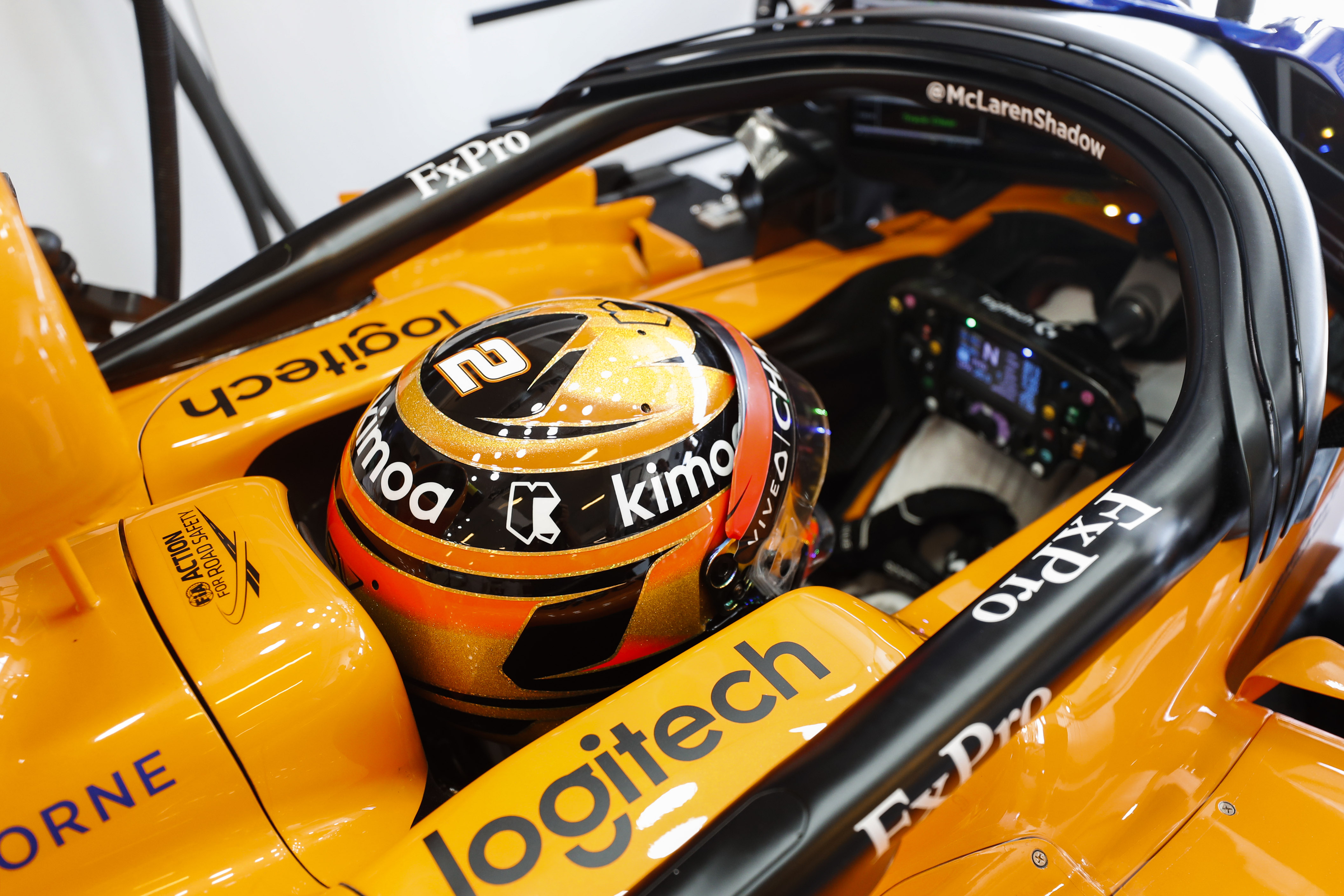
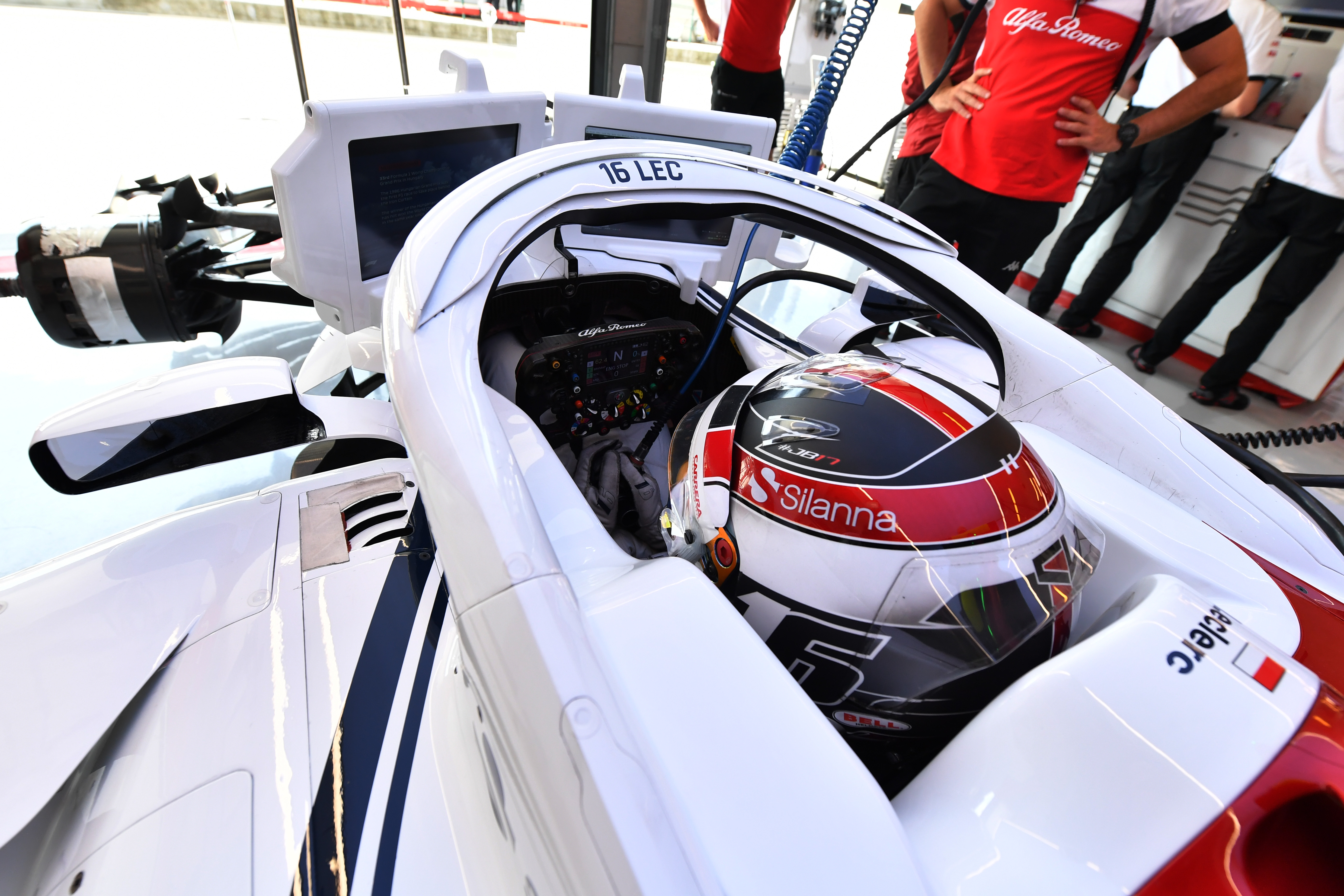
The Halo is a new feature for 2018, and it is being steadily introduced across all FIA-sanctioned series’.
The Halo is designed to prevent debris from hitting the driver in the head. The late Jules Bianchi’s crash was cited, and if a car comes into contact with a recovery vehicle, the Halo is thought to be able to prevent the head hitting the vehicle.
Pirelli Media
Wheel tethers:
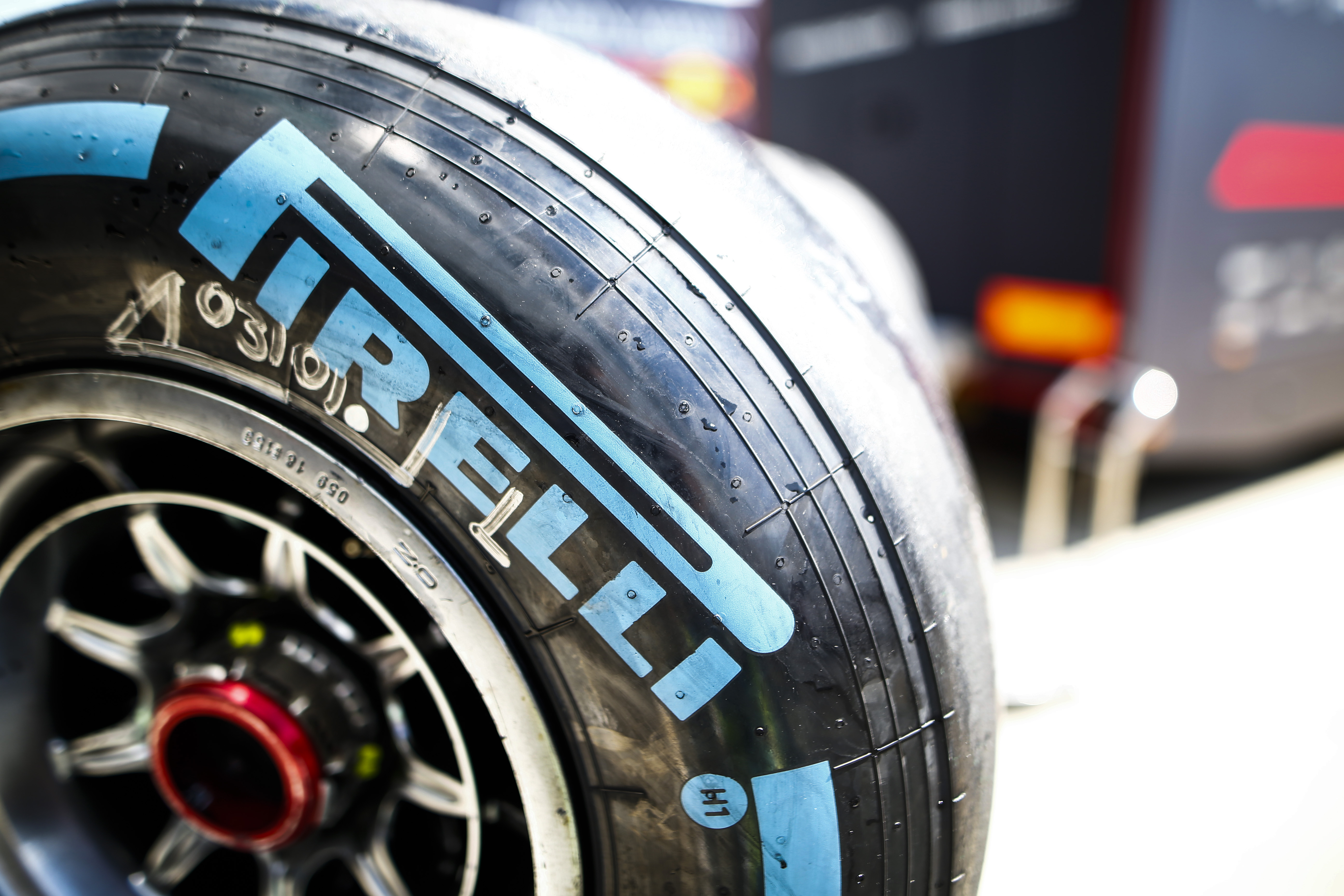
F1 now has much stronger wheel tethers than it did before, which greatly reduces the risk of wheels flying off during a crash.
In 2009, Henry Surtees tragically passed away when he was hit in the head by a flying wheel following a crash during a race. The wheel tethers now are designed to hold on to the wheel even during extreme impacts, so that there is much less chance of a wheel hitting someone’s head following a crash.
Pirelli Media
Barriers:
The cars are not the only things designed to keep drivers safe during crashes. Tecpro barriers were introduced to F1 several years back to help absorb the impact when a car hits it, rather than spitting the car back out again like metal barriers do.
Tecpro barriers provide more of a cushion for the car and the driver, so as to provide extra protection during a crash.
Pirelli Media
Crash tests:
Every year when a team releases their new car, the FIA runs extremely thorough crash tests to make sure the car can survive high speed crashes, and that they will provide the correct protection for the driver in the event of a crash.
The team will not be allowed to run their car on track until they have met all the criteria in the crash test.
The Head and Neck System (more commonly referred to as the HANS device) is often overlooked in the world of modern Formula One. Its historical significance, though, should not be underestimated, not least because at the time of its introduction it was one of very, very few occasions in F1’s history up to that point where the FIA had reacted to a non-fatal accident.
Photo credit, Dan Istitene / Getty Images / Red Bull Content Pool
The accident in question occurred at the 1995 Australian Grand Prix, hosted at the popular Adelaide circuit. At one of the fastest points on the track, a rapid tyre deflation sent Mika Hakkinen – then in his third season in F1 – hurtling into the barriers. The impact was so extreme that his neck hyperextended, his skull was fractured, he swallowed his tongue, and he suffered major internal bleeding. He spent over two months in hospital – a significant amount of that in intensive care – but he eventually made a full recovery and returned to F1 for the 1996 season.
F1 drivers in that era were still sitting very high up in the cars with their shoulders often clear of the chassis, making them extremely vulnerable to head and neck injuries. It was this driving position, mixed with the fact that Hakkinen had nothing supporting his neck, which made his injuries so severe.
The HANS device was already in existence at this point, having initially being designed in the 1980s by Dr Robert Hubbard, but it was too bulky to fit into the narrow cockpit of a single-seater racing car, and he was unable to find sufficient financial backing to complete the necessary redesigns. Hakkinen’s accident, though, made the FIA realise its potential in terms of safety, and they offered to help in and fund its development.
Photo credit, Alfa Romeo Sauber F1 Team
The HANS device, because of Hakkinen’s accident, evolved into what it is today – a collar-type piece of carbon fibre that fits either side of the drivers’ shoulders, attached to mounting points either side of their helmets by two tethers and held in place by the seatbelts. In the event of a crash, these tethers stop the head from whipping backwards and forwards, keeping the neck in line with the spine and thus preventing it from hyperextending like Mika Hakkinen’s had. In addition, it helps to transfer the energy that would otherwise be absorbed by the head, into the stronger torso, seat, and the belts, reducing the strain put on the head.
Even today, head and neck injuries are still the leading cause of driver deaths regardless of category, and it begs the question just how many potential fatalities were prevented by the HANS device.
Hindsight, though, is a wonderful thing. When the HANS device was initially introduced, it was greeted with a very lukewarm reception. Many drivers claimed that it was cumbersome, uncomfortable, and might even cause more injuries than it prevented. NASCAR legend Dale Earnhardt even went so far as to refer to it as a ‘noose’. In a somewhat ironic twist of fate, Earnhardt was killed by a basal skull fracture in 2001, the forth NASCAR driver in the space of fourteen months to die of such an injury, one which the HANS device would have helped prevent.
Photo credit, Paul Ripke / Mercedes AMG
The National Hot Rod Association was the first series to adopt the HANS device, following the death of Blaine Johnson in 1996. In 2002, at the Italian Grand Prix, Felipe Massa became the first man to wear the HANS device during a Formula One race. The next year, in 2003, it became mandatory for drivers in any and all FIA series to wear the HANS device, at the risk of being disqualified from the event should they fail to do so. Some have claimed that Massa’s accident at the 2004 Canadian Grand Prix was the first example of the HANS device potentially saving a driver’s life.
Amid all the talk of Virtual Safety Cars and halos of late, it is easy to overlook the HANS device and the impact it has had on safety in motorsport. Before its introduction, even crashes that did not on the face of it seem that dramatic could end in tragedy. Yes, head and neck injuries may still be the leading fatalities of drivers, but the number of times the HANS device has prevented such an incident from happening is innumerable and worth its weight in gold. It has become a staple of motorsport safety, and in no way should it be taken for granted.
The Hungarian Grand Prix was the twelfth round of the 2018 Formula One season, meaning we are now over halfway through the year. All the teams will enjoy a well-deserved break for four weeks, which gives them the time to relax and maybe come up with some new ideas to improve the car and gives us the time to look back at this season before looking ahead to the Belgian Grand Prix.
After the Hungarian Grand Prix, Lewis Hamilton leads the drivers’ championship with 213 points, in front of rival Sebastian Vettel who has 189 points. Behind him are Räikkönen (146 points), Bottas (132 points), Ricciardo (118 points), and Verstappen (105 points), with Hülkenberg (52 points), Magnussen (45 points), Alonso (44 points) and Perez (30 points) closing the top ten in the drivers’ championship.
However, these numbers don’t tell the whole story. How did it come to these standings? How did each team perform this year so far? How did the drivers perform? Let’s take a look at that, team by team.
Mercedes
Currently leading both the drivers’ championship with Lewis Hamilton and the constructors’ championship, it would seem that Mercedes are on another dominant run. However, that is far from the truth. Mercedes are having a very tough season currently. Their season started mediocre in Australia as Hamilton ended in a solid second place (the VSC cost him a shot at victory), but Bottas only ended up in eight place after an awful qualifying.
In Bahrain things got a little better for the Brackley-based team, with Hamilton bringing home eighteen points with his P2 finish, whilst Bottas brought home fifteen points with his third place finish. The following races they scored some good points too, although a late drama in Azerbaijan cost Bottas a victory as he ran over debris and incurred a puncture.
Mercedes have so far achieved two 1-2 finishes, one at the Spanish Grand Prix and one at the German Grand Prix, with the latter meaning a lot more to the German team, especially because Hamilton started from fourteenth place and came through to win the rain-affected race.
A definite all time low this season for Mercedes came at the Austrian Grand Prix, where both cars failed to cross the finish line due to mechanical problems (just after they got an upgraded engine).
The team can go into the summer break buoyed by a victory in the Hungarian Grand Prix, courtesy of Lewis Hamilton. Bottas had a disappointing race in Hungary, though, as he made contact with Vettel and Ricciardo in the last ten laps of the race, costing him his front wing and resulting in a ten-second time penalty after the race.
Mercedes are still the team to beat, and it is most likely that if they continue like this Lewis Hamilton will become a five-time World Champion. Bottas looks out of the running for the championship battle, because of his bad luck early on this season.
2018 Großer Preis von Ungarn, Sonntag – Wolfgang Wilhelm
Ferrari
Someone else who is hoping to become a five-time world champion is Sebastian Vettel. In the first couple of races of the year it was the German who got away with a full complement of points. A very chaotic Chinese Grand Prix, however, ruined his winning-streak as he got hit by Verstappen. Vettel was spun and picked up some damage so he could only finish in eighth.
His teammate Kimi Räikkönen scored some solid points too with a third position in Australia and China, although he retired from the Bahrain Grand Prix.
Räikkönen will probably have to help his teammate in this fight – he got ordered at Hockenheim to let Vettel past. It was at that race where the biggest disaster this year so far took place for Ferrari, as Vettel crashed out of the lead of his home race in the rain. This very rare mistake from Vettel kept him from taking his first every victory at Hockenheim and, with the track’s uncertain future you wonder if it will even be possible for him to make up for it in the future. This meant he lost some important points, and with his rival Hamilton taking victory it meant Vettel lost the championship lead.
In the Hungarian GP Vettel crossed the line in second place, losing another seven points to his rival Hamilton, who took victory.
With the passing of Ferrari president Sergio Marchionne at the age of 66 just before the Hungarian Grand Prix the Italian team might lose some stability. Marchionne led Ferrari to become the team it is now and they are the closest they’ve ever been to a constructors championship since 2007. Let’s hope Ferrari can continue to fight Mercedes for the constructors championship and bring it home for Marchionne.
Red Bull
The Austrian team were the third-best team last year, and this year it is no different. They are not fast enough to regularly beat the Mercedes or Ferrari, but are much faster than Renault, Haas and McLaren in the mid-field.
Where Mercedes and Ferrari have a pretty stable point scoring record so far, Red Bull have had more problems. They have walked away from a race weekend with no points on two occasions this year. At the Bahrain Grand Prix mechanical issues ended the race of both Max Verstappen and Daniel Ricciardo, and the Azerbaijan Grand Prix ended up as a major disaster for the team as their drivers crashed into each other, costing the team valuable points.
However, there were still some very good moments for the Austrian team this season. In China Ricciardo took victory because of a brilliant strategy in what was a chaotic race, whilst Verstappen took victory at the team’s home Grand Prix at the Red Bull Ring, although they were helped by the DNFs of both Mercedes drivers. Ricciardo also dominated at the Monaco Grand Prix, even though he suffered some problems with the car during the race.
The team announced earlier this season that they will switch to Honda engines for 2019, and they hope this will make it possible for them to not just fight for the third position in the teams standings, but also for the first place.
For now though, they still have ten races to go with Renault engines. With circuits coming up like Mexico and Singapore there should be enough possibilities for them to get at least another victory.
Renault
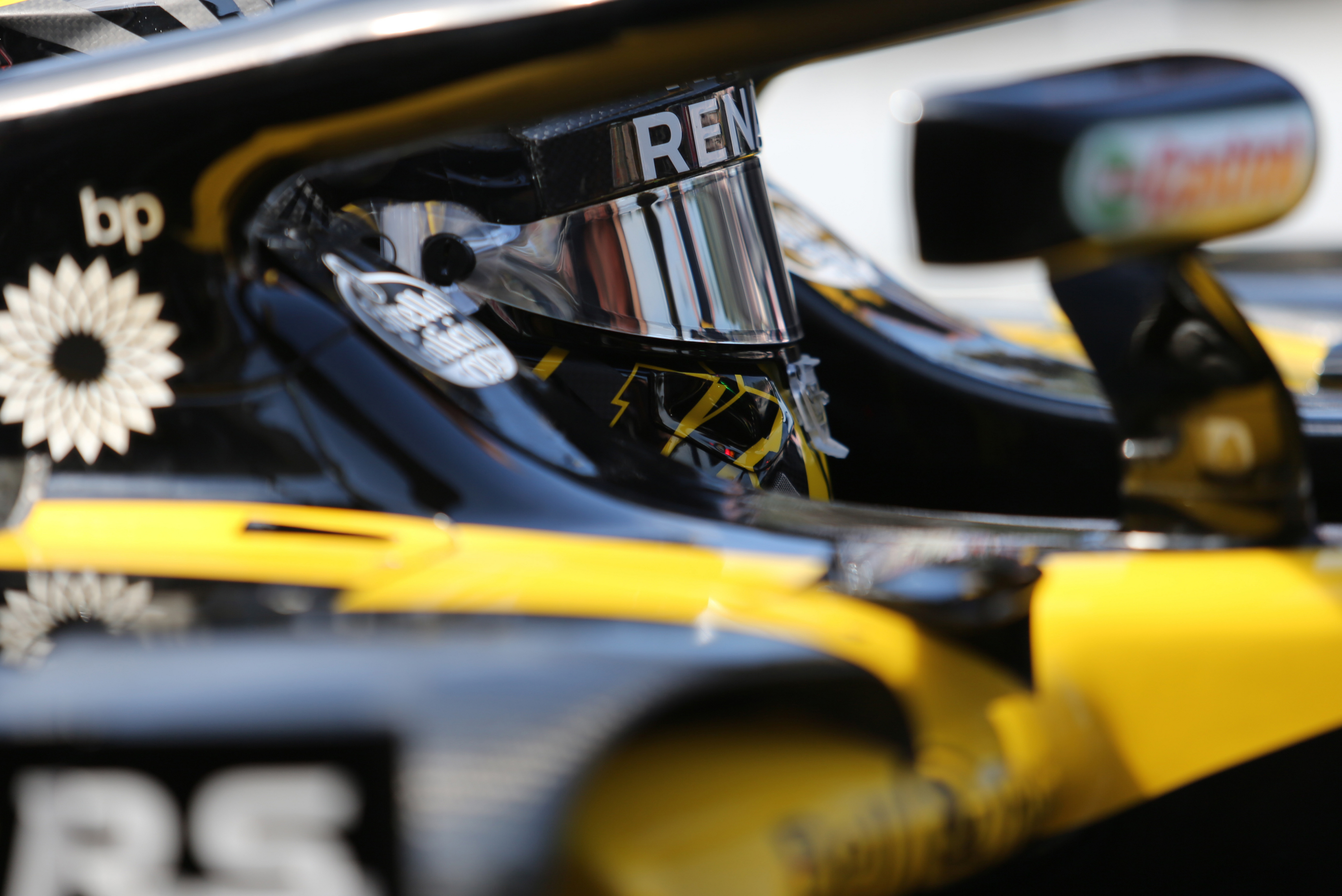
Best of the rest at the moment are Renault. The French team are currently embroiled in a tight battle for the fourth position in the constructors championship, with Force India, Haas and McLaren.
There has only been one race so far where they haven’t scored any points, which is a very impressive result for the French team.
Two fifth places are the highlights of the year so far, by Hulkenberg at his home Grand Prix at Hockenheim, and by Sainz at the Azerbaijan Grand Prix. The difference between the two teammates in the drivers’ championship, however, is big, with Hulkenberg on almost twice as many points as Sainz.
The fight for the constructors championship is still very much on, and Renault have to find improvements from Spa-Francorchamps onwards as their rivals are still on their tail.
Renault Sport F1 Team
Force India
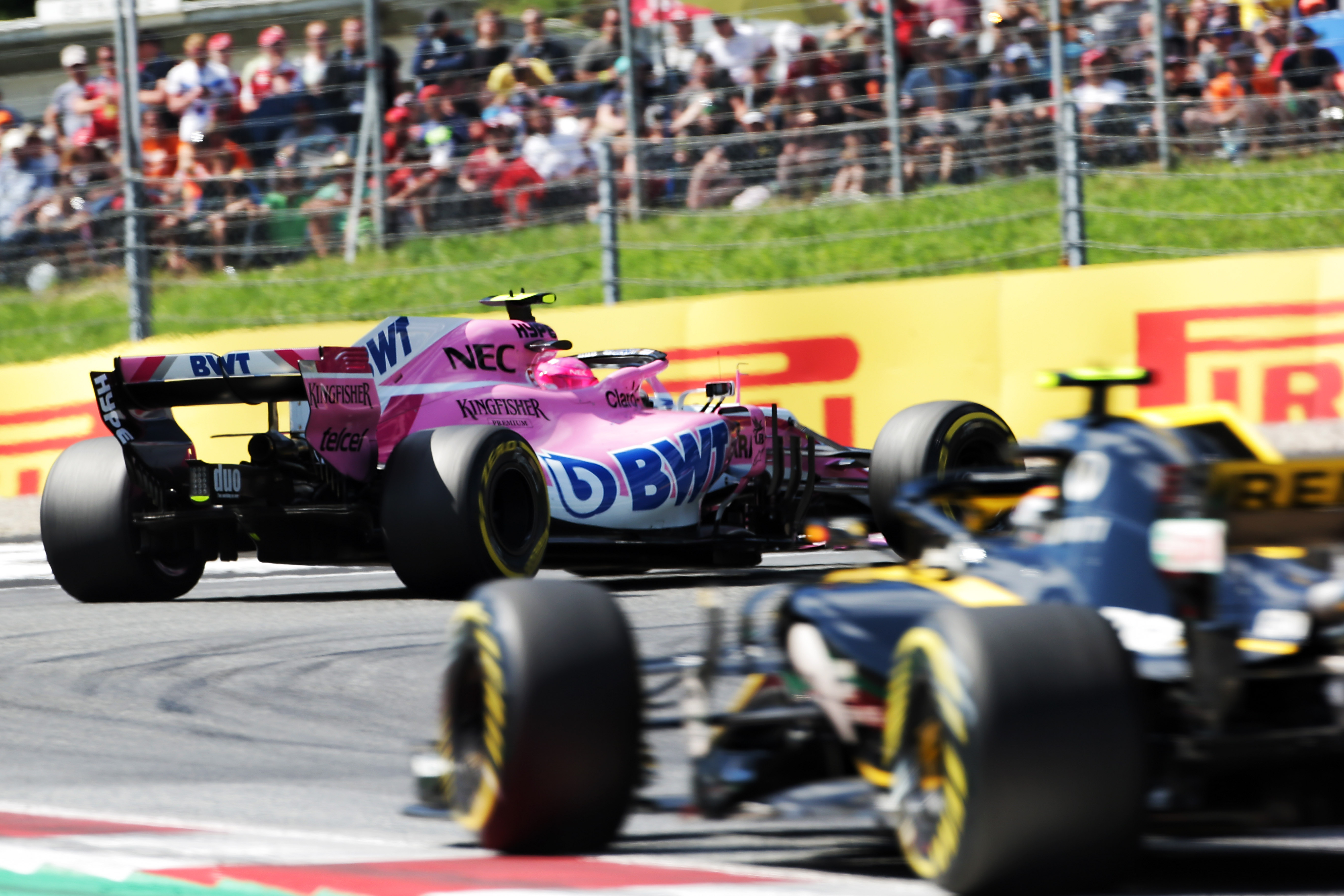
After a terrible qualifying at the Hungarian Grand Prix the gap to their main rivals at Renault only increased for Force India. The team really struggle to even get in the top ten regularly, and there have been three races so far where Esteban Ocon and Sergio Perez have not scored any points between them.
Their biggest points haul came from the Azerbaijan Grand Prix, where the team scored fifteen points in total, thanks to a spectacular third place for Perez.
Placed into administration over the Hungarian Grand Prix weekend, the team’s future is uncertain. Sergio Perez, his manager, BWT, and Mercedes want the money back Force India owes them, with Perez saying he brought action against his team to “save [them] and protect the 400 people who work there”. Now it is even a question whether they’ll start the Belgian Grand Prix or not. Let’s hope they can get out of trouble,as it would be a huge shame to lose such an amazing team.
Haas
Haas began the Hungarian Grand Prix equal on points with Force India. The so-called “second Ferrari” team started the season very promising at the Australian Grand Prix after an impressive qualifying. The race, however, ended in a horrible nightmare as two identical mistakes at the pit-stops of both Romain Grosjean and Kevin Magnussen meant they had to retire.
At the Austrian Grand Prix they once again put in an impressive qualifying and followed that up with an even more impressive race in which they scored twenty-two points thanks to a fourth place for Grosjean and fifth place for Magnussen.
After a pretty good Hungarian Grand Prix the team jumped to fifth in the constructors championship, leaving Force India behind.
The team seem to have found pace this year. Of course not all races ended well, but for a relatively new team they are surely proving what they are capable of. Can they keep up their good performances for the upcoming nine races?
McLaren
After years of disappointment due to problems with the Honda engine, this year could finally have meant the Woking team could fight for the podiums.
Now driving with a Renault engine, they were immediately aiming to fight the Red Bulls. At the Australian this looked very much possible, with Alonso finishing in P5 and saying “now we can fight!’”. Vandoorne ended that race in ninth, a nice result for McLaren then, scoring almost more points in one race than in the whole of last year. The dreams of fighting the Red Bulls continued when they finished the Bahrain Grand Prix in seventh and eighth.
Unfortunately, these dreams were shattered from Monaco onwards, where the pace had seemingly vanished and the points almost became out of reach. At the Monaco, Canadian and French Grand Prix the team scored no points, mostly because of retirements (Alonso had DNFs in all these races).
The highest position they achieved after these problems was P8 in Austria, Great Britain and Hungary, all thanks to Alonso. Team-mate Vandoorne was lacking pace, even losing almost a full second to Alonso at the qualifying for the British Grand Prix, and he had to retire from the Hungarian Grand Prix from what would have been a ninth-place finish.
The Renault engines have not brought the real change the team were hoping for. It even looks like the team are struggling more than ever, as qualifying pace is way off and results in the races are disappointing for such a great team. Maybe the summer break will bring the change they desperately need.
Steven Tee/McLaren
Toro Rosso
Currently standing eighth in the constructors standings with just twenty-eight points, the team will not be happy.
Brendon Hartley in particular has just had no luck. This became especially clear when he crashed heavily during free practice at the British Grand Prix due to a suspension failure. Two days later, he had to retire from the race after just one lap as the team found a problem with the car.
Seven races out of the twelve so far have yielded no points. When they have gotten into points though, the results have been very impressive. Gasly got P4 at the Bahrain Grand Prix and P6 at the Hungarian Grand Prix.
Hartley has just two points to his name, whilst Gasly brought home twenty-six points. The Kiwi’s future is uncertain because of his disappointing results, but a lot has been due to problems out of his control.
Alfa Romeo Sauber
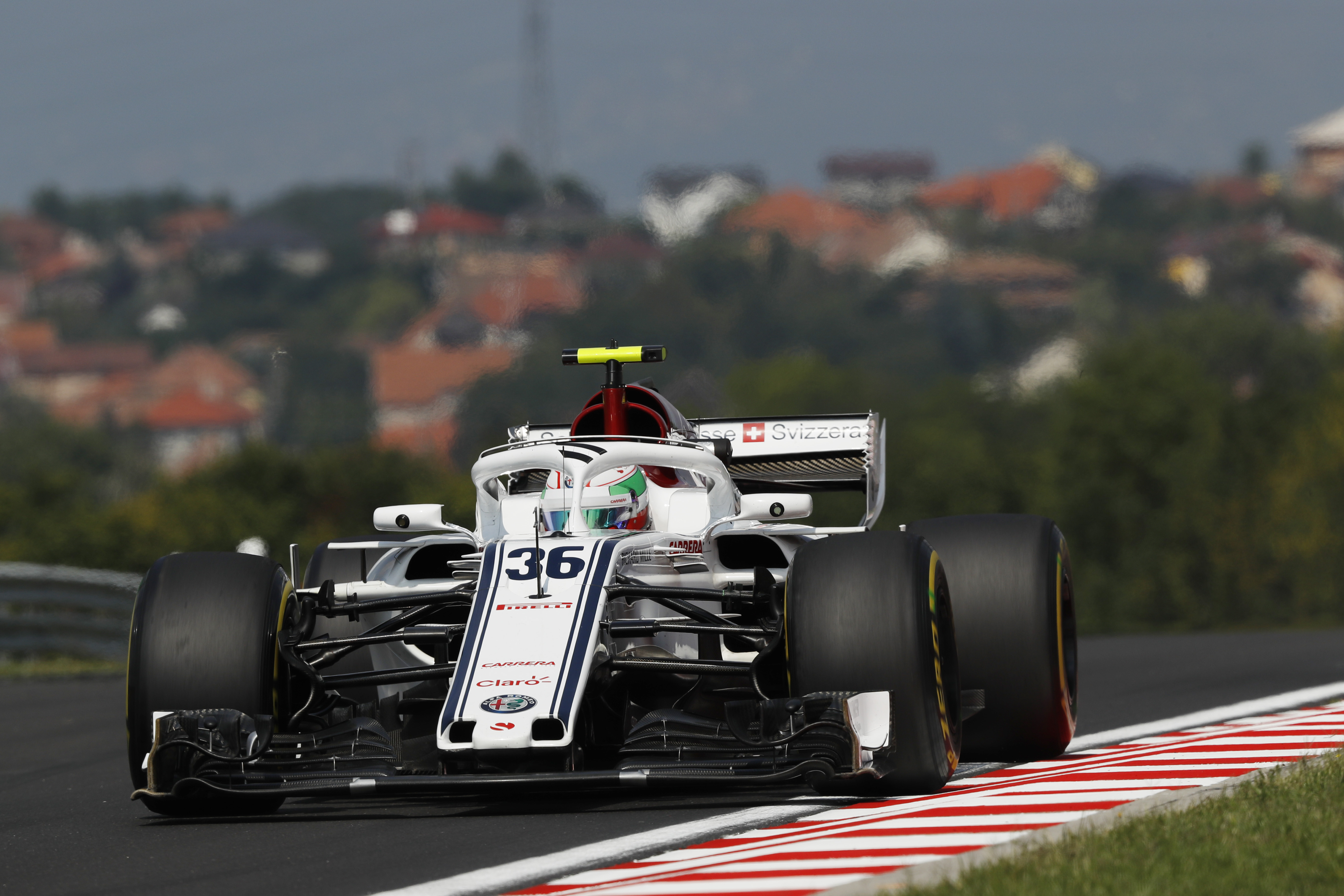
One driver showing his potential this season is Charles Leclerc. The Ferrari Driver Academy driver from Monaco just keeps on impressing everyone. With a car that shouldn’t regularly finish in the points, he got himself two consecutive points finishes in Baku and Spain. His sixth place in Baku definitely was a highlight for the team, bringing home eight very important points for the team. He even held up Alonso in Spain in a tense battle in a race where he finished in tenth place.
His teammate Ericsson has improved himself. Seemingly motivated by the speeds Charles has shown, he now too scores points from time to time. With five points for the Swedish and thirteen points for Leclerc, the team are now ninth in the constructors championship.
The last few races Sauber were able to out-qualify McLaren, and even in the races they have showed they have the pace to fight for position. Hopefully they are able to continue this fantastic performance.
Williams
It has been an absolute nightmare for Williams so far. Eleven of the twelve races resulted in zero points for the team, leaving them last in the championship. The only points they have managed so far were the four points Lance Stroll achieved because of his eighth position at the Azerbaijan Grand Prix.
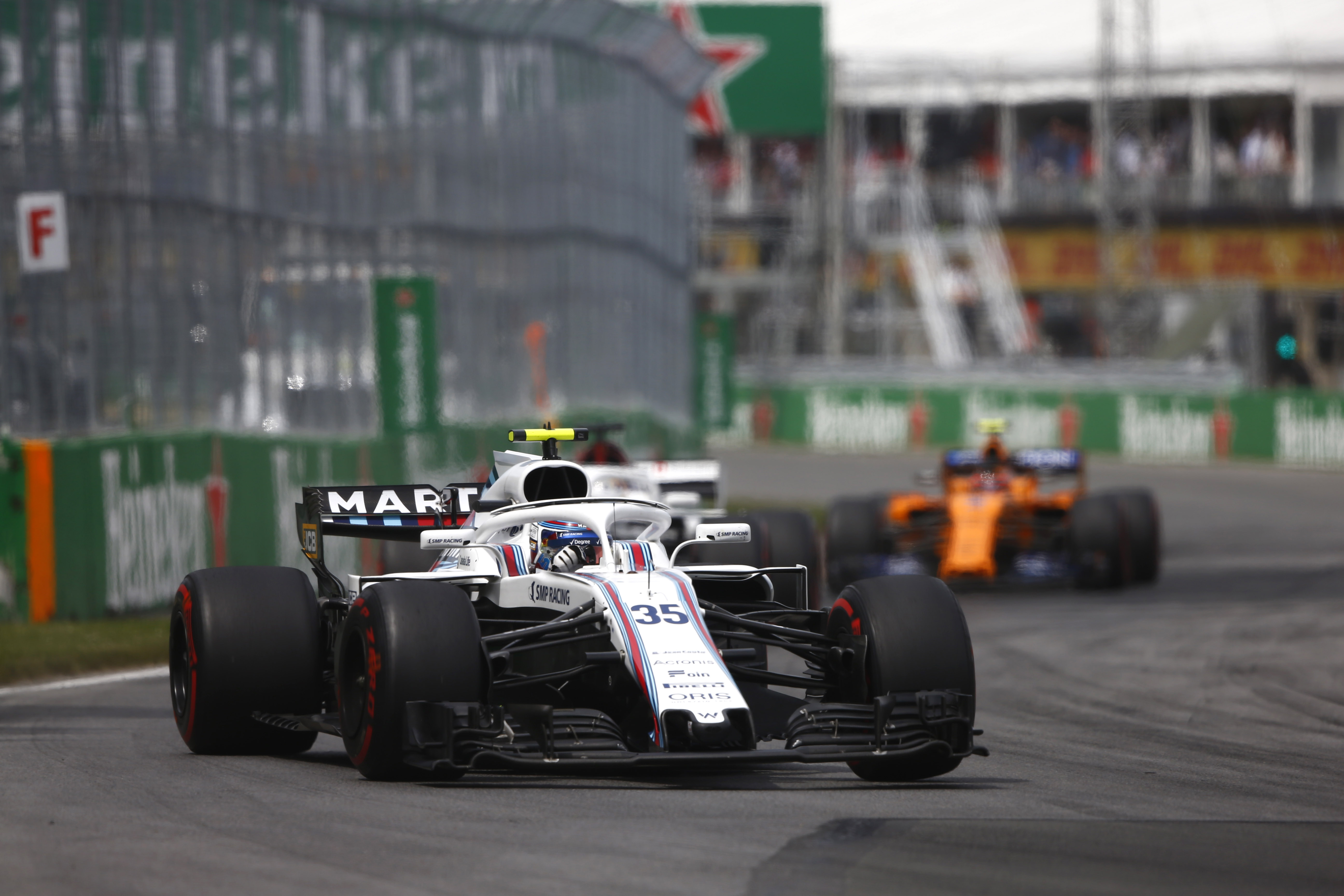
Even Robert Kubica, test driver for the team, said it is “embarrassing” to drive the car. Newcomer Sergey Sirotkin, while showing a few flashes of pace, doesn’t seem to be able to build up any momentum.
Williams has lots of work to do if it wants to score some points after the summer break. If they don’t, they will be hoping for another chaotic race like Azerbaijan, otherwise the points will be scarce.
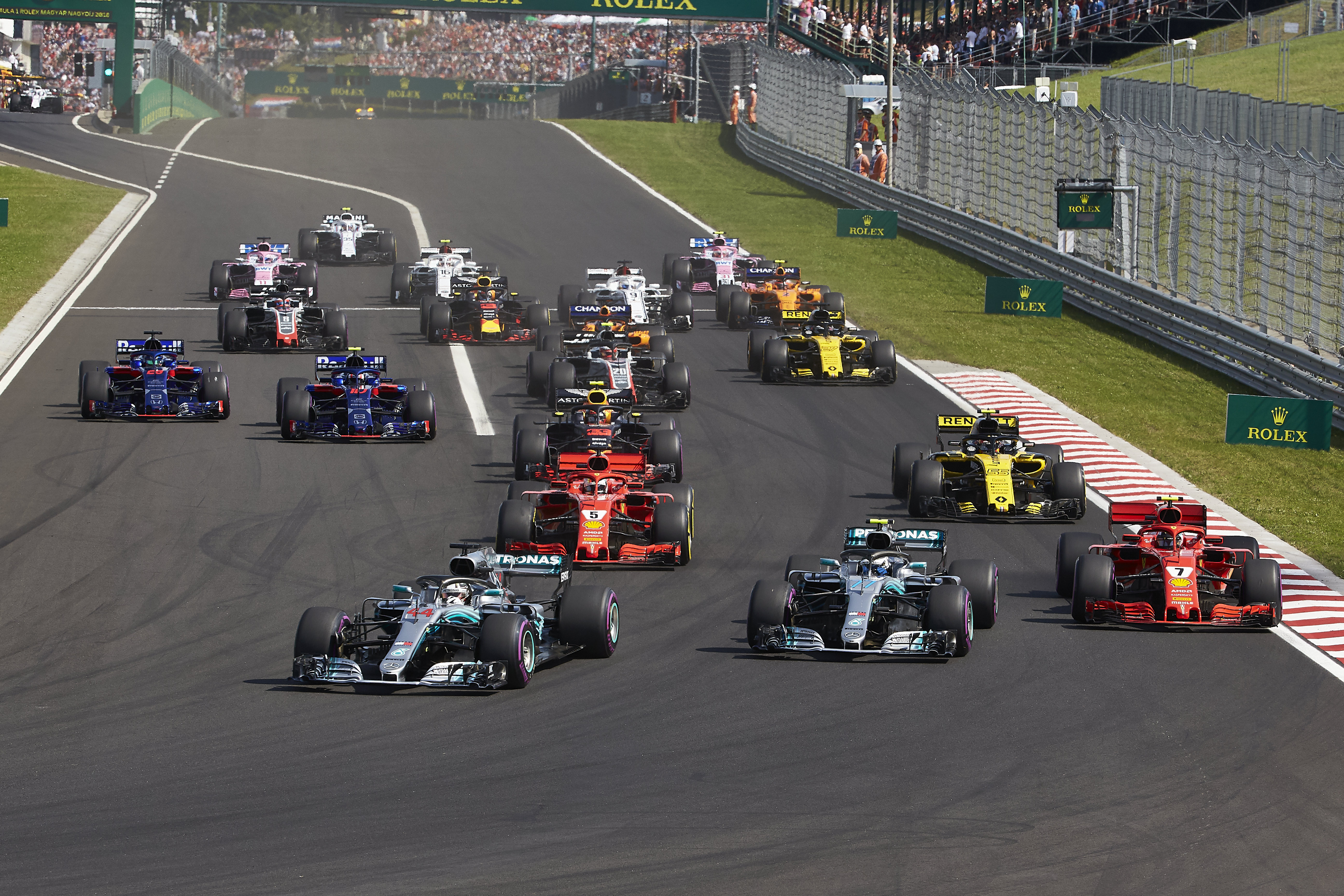
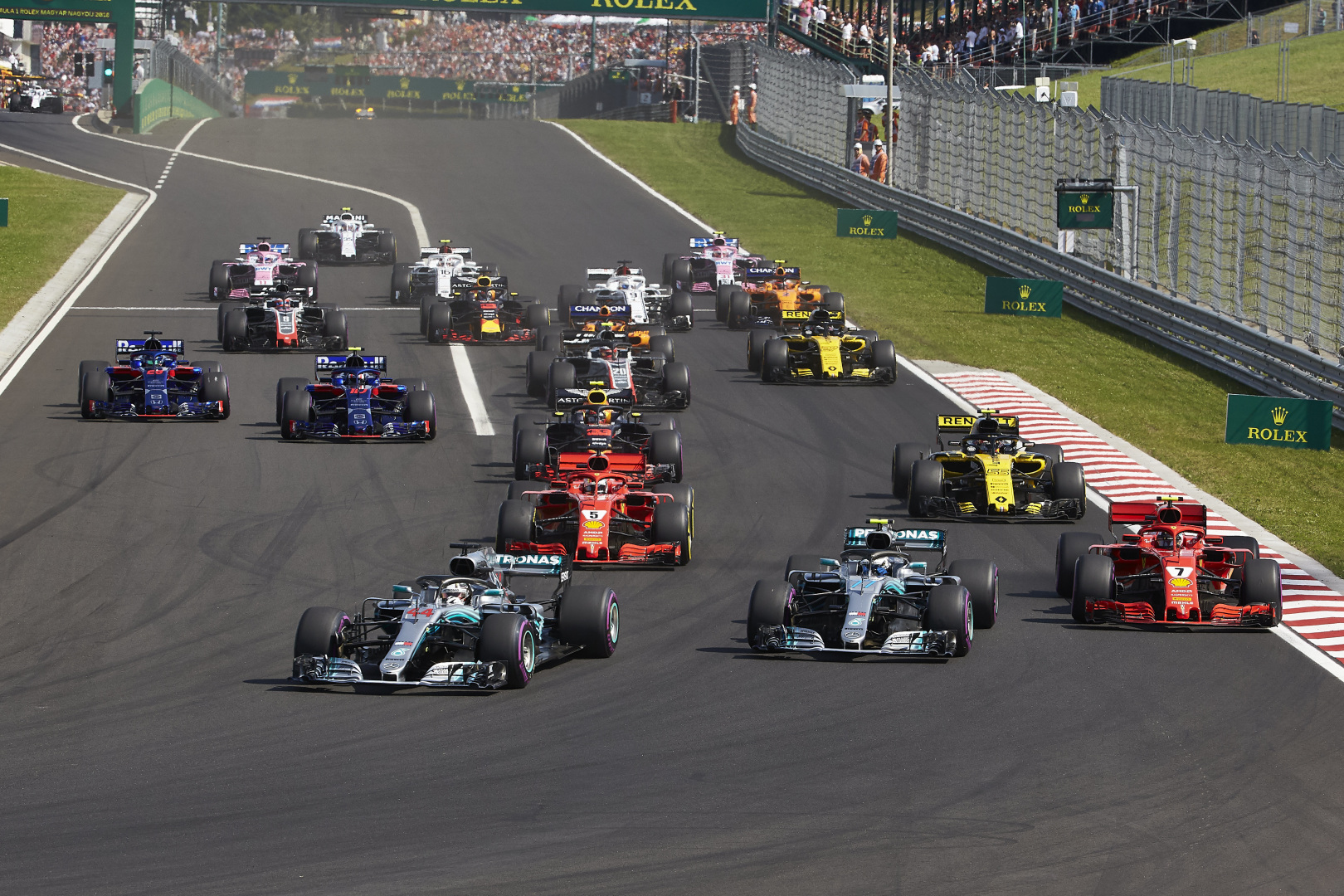
The last race before the teams could enjoy the summer break took place at the Hungaroring, on the outskirts of Budapest. The twelfth round of the season started very interesting with a spectacular wet qualifying. The starting grid was thus very shaken up, with Toro Rosso in P6 and P8. Carlos Sainz started from fifth, while Red Bull were disappointed with P7 and P12. Force India were disappointed as well, with neither driver making it to Q2. Lewis Hamilton took pole in front of his teammate, with Kimi Räikkönen following in third ahead of Sebastian Vettel.
A wet qualifying meant that all teams were free to choose on what dry tyre to start the race on. Both Mercedes drivers started on the ultrasofts, while Vettel chose the softs and Raikkonen chose the ultrasofts.
The start went well for Lewis Hamilton and he maintained the lead, while Bottas kept second. It was behind them where a change took place as Vettel overtook his teammate Räikkönen into turn two. By the end of the first lap there was already one retirement. Charles Leclerc was forced to bring his car to a halt after flying debris from contact between Ricciardo and Ericsson ahead of him damaged his radiator.
On lap six, Max Verstappen pulled over to the side of the circuit, telling his engineer over the radio that he had no power. He sounded very angry and disappointed, with the spotlight once again on Renault after yet another forced retirement. His expletive-filled message made sure that FOM had a busy time censoring it. It was reported that the problem lied within the MGU-K, meaning he might have to take a grid penalty at the Belgian Grand Prix.
On lap fifteen Kimi Raïkkönen was the first to make a pit stop. He went from the ultrasofts to the softs, which meant he was probably going for a two-stop strategy rather than a one-stop. The stop took a bit longer than normal, because there was some rubber stuck in the brakes that the mechanics had to remove. He emerged in sixth, in front of Sainz and Ricciardo.
2018 Großer Preis von Ungarn, Sonntag – Wolfgang Wilhelm
Valtteri Bottas responded to Raikkonen’s stop by going to the soft tyre a lap after his fellow Finn. That same lap, Ricciardo finally got past Sainz, and he set about chasing down Raikkonen and claiming the fastest lap as he did so. Vettel was losing time to Hamilton, and by lap nineteen the gap had opened up to almost nine seconds.
On lap twenty-two Ferrari told Vettel over the radio that they had switched to ‘plan C’. He began to close the gap, but a mistake on lap twenty-three meant he lost all the time he had gained.
McLaren were struggling for pace, with Alonso and Vandoorne fighting for eleventh place. Hamilton stopped for new tyres on lap twenty-six, changing from the ultrasofts to the softs. Could he make it to the end on these tyres?
Daniel Ricciardo meanwhile was fighting against Gasly. The Honda-powered Toro Rosso looked strong, but the Australian lunged down the inside at turn one and taking fifth place, although he had yet to make his pit stop.
Mercedes told Bottas that Vettel was probably going for another fifteen to twenty laps on his softs, and that the German was being held up by traffic.
After thirty-five of the seventy laps, Vettel was leading with a 12.5 second gap to Hamilton, who had a gap of twelve seconds to his teammate behind. Räikkönen was fourth, followed by Ricciardo, Gasly, Alonso, Vandoorne, Magnussen and Ocon completing the top ten.
On lap thirty-nine Ferrari mechanics brought Raikkonen in for a second pit stop, opting for another set of softs. A lap later Vettel pitted for his first stop of the race, choosing the ultrasoft tyres so he could try and attack the Mercedes duo. The pit stop was a bit slow, and he re-joined one second behind Bottas.
Daniel Ricciardo went to a set of ultrasoft tyres with twenty-five laps to go. He was sitting comfortably in fifth place, with a gap of fourteen seconds to Kimi ahead and twenty-two seconds to Gasly behind.
On lap fifty-one a yellow flag was brought out for Vandoorne, who had to retire the car because the gearbox was gone. This yellow flag resulted in a Virtual Safety Car, but Hulkenberg was the only one who used it to make another pit stop.
With fifteen laps to go the battle between Vettel and Bottas was heating up, as Vettel got into DRS range. Ferrari reported to Vettel that Bottas was struggling with his tyres, and to continue to put pressure on him.
2018 Großer Preis von Ungarn, Sonntag – Wolfgang Wilhelm
In the closing laps it became a three-way fight for P2, with Raikkonen having joined the fray, although it was clear that Räikkönen was not allowed to make it difficult for his German teammate. Over the radio Vettel was asked by his engineer how fast he could go. In response, he said he could go half a second faster but it was impossible as he was still stuck behind Bottas.
On lap sixty-five Vettel tried the overtake on Bottas, going around the outside of the Finn at turn one to get a better exit. He was in front of Bottas going into turn two and closed the door. Contact between the two, as Bottas clipped the back of Vettel, damaged the front wing of the Mercedes. Replays suggested Bottas braked too late, and that it was no more than a racing incident.
Bottas dropped back as a result, and found himself fighting with Ricciardo for fourth. By lap sixty-eight Ricciardo was in DRS range and tried to overtake Bottas around the outside of turn one, but it once again ended in disaster as Bottas ran a bit wide, making contact with Ricciardo’s sidepod and pushing the Australian wide.
Mercedes advised Bottas to let Ricciardo pass in the hope to avoid a penalty afterwards. He did get a ten-second penalty after the race, but he kept his fifth place because the gap to Gasly was big enough. He also received two penalty points.
Up front, Hamilton took victory, with Vettel and Räikkönen completing the podium. Bottas finished in fifth place after letting Ricciardo pass. Behind him, Gasly, Magnussen, Alonso, Sainz and Grosjean completed the top ten.
Hamilton now leads the championship with 213 points, and Vettel follows with 189 points. Meanwhile a Finnish battle for third place is on, with Räikkönen on 146 points and Bottas on 132 points.
Now the summer break finally has arrived. In four weeks time Formula One will return to the Ardennes forests for the Belgian Grand Prix at Circuit de Spa-Francorchamps, a fan-favourite track and loved by the drivers. Let the fight for the championship go on.
Featured image – 2018 Großer Preis von Ungarn, Sonntag – Steve Etherington
Last weekend’s German Grand Prix opened with the unsurprising news that Lewis Hamilton and Valtteri Bottas would be remaining with Mercedes for the next year and beyond.
Coming just before the summer break, Mercedes’ announcement is set to kick-start what has so far been a slow-building driver market for 2019. Daniel Ricciardo is expected to remain with Red Bull, while the current paddock word is that Ferrari will hand Kimi Räikkönen another year’s extension.
But with the top teams entering a holding pattern, what does that mean for any potential moves elsewhere on the grid?
Sahara Force India F1 Team
Force India, Renault now key to the midfield
With the grid’s top six seats filling up, all eyes are turning now to Force India, Renault and Esteban Ocon.
Despite Force India holding an option on Ocon’s services, Mercedes has been trying to place their young Frenchman at Renault next year to safeguard his career against the financial and legal troubles plaguing Force India. It’s unclear whether this switch will still go ahead now that Force India is no longer facing a winding up order, but the consensus is that it’s still on the cards at least.
If Ocon does make the move it will be at the expense of Carlos Sainz, even though the Spaniard will be free to commit to Renault long-term once Ricciardo blocks off the final Red Bull seat.
Force India could have another vacancy to fill, with Sergio Pérez on the shopping list for Haas. If there is a seat free at the Silverstone-based team, Lance Stroll will be at the front of the queue to take it with help from his father’s backing. Stroll is also said to be keen on bringing Robert Kubica with him from Williams, to act as his benchmark and mentor, should both Force India seats open up.
Andrew Hone / Williams F1
Williams and McLaren fall into place
With Stroll almost certain to switch to Force India, that leaves an opening at Williams. And despite that seat being arguably the least attractive on the 2019 grid, Williams does still have a few options to fill it.
The first is Kubica (if there’s no room for him at Force India), who would provide Williams with a relatively consistent lineup as they try to escape their downward spiral. Mercedes junior George Russell is also in the frame, and would bring with him a discount on the team’s power units to offset the loss of Williams’ Stroll and Martini funding. (Russell also has the added perk of being Williams’ first full-time British driver since Jenson Button in 2000.)
McLaren will also be keeping an interested eye on the Force India/ Renault situation as they look to finalise their 2019 lineup over the summer break. Fernando Alonso looks likely to stay with the team for another year at least now that their IndyCar talk has cooled, although Stoffel Vandoorne’s McLaren future is far less certain.
Early season reports had Lando Norris as sure to replace Vandoorne for next year, but a midseason F2 slump has put Norris’ F1 promotion into doubt for now. Sainz’s contractual limbo has moved him into play for the second McLaren seat, arguably the most competitive option open to him if he is forced out of Renault. Kubica has also been touted as an outside contender.
Alfa Romeo Sauber F1 Team
Few options for Red Bull and Ferrari juniors
The deadlock at the top of the grid means that there isn’t much upward movement available for the likes of Pierre Gasly and Charles Leclerc. The latter has been linked to Grosjean’s Haas seat lately, but there seems little sense in Ferrari switching Leclerc from one midfield team to another for the sake of it—given his trajectory, it would be better to see how Leclerc develops in a sophomore year at Sauber.
Leclerc staying put rules out a Ferrari-backed Sauber placement for Antonio Giovinazzi—with one of the Scuderia’s juniors already in the team, Sauber is more likely to either keep Marcus Ericsson for a fifth season or pick up Vandoorne from McLaren.
As for Red Bull’s academy team, the likelihood of seeing a brand new face replacing Brendon Hartley is slim. Red Bull may want F3 protege Dan Ticktum in the car, but his lack of superlicence points is an obstacle the FIA won’t be willing to overlook—so too is the case for Honda juniors Nirei Fukuzumi and Tadasuke Makino.
Featured image by Steve Etherington, courtesy of Mercedes AMG
Well, I’ve been here five years. I started out in the customer engineering department, spent a couple of years there, I was working with Nassar Al Al-Attiyah, and we did WRC2 and we won that championship, did a couple of years in the Middle East. I then transferred over to the works team in 2015 and been there ever since. I worked with Elfyn these past years including last year in the D-Mack car and obviously this year as well, so that’s where we’re at really. With the works team, we actually quite a small team, we have a lot of responsibilities, not just the car, kind of spread out to other departments.
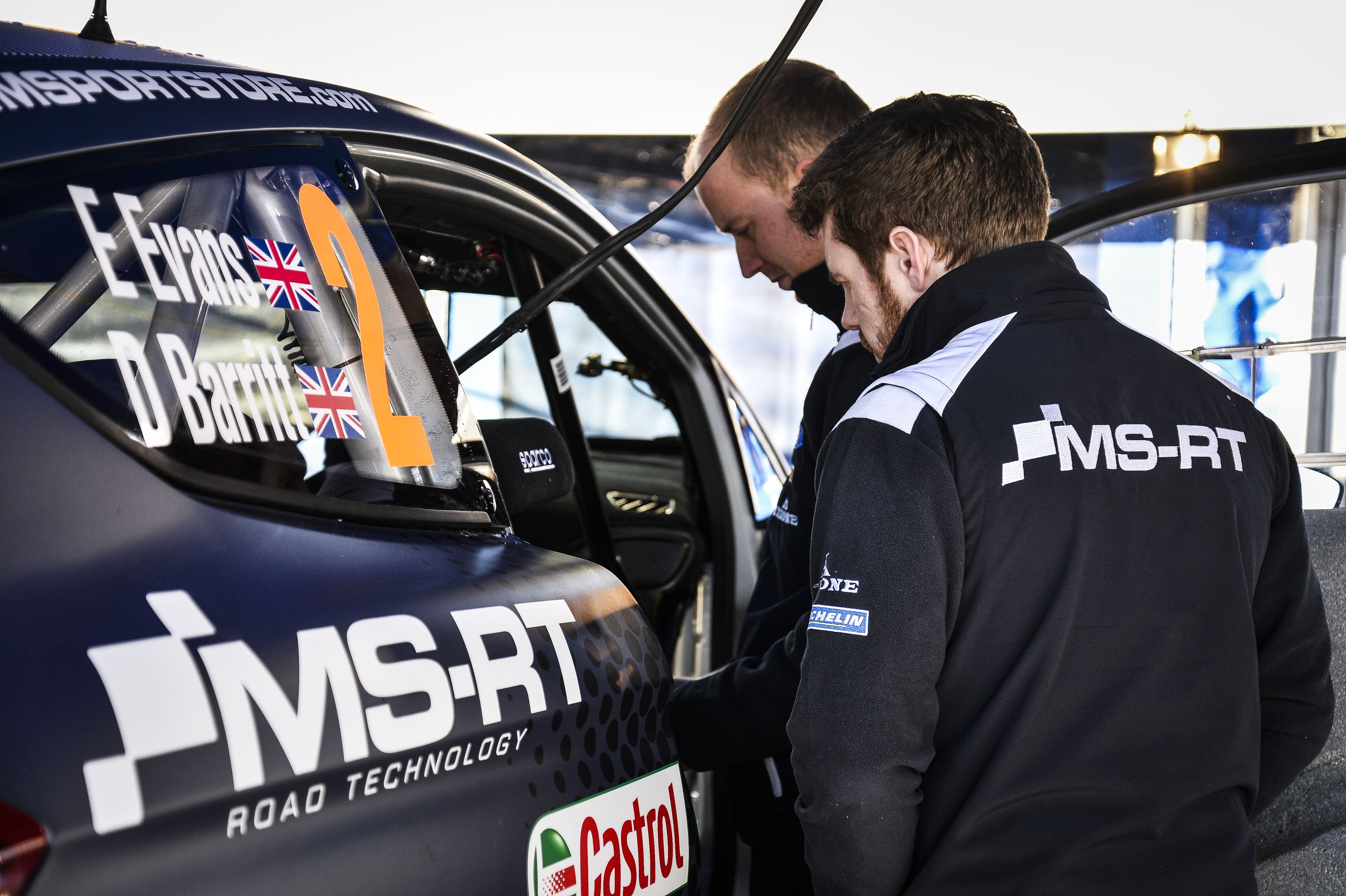
Chris Roberts is the furthest from the camera – M-Sport engineer to Elfyn Evans and Dan Barritt / FIA WORLD RALLY CHAMPIONSHIP 2017 -WRC Monte Carlo (FRA) – WRC 24/01/2018 to 28/01/2018 – PHOTO : @World
Okay, well the reason for this call is to get a point from the safety aspects of the way the cars are constructed, how you tackle the events, from that safety aspect, keeping everything safe so they can go all out knowing it’s all safe.
Warren Nel
The first question is, in terms of the FIA, what kind of checks do they do on the cars, are there any inspections for the cars, before you enter each year?
Chris Roberts
Yes, the main inspections are during scrutineering at each event, so with the car being homologated the FIA expect you turn up with a design that is homologated, within the safety regulations. As a manufacturer, we actually self-scrutineer before the event.
The event scrutineers and the FIA technical delegate will arrive in the service park and will go to each manufacturer team and they will inspect simple things like fire extinguishers, they’ll look at the cut off switches and they’ll check the safety foam around seat and the doors, side impact structures, just very basic checks, but they expect us to self-scrutineer and present the car in a safe manner. Now one of my responsibilities is to liaise between the FIA and ourselves with regard to what we are going to seal at each event, be it engines, transmissions, whatever it is we are sealing and we present a scrutineering form for each car and that declares that part is safe to start the event.
If you then get caught at post event scrutineering, if that part of the car is found not to conform to the form, there can be penalties. There is a certain amount of trust from the FIA to the manufacturers as we present the car in a safe manner. Now, that is different for a customer team, so anybody who competes as a customer WRC or in the WRC2 or any of the support championships, they don’t self-scrutineer, they are inspected a bit more thoroughly, as I guess they have fewer resources, they maybe are not familiar with the regulations, so they have to present their car to the FIA and pass a series of tests before they start. In that respect, it’s easier for a manufacturer, but a lot goes into it, with homologating the car and so on.
W.N
In terms of the construction of the car, were there many changes to the cars, compared to the previous generation, other than the obvious things?
C.R
Yes, there was a big drive in fact. The main concern from the FIA was looking back to the mid 2000’s, the cars hadn’t really progressed from then to 2015, 2016, so in that ten-year period the safety side hadn’t really developed, so there was a bit of a push from the FIA and also the Global Institute for motorsport safety, which is an independent body that sits inside the FIA. So, going back to when they presented the new regulations in 2015, the FIA came up with a safety road map for the WRC.
The first thing presented to the teams, a proposal for safety enhancements as part of the new for 2017 regulations. Now each car is fitted with an accident data recorder and using statistical analysis they were able to see the highest ‘G’ impacts on the cars could sustain without having any injuries and if there was a threshold above which there were injuries to the crews and then they would work to increase that threshold by improving various aspects of the safety that’s when they started to present a proposal for new equipment, to change the design of the cars that means that incorporated new seatbelts and new side impact, new regulations on seats as well.
That was all the effort to increase the safety. Now the safety road map is something that all the teams are working towards, for 2017 we had to as part of the new regulations, the cars were wider and that allowed us to add 20% extra impact foam and this was in the door the carbon structure along the sill as well. As well as that we were able to introduce new regulations for the fuel tanks and we had to fit a medical light to the windscreen so that in an impact of over 25g the light switches on and any marshal that arrives at the car, if this bright blue light is flashing, then the crew will need medical attention.
W.N
Thinking then during an event, if there is any damage to the car during an event what happens there, obviously you’d try to fix it, but would the FIA come a re-inspect the car before it goes back out?
C.R
If it’s an impact that damages the safety cage, the FIA will want to inspect that. If it’s an impact that we deem we car repair, we’ll have to get the car re-scrutineered again during the rally2 service, plus if it’s an impact that we deem we can’t repair then at that point the FIA remove the seals that are on the body shell and roll cage and then when that shell is repaired and brought back into circulation, it will have to be re-inspected and sealed again.
We always have the FIA technical delegates around and they’ll always be checking if there is any damage to the roll cage. Effectively the roll cage can be damaged and repaired during an event. We can change parts of the roll cage if we need to, but if we do that it has to be with a piece that’s already been pre-inspected at the start of the homologation process to the car, we will present pieces of roll cage that aren’t assembled to the FIA and they will fit seals to them and those will be the only parts we can fit into the car.
W.N
How many pieces would you therefore be transporting to each event?
C.R
Well, I think we carry three full kits to each event, actually and they take up a lot of space. Certainly, since this new generation of car that came in at the start of last year (2017) we’ve never had impacts there, we’ve not needed to replace roll cage parts, but we’ve only had one large accident, which was with Elfyn in Mexico, and in that case the shell had to be completely rebuilt and that car hasn’t come back into circulation yet, so when that does come back in we’ll have to get it re-inspected and sealed again.
W.N
Now thinking of the safety crews that go into the stages, when are they mainly used?
C.R
They are mainly for tarmac events, and each crew has a safety crew and they don’t have to be a qualified person, but they tend to be. Obviously in Elfyn’s respect, it’s his dad, ex-WRC driver Gywndaf and Phil Mills and these guys have a timetable they have to follow when they go through the stages and that can be as close as forty minutes before the stage actually goes live and those guys would call back to the crews and engineering as well and then if they correct the notes they will pass those through the team back to the rally crew.
W.N
Of course, we saw Phil Mills sit in alongside Elfyn after Dan’s concussion which was caused by that high-speed roll during Mexico, so I asked Chris about this.
C.R
It’s something that I feel quite strongly about, I have strong views personally. The issue with the crews, when they get concussion is it maybe that they feel okay within themselves, or they may not feel they have concussion, but say in Dan’s case, he felt ill, he wasn’t sure if he could continue, so in that case the first point of contact between the team and the crew is myself or the car engineer, so it’s possible if you don’t have immediate medical assistance to basically diagnose possible concussion, you can end up with the crew speaking directly to the engineer, I don’t know if we can continue, and for me I think someone who has not qualified and should not have an opinion on medical issues and it shouldn’t really fall to the team or the engineer to make a decision if they should continue or not.
With Dan, it was a case that he felt a bit ill, and obviously didn’t know he was concussed, and we took a view that he had to seek medical assistance, but he did one more stage after the accident, a little super special before coming into service – so he actually went through another stage, a small stage, and the kind that you wouldn’t expect them to have another accident, but because there hadn’t been any kind of medical assistance where he was checked out, it’s possible they could have had another accident there, so for me I think that was a bit of a failing there in the safety system. I think that’s something that needs to be looked at. (Chris made it clear this was his own personal opinion).
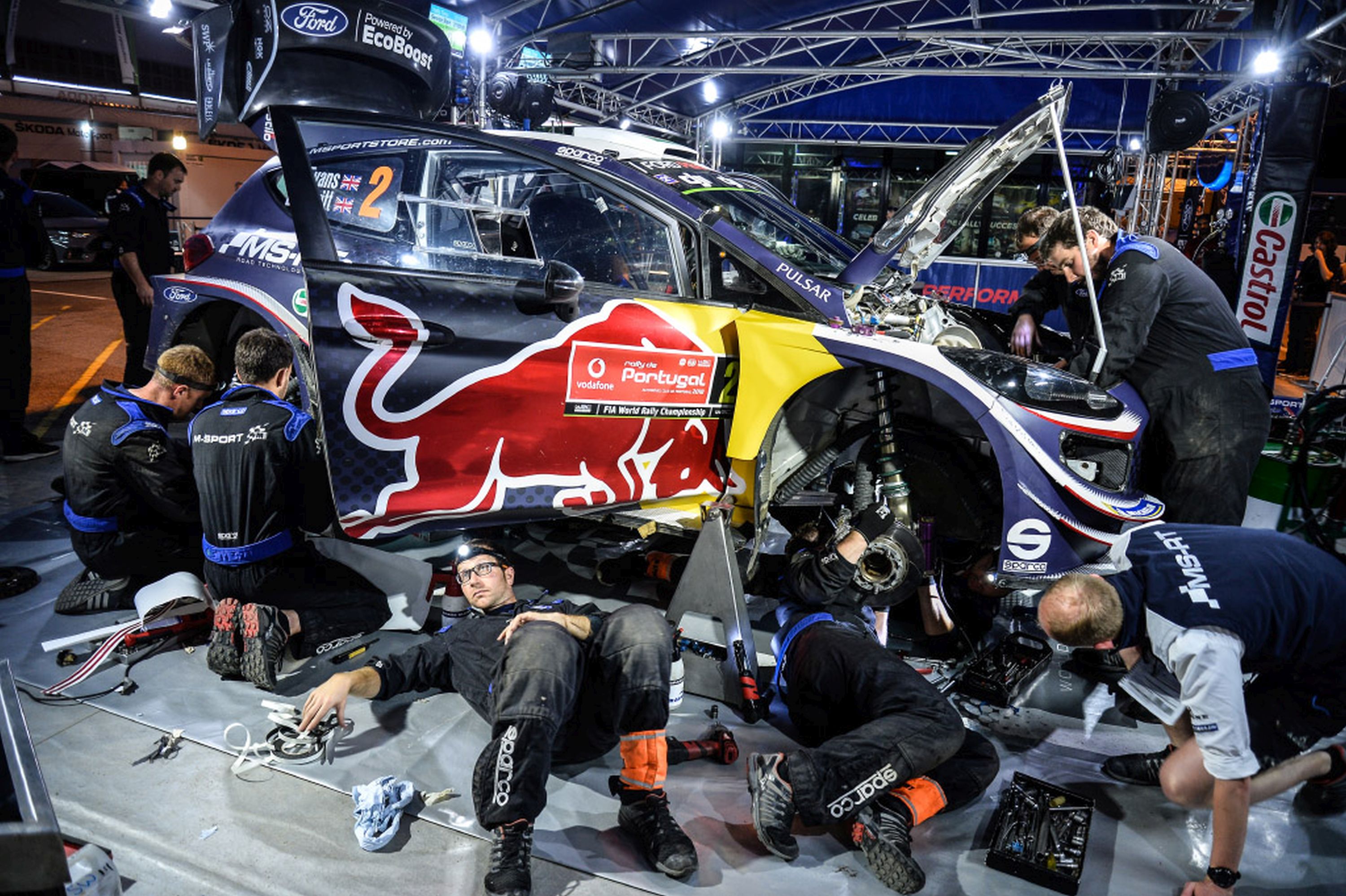
M-Sport mechanics hard at work. Photo credit Anna Rudd, M-Sport Ford
Chris also talked about Julian Ingrassia, who suffered concussion last year at Rally Finland.
C.R
They were both side impacts, which were between the head and the seat, which is an area the FIA are looking at, going forward and next year they are bringing in a new helmet standard for Formula One which is supposed to improve safety. We’ve not seen a rally version yet, but the intention of the FIA is back to the safety road map is that will be introduced next year. Hopefully that will reduce these concussions.
W.N
One more question for you then – When the recce is completed, do you sit down with Elfyn and Dan and discuss the stages?
C.R
Yes, we have a team debrief, and debrief just after the event with all the crews together, go through aspects of the cars performance, team performance as well. We’ll also give feedback to the team manager about how the event has been run, tend to do that as soon as possible after the event, so we’ll do that at four or five o’clock, Sunday afternoon.
Then after that we’ll conduct our test for the next event which tends to be a about a week later. Now with Elfyn in the UK, he sometimes comes up to the factory and we’ll sit down in the office and we’ll look at things in more detail, so in that respect it’s quite good that he’s only a few hours down the road, and we can get together and look at some things. Obviously, the relationship between the engineer and the crew is a close one. We are always in constant contact.
W.N
Finally, I asked Chris if there was anything he wanted to talk about additionally.
C.R
Well, we’ve got a few more safety things coming in the pipeline. Things being brought forward by the FIA. One area we’re working on with the FIA is the seat rails, integrating the seats into the bodyshell. We’re looking how these can bend and deform to take some of the impact away from the crew, and this is something which will be introduced for 2020 – that’s the seats themselves, the way they’re anchored into the shell.
For next year we’ll start using the Formula One biometric gloves, so basically the crew will wear these, and they’ll send real time data, actually measure blood oxygen levels, that will be sent to the FIA and the medical crew and if there’s been an accident, particularly an accident where the car has gone off the road and they can’t quite reach the crew, the medical crews will be able to assess the crew without being with the crew and this will be a good advancement.
One final thing which is being brought in is a high-speed camera, which is fitted into the cockpit and this means we can see the impacts and how the body is moving inside the car and that’s something that’s started being used in Formula One and we started testing that, with the intention to bring that in next year.
These are all good steps indeed to look after the crews and Chris said,
Rallying is a living environment, rather than a circuit, so has different safety requirements.
Finally, I’d like to say a big thank you to Anna at M-Sport for being so helpful in arranging this and to Chris a massive thank you for taking time out of his busy schedule to answer my questions.
Look out during this week for more articles from my colleagues about safety in motorsport.
Josh Cook at last years Snetterton race. Image courtesy of BTCC
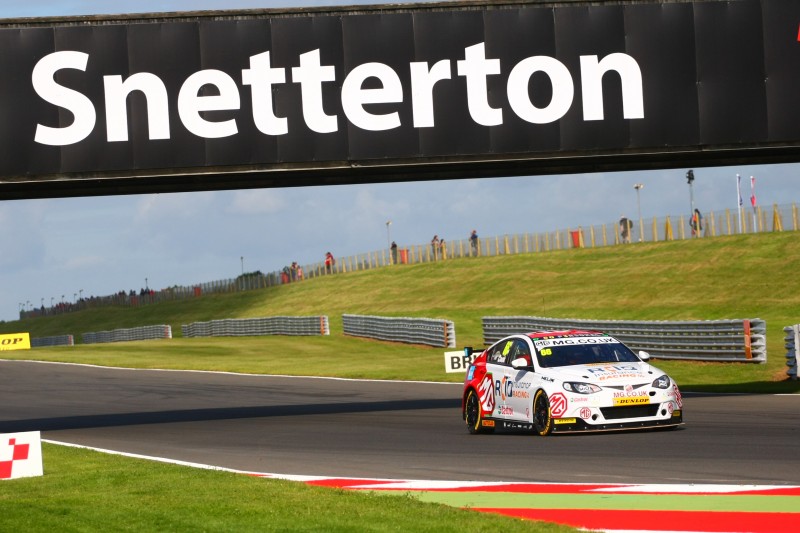
This weekend is the sixth meeting on the 2018 BTCC calendar, and also marks the sixtieth anniversary of the BTCC forming. There are numerous things to be discussed about the weekend, most notably the special ‘Diamond Double’ race, which is a mouth-watering prospect for both the drivers and their fans. First, however, let’s recap.
Recap
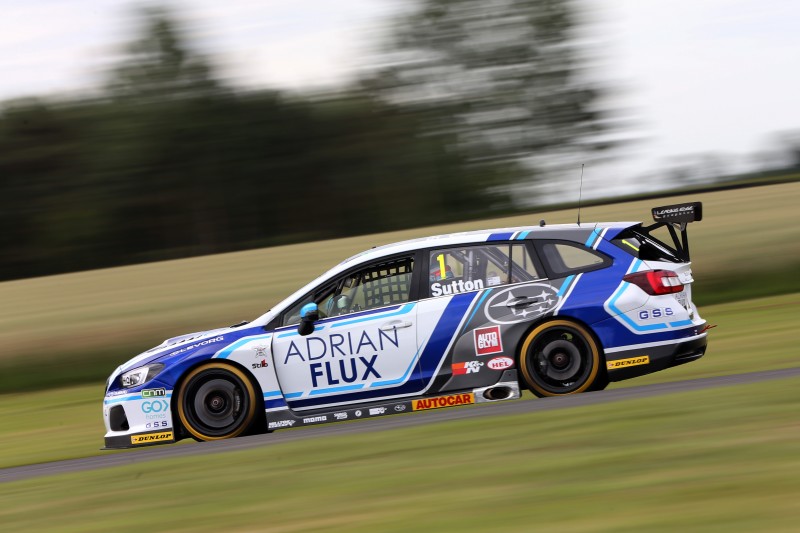
Last time out at Croft was a hectic event packed with action as well as a resurgence from the reigning champion Ash Sutton. Sutton scored his first win of the season in round thirteen and his second in round fourteen. Dan Lloyd took to the top step of the podium in round fifteen after benefiting from the reverse grid. Colin Turkington emerged from Croft as the championship leader, despite having only won a single race so far this year. The BMW driver, however, has finished on the podium an impressive five times, showing that consistency has been key to the season thus far. His nearest challengers, Tom Ingram and Matt Neal, aren’t far behind. Neal in particular should be one to watch this weekend, with the Hondas having run fastest in the two day test at Snetterton.
Ash Sutton at Croft 2018. Image courtesy of BTCC
The circuit
The circuit itself is an exciting one, with two of the longest straights in the country as well as the iconic ‘bomhole’. Rob Collard is the man with the lap record, a 1m56.352, which was set in 2016.
Diamond double
The drivers will have the perfect opportunity to set a new lap record in the third race of the weekend. Dubbed the ‘Diamond Double’, round eighteen of the season has a completely different format to the other races. The race will be for double points, with its own qualifying session used to determine the grid. All cars will be on base weight and the length of the race is approximately double that of a regular one. The double points on offer will allow drivers to potentially close gaps (or open them) throughout the championship standings. Expect a highly competitive race with perhaps a hint of caution, as not finishing this race would be very detrimental to driver’s championship hopes.
Overall this weekend looks set to be another thrilling chapter of this season’s BTCC championship. Be sure not to miss the action, especially the Diamond Double race. Going into the business end of the season, it could be hugely significant.