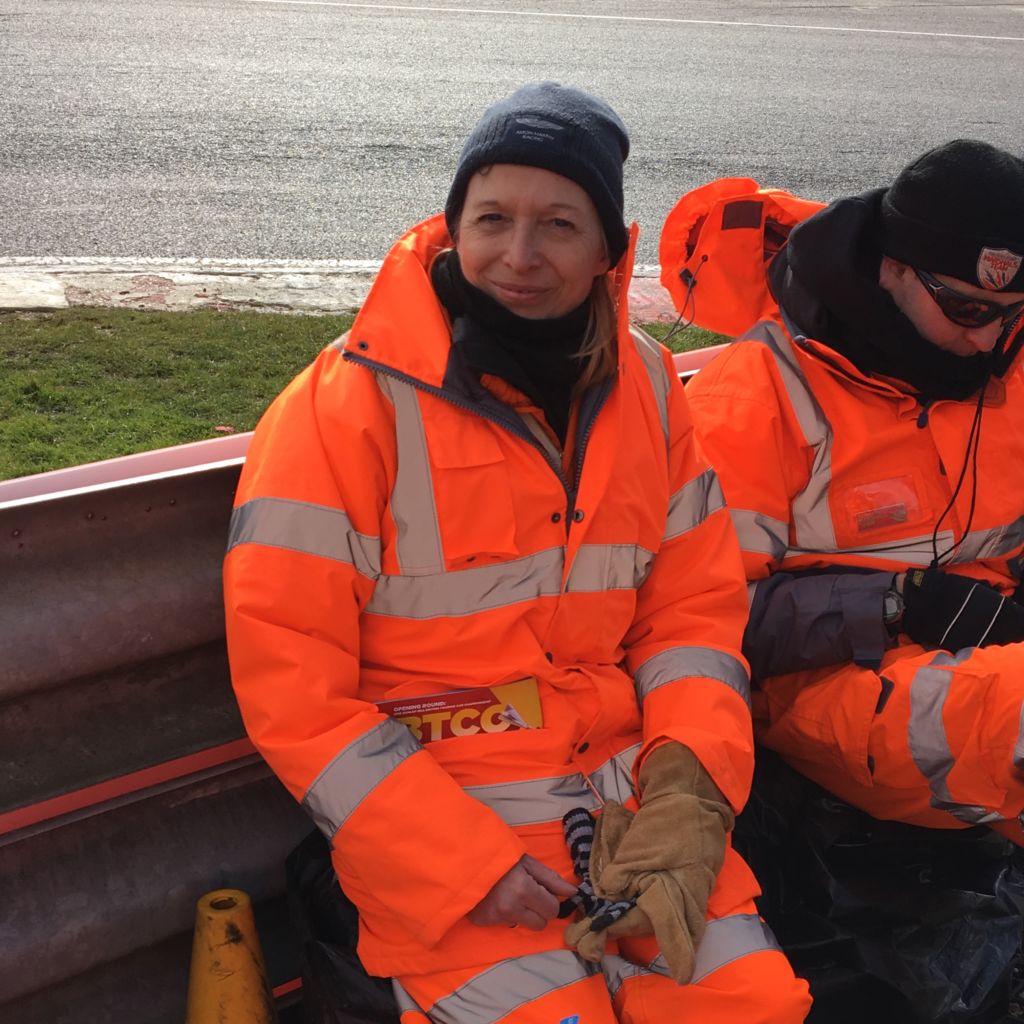
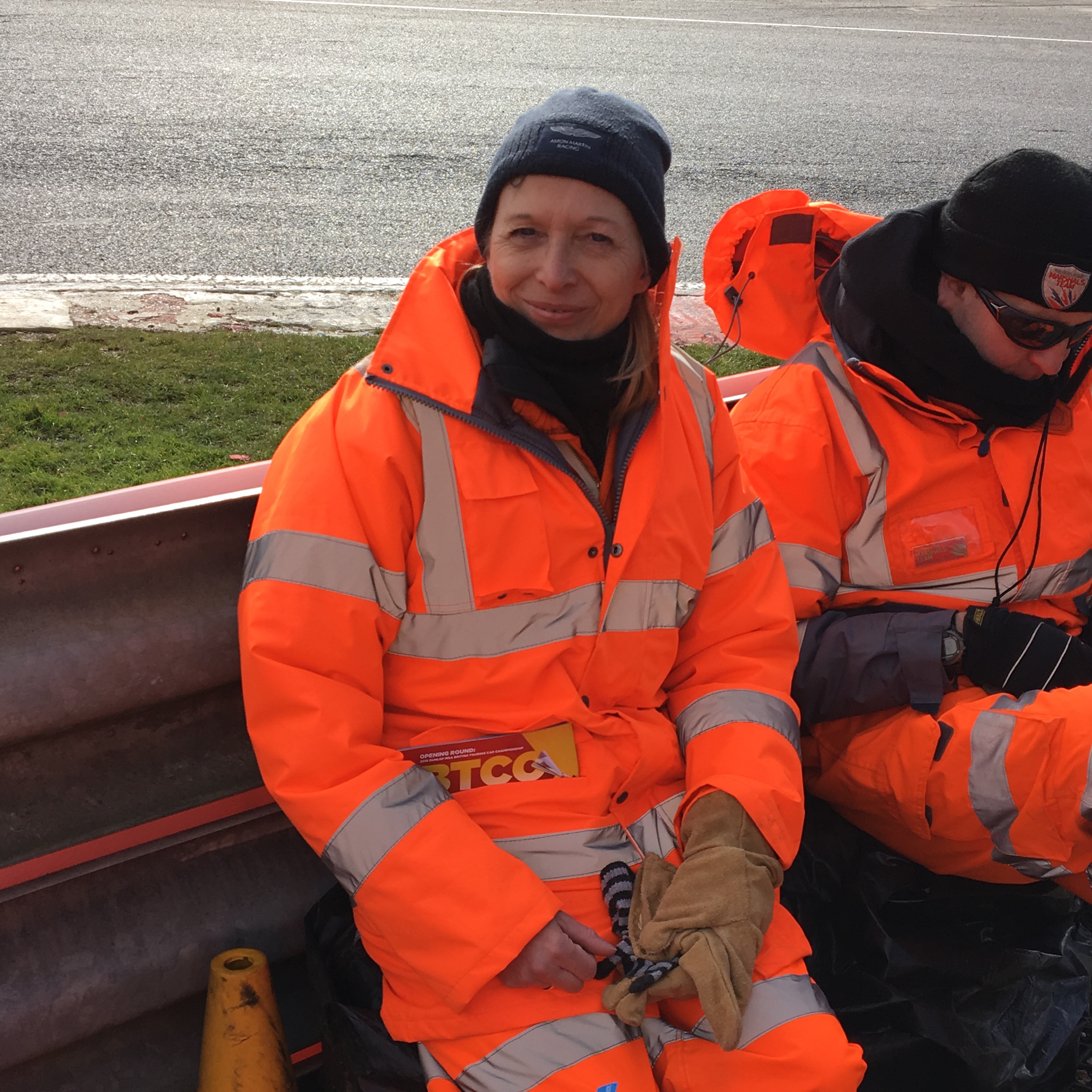
At every motorsport event, there is an army of marshals, prepared to deal with whatever the racing throws at them – from cleaning the track after an incident to waving warning flags, the marshals are vital to any and every race weekend, be it club racing or F1. We caught up with Karen Richards, a marshal with four years’ experience, to find out about what the job entails.
Emily Inganni: What inspired you to start marshalling and how long have you been doing it for?
Karen Richards: We, my husband and I, have been keen motorsport spectators for many years. I think my earliest memories are of Hunt vs. Lauda, especially the epic 1976 season and of course later on Senna vs. Prost. A few years ago, we were at Goodwood Festival of Speed & dropped into the Goodwood Marshals Club tent for a chat & the rest as they say is history! We have been marshalling for 4 years now and love every minute. It gives you the opportunity to be more involved with racing at all levels and of course, the views are great when you’re on post!
EI: What is the training process for new marshals? How long does it take?
KR: There are training programme for new marshals run by various Marshal clubs, we belong to the British Motorsport Marshals Club (BMMC). Potential new marshals can attend a ‘taster day’ at their local circuit where they shadow marshals on post to get an idea of what the role is all about. Then it is advisable to join a club and attend a training programme before becoming a trainee marshal. Training sessions include both theory and practical sessions, also covering firefighting and rescue unit work. Training will cover all aspects and disciplines of the sport and whilst being a trainee there will always be experienced marshals to guide and advise you at race meetings.
Full details of the training process and membership advice is available on the BMMC website at: www.marshals.co.uk
Image courtesy of Karen Richards
EI: Which events have you marshalled at so far? Do you have any favourites?
KR: We have covered a multitude of different events from club racing, Formula E and endurance racing. I think my favourite is the Le Mans 24-hour event closely followed by the London EPrix in 2016, there was something special seeing cars racing around the streets of London.
EI: What does a race weekend entail for you day-by-day as a marshal?
KR: Race weekends always start with a daily sign on and allocation of post and duties/role for that day. This could be anything from flagging, track or incident depending on experience, other roles can include paddock marshal, start line marshal, pit marshal and scrutineer amongst others
Once on post there are checks and distribution of fire extinguishers, ensuring the circuit equipment is available e.g. flags, brooms etc, then the post chief will brief everyone before the meeting starts
EI: What safety protocol is in place for incidents near your marshal post? What kind of ones have you had to deal with?
KR: There is a general safety protocol for all incidents which is covered in training. There will also be an allocated incident officer, an experienced marshal, who will direct proceedings in the event of an incident. Generally speaking you will deal with cars stuck in gravel traps, car fires, collecting debris from the track etc.
EI: Do the procedures differ from event to event or is there a universal way of doing things?
KR: There is a universal approach to dealing with events with safety for marshals, drivers & spectators being paramount.
EI: How much contact do you have with race control during a race?
KR: The post chief is in contact with Race control throughout the meeting & will pass on relevant information as appropriate.
EI: Are there any specific events that you’d like to marshal at in the future?
KR: Not specifically but I am always looking forward to the next Le Mans 24 Hours!
EI: Finally, what would you say to people thinking of marshalling? Do you have any advice?
KR: If you love motorsport then try marshalling as it gives you a different perspective on the art of motor racing… I don’t think you will be disappointed!
Thanks to Karen for taking the time answering my questions, if you want to find out any more information about marshalling or are thinking of giving it a go, hit the link above!
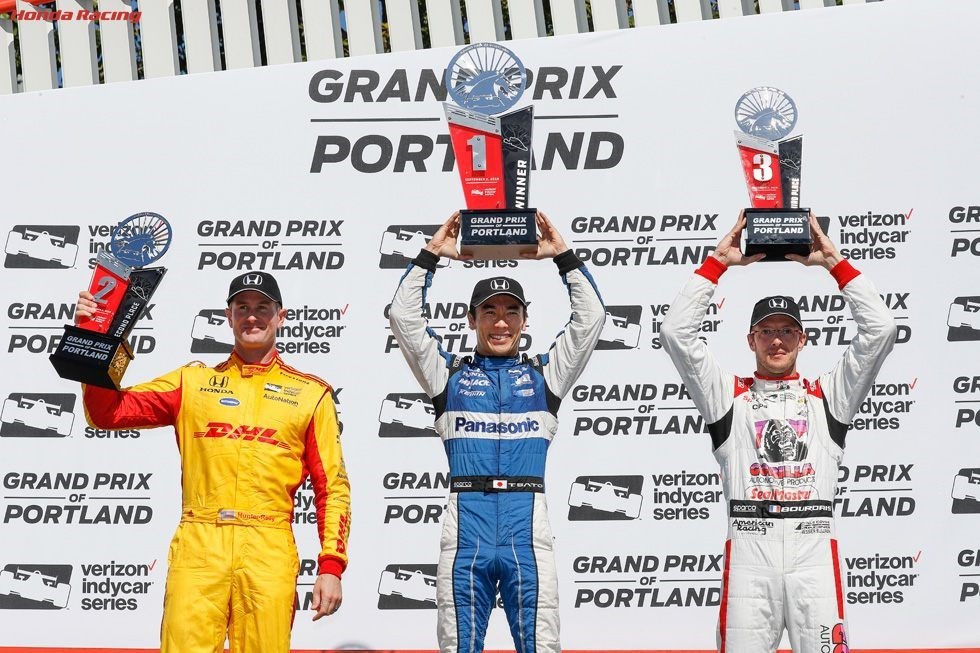
Takuma Sato took only his third IndyCar career win at Portland in a race that was turned on its head time and time again by the four cautions. Ryan Hunter-Reay came home second, but it was not enough to salvage his title challenge while Sebastien Bourdais returned to the Portland podium, ten years after winning the last race at the track.
Takuma Sato wins The Grand Prix of Portland. Image courtesy of hondanews.eu
Sato was never the one anyone had pegged on for the win. First it was Alexander Rossi and then, when his challenge faded, it was Hunter-Reay and maybe even Bourdais but never Sato, yet here we are! Perhaps the pivotal moment of the race for Sato came shortly before the second caution – the #30 Rahal Letterman Lanigan driver was the last to pit for the first stops, meaning when the end of the race came around, he had four laps more fuel that Hunter-Reay. This proved crucial, but it was the last two cautions that pushed him to the front of the field, at least once Max Chilton was forced to pit after coming up short. That means Sato takes his first ever permanent road course win – with his two other wins being Long Beach (street course) and the Indy 500.
In the first half of the race, Rossi looked nailed on for not only the win but a huge points swing in the championship with title rival Scott Dixon well down the order. At one point, Rossi had a seven second lead over teammate Hunter-Reay, but his race was brought crashing down by the second and third cautions. Will Power caused the second caution of the day by nosing into the barriers at Turn 12, eliminating Rossi’s lead, while Zach Veach caused the third by spinning – catching Rossi out in the pits and leaving him down in 17th. From there, Rossi fought back as hard as he could but eighth proved to be the best he could do, unable to pass Charlie Kimball in the latter stages of the race. Rossi’s deficit in the championship has increased to 29 points, but it didn’t always look that way…
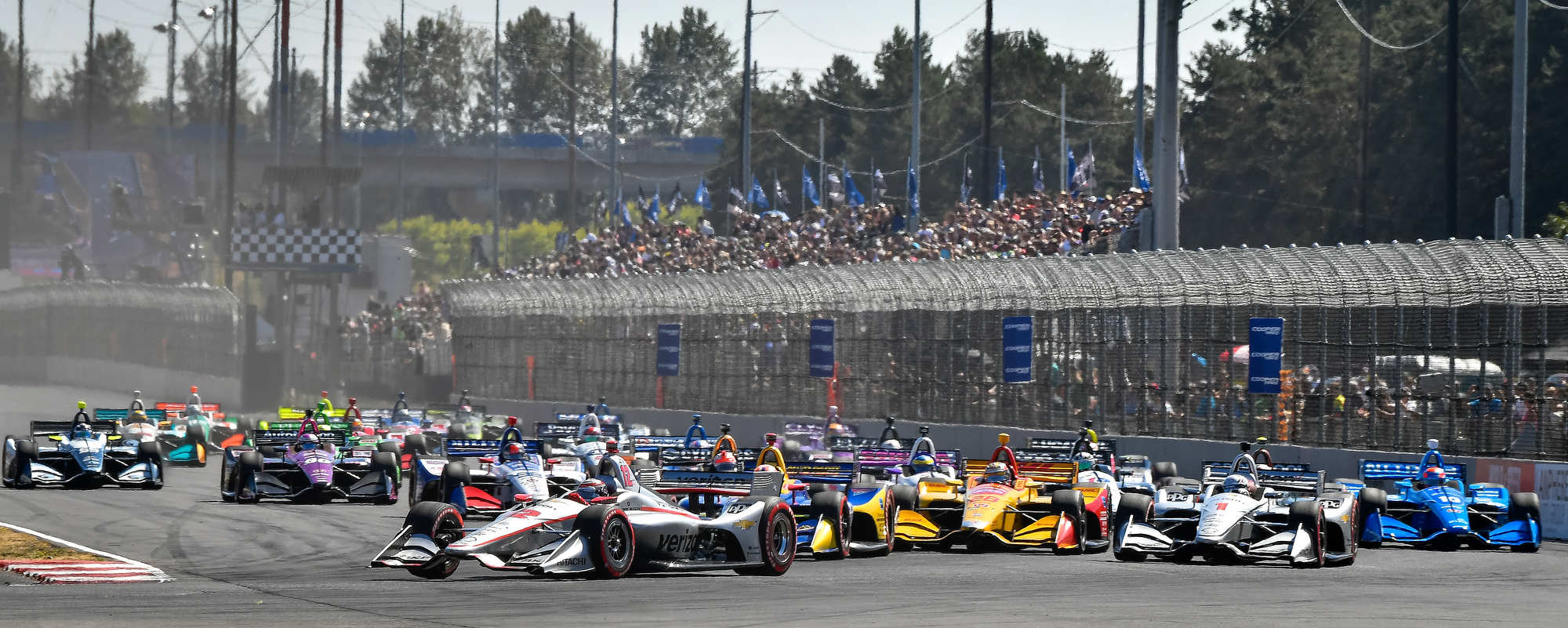
The Start of the Grand Prix of Portland. Image courtesy of Scott R. LePage/LAT for Chevy Racing
Dixon said after the race that he wanted to cry after the Lap 1 crash that very nearly ended his race, but, in true Dixon style, he drove the recovery drive of all recovery drives to finish the race in fifth, extending his championship advantage. It all started when James Hinchcliffe got squeezed at Turn 2 by Veach, causing the #5 to spin. Hinchcliffe in turn collected Ed Jones, Graham Rahal, Dixon and Marco Andretti, the latter of whom ended up flying backwards over both Jones and Hinchcliffe, eventually coming to a rest upside down. It’s a wonder they all walked away from that with Jones having scuff marks on his helmet from Andretti’s car, Hinchcliffe being very nearly hit and Andretti ending with his helmet touching the ground.
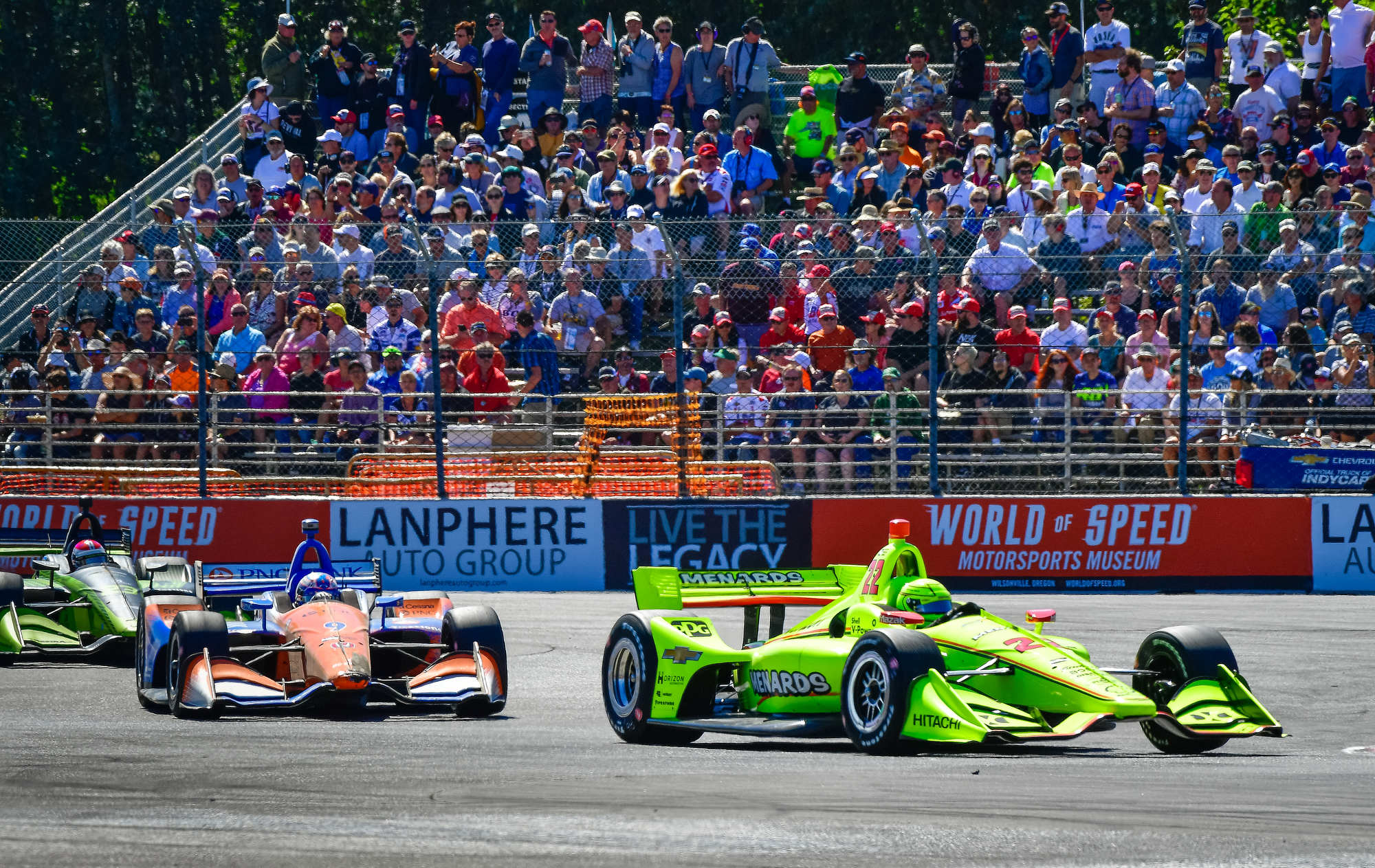
Amongst all that, it was easy to forget about Dixon but the #9 Chip Ganassi driver managed to keep his engine running and, once his path was cleared, was able to re-join the race with only a scuffed front wing to show for his ordeal. That was, however, not the last of Dixon’s dramas. After the first stops, Dixon received a drive-thru penalty for speeding in the pit lane and, later on in the race, he was very nearly taken out at Turn 1 by first Josef Newgarden and then Spencer Pigot. Despite all this, Dixon came home in fifth in what was a true testament of why he’s regarded as the best driver in IndyCar. Something that Rossi said a few rounds back really rings true here, “Dixon never has a bad race”.
Simon Pagenaud and Scott Dixon at The Grand Prix of Portland. Image courtesy of Scott R. LePage/LAT for Chevy Racing
Portland wasn’t really a good race for any of the title contenders other than Dixon. We’ve already covered Rossi’s troubles and Newgarden had pretty much the same fate, finishing down in tenth. Hunter-Reay has been ruled out of title contention as he heads into Sonoma 136 points back with only a maximum of 105 points on offer while Power’s day couldn’t have been much worse if he’d tried. It was all going so well until the first restart when he lost all speed and with it a heap of places. This was later attributed to a gearbox issue that plagued the rest of his race and made pit stops a very difficult affair. Eventually, Power hit the barriers at Turn 12, bringing out the second caution, and effectively ending his race – he did re-join but he was seven laps adrift of the lead.
One to have a good race was defending Portland winner Bourdais who scored his first podium of the season since his win first time out at St Petersburg. Towards the end of the race, it looked like the Frenchman could challenge for the win, but it was not to be, and he dropped back from Hunter-Reay, finishing in a solid third place. Bourdais’ newest teammate, Santino Ferrucci, also had a good race, even if the results don’t show it. The American was running fairly high up in the order when his Dale Coyne conked out with a ‘fuel system issue’. Of course, Ferrucci comes with a fair amount of baggage after his time in F2 but IndyCar has given him a second chance, and he’s already proving his worth.
The other Dale Coyne car of Pietro Fittipaldi also had a decent race with the rookie scoring his first ever IndyCar Top 10, finishing ninth, just ahead of defending champion Newgarden.
The last mention of the day goes to Carlos Munoz who took part in his first non-oval IndyCar race for a long time, replacing the injured Robert Wickens. Munoz finished the race in a respectable twelfth place and is set to drive at Sonoma as well as Wickens continues his recovery. The latest Wickens news is that he’s been transferred to the IU hospital in Indianapolis and is due for more surgery of his ‘lower extremities’.
Next up for IndyCar is the very last round of the season at Sonoma which offers double points, meaning Dixon’s lead is far from safe…
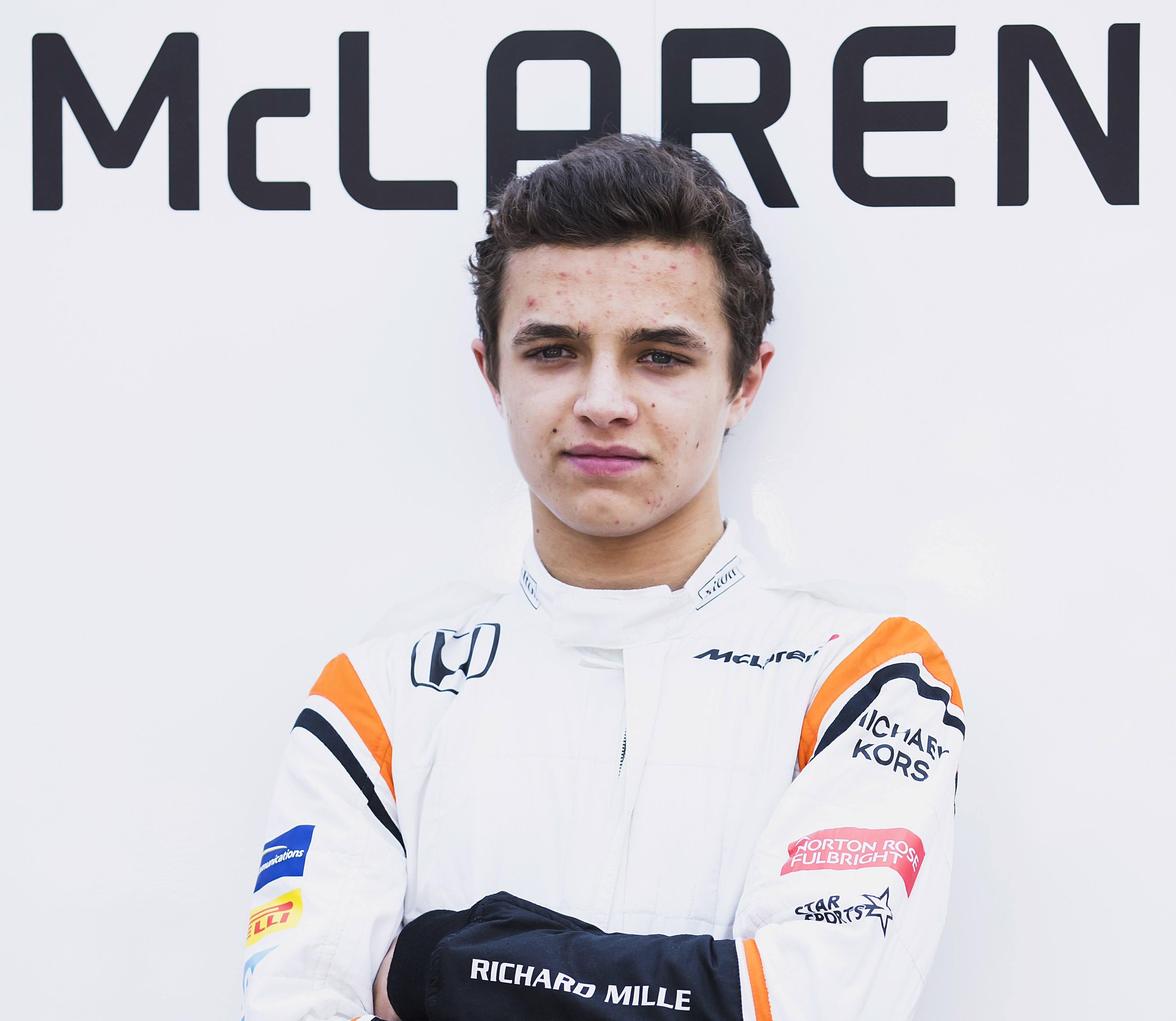
McLaren have signed up-and-coming British star Lando Norris as their second driver for 2019, alongside in-bound Carlos Sainz.
The 18-year old from Somerset will be replacing Stoffel Vandoorne, who was announced this morning to be leaving the team at the end of the season after two difficult years with them.
Norris won the prestigious McLaren Autosport BRDC Award in 2016, and the year after that claimed the FIA Formula 3 European Championship and joined the McLaren Young Driver Programme, before graduating to F2 for 2018, where he is currently embroiled in a battle for the title with fellow Brit George Russell.
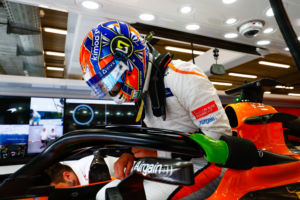
Spa-Francorchamps, Belgium. Thursday 23 August 2018. Lando Norris, McLaren, lowers himself into his seat. Photo: Sam Bloxham/McLaren ref: Digital Image _J6I9762
His first taste of F1 came when he participated in the end of season test in Abu Dhabi in 2017. Since then, he has taken part in 2018 pre-season testing, the mid-season test in Hungary, and also in FP1 at both Spa and Monza.
“To be announced as a race driver for McLaren is a dream come true,” said Norris. “Although I’ve been part of the team for a while now, this is a special moment, one I could only hope would become reality.
“I’d like to thank the whole team for this amazing opportunity and for believing in me. I’m also extremely grateful for the commitment McLaren has already shown in my development, allowing me to build my experience in a Formula 1 car in both testing and on Fridays during the past two race weekends.”
McLaren CEO Zak Brown added, “We believe Lando is an exciting talent, full of potential, who we’ve very deliberately kept within the McLaren fold for exactly that reason.
“We already know he’s fast, he learns quickly, and has a mature head on his young shoulders. We see much potential for our future together. The investment we have made in his budding career with simulator development and seat-time in the car has been well-deserved, as he has continued to prove his abilities both behind the wheel and in his work with the engineering team.”
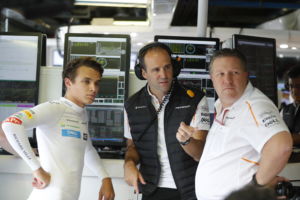
Monza, Italy. Friday 31 August 2018. Lando Norris, McLaren, with Tom Stallard, Engineer, McLaren, and Zak Brown, Executive Director, McLaren Technology Group. Photo: Steven Tee/McLaren ref: Digital Image _2ST6519
IndyCar returns to Portland’s road course, after a 10-year absence, for the penultimate round of the 2018 season. Scott Dixon holds a 26-point lead over Alexander Rossi with the title race now down to four drivers who each have three wins a piece – Dixon, Rossi, Will Power and Josef Newgarden.
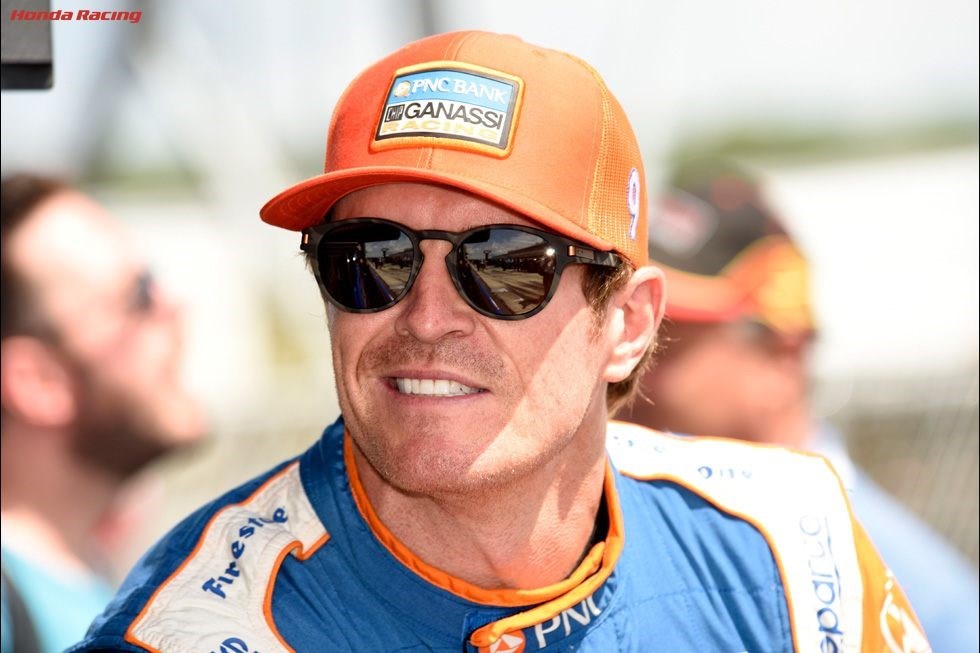
Scott Dixion. Image courtesy of Hondanews.eu
Power was the victor last time out at Gateway, significantly boosting his own championship challenge while pushing teammate and reigning champion Newgarden down into fourth in the standings. The victory itself was a very strategic one with Power jumping long-time leader Dixon in the pit stops to take the win, despite an off-piste strategy call from Rossi to, in true Rossi style, stretch his fuel out longer than it should reasonably go in the final stint.
Simon Pagenaud picked up one of his best results of the season in fourth, but it was far too little too late to do anything to help his title challenge – the 2016 champion will not be adding another to his tally this season, though insists his Penske future is not in doubt despite various rumours.
Zach Veach took the top rookie slot and is really starting to shine, having been overlooked for most of the season due to his Andretti teammates and fellow rookie Robert Wickens. Wickens is out of action but teammate and close friend James Hinchcliffe had some promising news for the media at Portland, he said that Wickens was improving daily and that the first thing he said to Hinchcliffe was a comment about the compression gloves that he’s been wearing since the Pocono crash – it’s good to see that he definitely hasn’t lost his sense of humour!
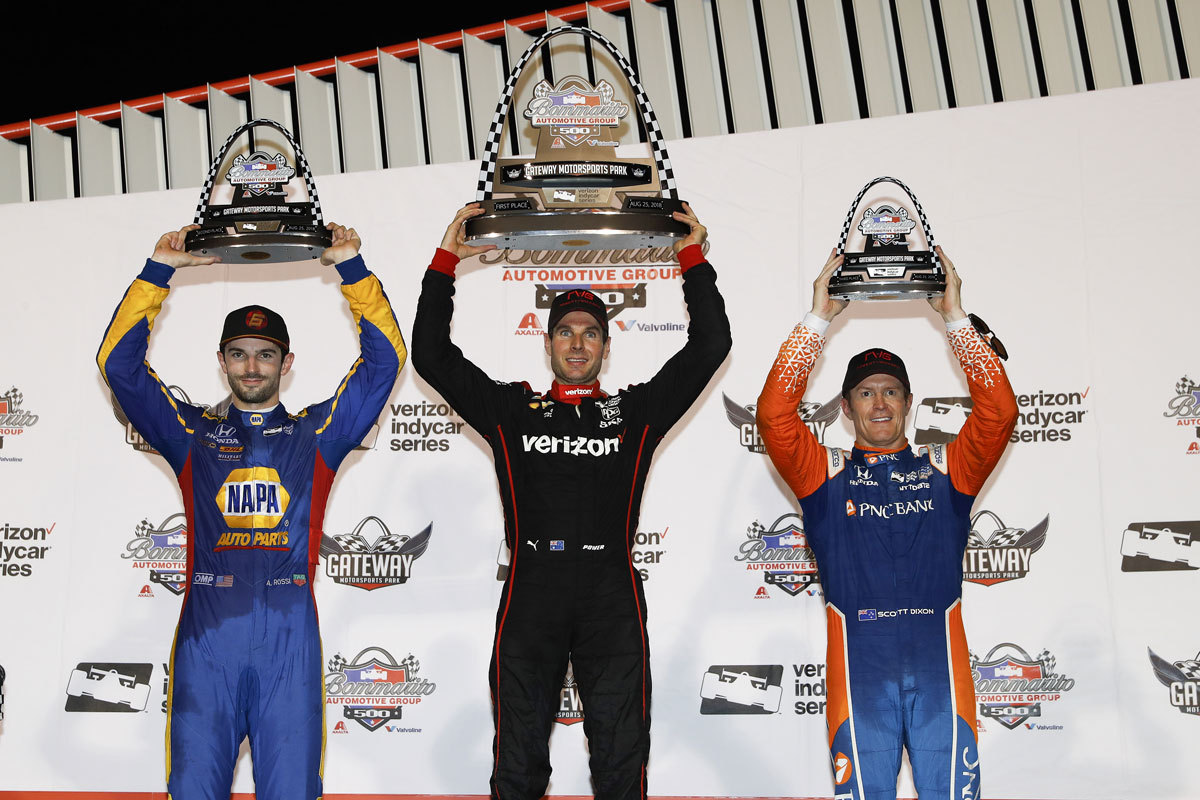
Will Power, Alexander Rossi and Scott Dixon at the Gateway 500. Image courtesy of Team Penske
Looking ahead to Portland and you have to go back to 2007 for the last IndyCar race there… and that’s when it was under the name of Champ Car. Then reigning champion Sebastien Bourdais took the win in the race that famously held the first standing start in Champ Car history – something that has certainly not become common-place in IndyCar.
Only a handful of the current grid have actually raced at Portland, obviously Bourdais has along with Power, Pagenaud and Ryan Hunter-Reay. For the rest, it’s a step into the unknown but those four don’t have much of an advantage given they haven’t been there since 2007 at the latest and for some it’s been even longer.
This absence means there no form book to go on and no previous set ups the teams can turn to. That should favour the bigger teams like Andretti and Penske over the smaller teams because they can gather more data as they have more cars, but only time will tell.
There are a lot of driver changes for this weekend… Carlos Munoz will take the wheel of the #6 Schmidt Peterson Motorsports car, replacing the injured Wickens for the last two rounds of the season. Jordan King is back in the #20 Ed Carpenter Racing, taking over from the boss for Portland and Sonoma while Gabby Chaves stays in his seat at Harding after being replaced for three rounds.
Jack Harvey is here for the last two rounds of the season with the #60 joint entry between Meyer Shank Racing and Schmidt Peterson. Force India linked driver Alfonso Celis Jr is in the #32 solo Juncos entry with news coming this week that they’ll be running two cars next year and lastly, banned-F2 racer Santino Ferrucci returns to IndyCar in a third entry for Dale Coyne for the final two races.
This round is so crucial for so many drivers, for the title contenders it’s the last stretch of the season and they can’t afford a mistake while for most of the other drivers, they need to prove their worth for a seat next season with Silly Season in full swing and a certain Fernando Alonso kicking around.
The timings this weekend are much more UK friendly than they were at Gateway and, in addition to IndyCar, we’ve got the whole Mazda Road to Indy programme in attendance with all three’s seasons coming to a close and two championships still to sort out. All the MRTI sessions are available to stream, along with all IndyCar practice and qualifying as well. The all-important race is on BT Sport 2 on Sunday evening with the full schedule as follows:
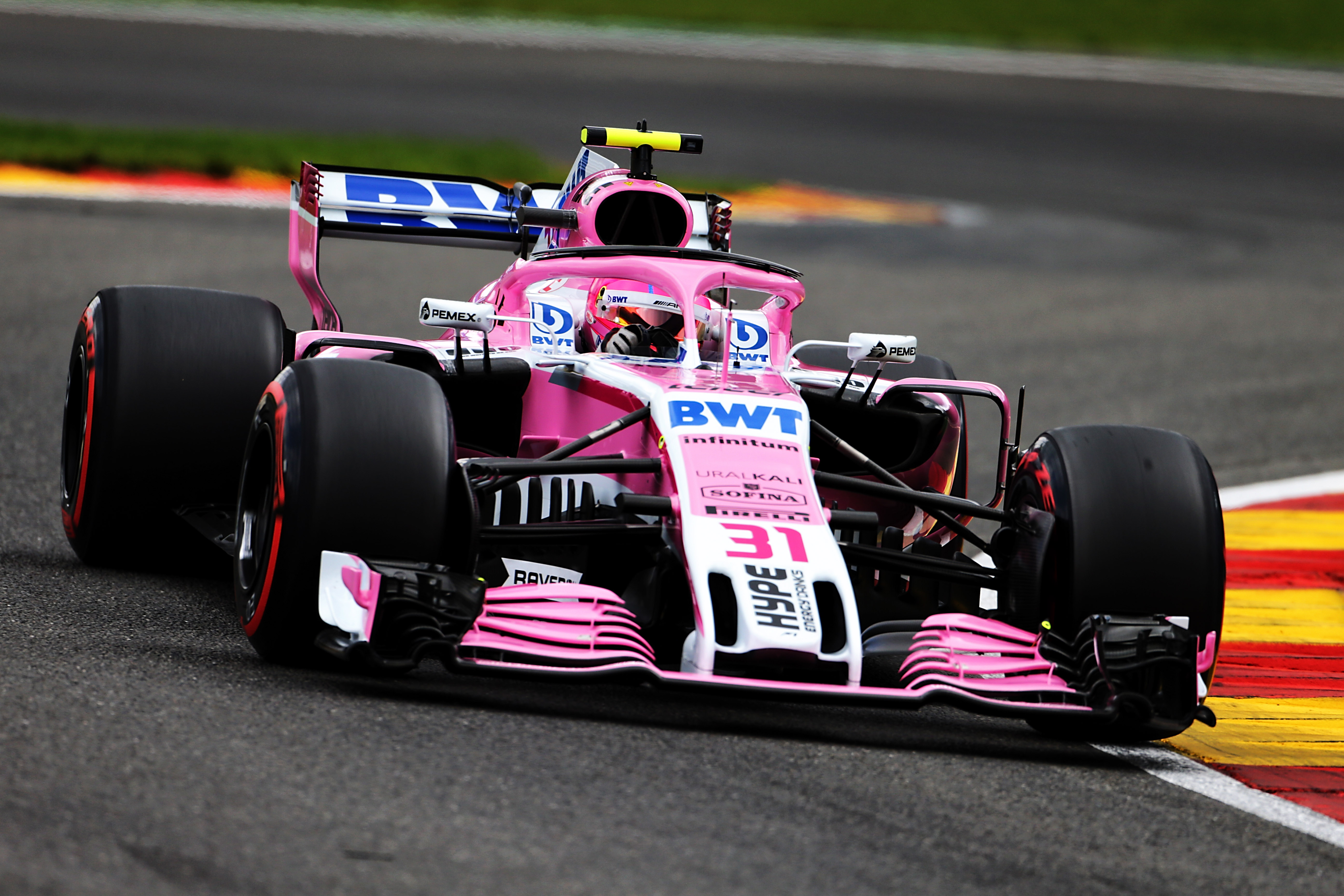
Racing Point Force India’s recently-promoted team principal Otmar Szafnauer has said he is keen for the team to keep things moving forward after their tumultuous summer break and the impressive performance from their two drivers at the Belgian Grand Prix.
“The last few weeks have been a period of transition for the team, but with the support of the Commercial Rights Holder, the FIA, and our fellow competitors we returned to competition in Spa,” Szafnauer said. “Getting some points on the board was the priority and to come away with fifth and six places was a wonderful reward for the entire team.”
Esteban Ocon (FRA) Racing Point Force India F1 VJM11 celebrates with the team at the end of the race. Belgian Grand Prix, Sunday 26th August 2018. Spa-Francorchamps, Belgium.
The Silverstone-based team was put into administration over the summer break but, after a period of uncertainty, was saved by a consortium led by Canadian billionaire Lawrence Stroll, father of Williams’ Lance Stroll. The buy-out saw Force India forfeit all of the constructors’ championship points they had accumulated over the first half of the season and effectively enter the Belgian Grand Prix as a new team, rebranded as Racing Point Force India.
Esteban Ocon and Sergio Perez started the race at Spa P3 and P4 after a rain-affected qualifying, and on the first lap there was a moment going into Les Combes where it looked like Ocon might have challenged Hamilton and Vettel for the lead. The Frenchman eventually finished the race in sixth, with Perez one position ahead of him in fifth, vaulting Force India ahead of Williams in the constructors’ championship and leaving them just one point behind Sauber already.
“The new ownership gives us a welcome injection of stability and investment,” Szafnauer added. “We retain a wonderful group of people working back at base and trackside, and with the off-track distractions now behind us we can concentrate on doing what we do best – building cars and going racing. Our performance level in Spa was a real credit to the entire team. The sight of Esteban and Sergio challenging for the lead on lap one is an image that we will cherish.
“We head to Monza determined to deliver more points. We need to keep up the momentum from Spa. Monza is all about top speed and stability on the brakes, and I think it will play to our strengths. Looking further ahead, we have more performance to introduce to the car over the next few events, hopefully starting from Singapore.”
Esteban Ocon (FRA) Racing Point Force India F1 VJM11. Belgian Grand Prix, Sunday 26th August 2018. Spa-Francorchamps, Belgium.
Featured image – Esteban Ocon (FRA) Racing Point Force India F1 VJM11.
Belgian Grand Prix, Saturday 25th August 2018. Spa-Francorchamps, Belgium.
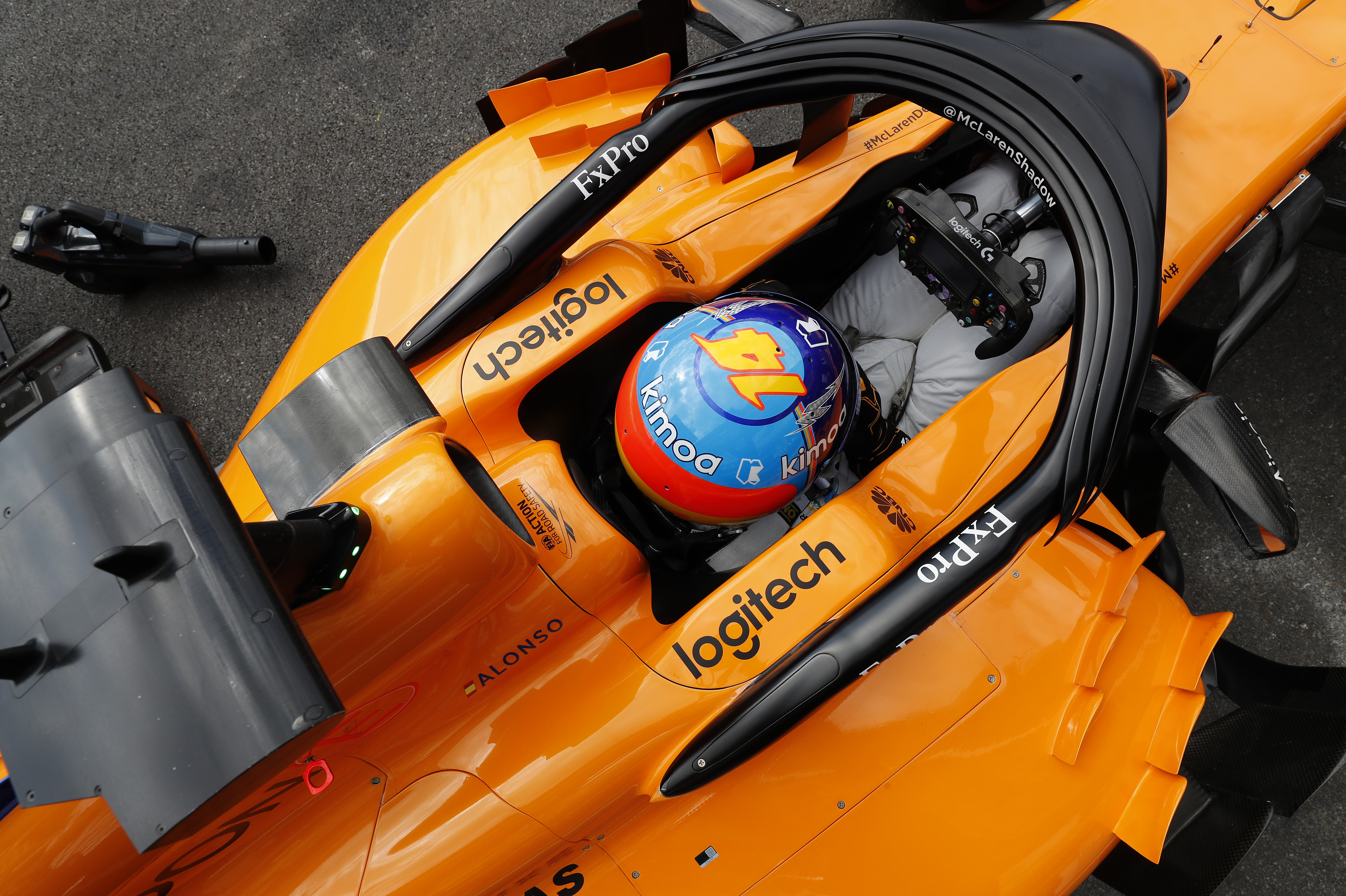
McLaren’s Fernando Alonso has said that despite having fond memories of the Monza circuit, he is not holding out hope for a good result at this weekend’s Italian Grand Prix, with the track unlikely to play to his car’s strengths.
“Monza is a very special circuit for me and I have a lot of happy memories there,” he said. “It has a different feeling to many tracks – maybe because of the heritage or the fans, I’m not sure – but the emotions you feel when the fans invade the track after the race is like nowhere else in the world – there’s so much passion there.
“For us we know this weekend will be difficult, like in Spa. Better tracks are coming for us, that’s for sure, but Monza has all the characteristics that expose the weaknesses of our package. We just have to work as hard as possible and see what we can get out of it.”
Spa-Francorchamps, Belgium. Sunday 26 August 2018. Fernando Alonso, McLaren, and Stoffel Vandoorne, McLaren, on the grid. Photo: Glenn Dunbar/McLaren ref: Digital Image _31I8707
Last weekend’s Belgian Grand Prix came to a rather jarring halt for Alonso before he’d even reached the first corner. P17 was his result in qualifying – the worst Saturday for McLaren so far this year after team-mate Stoffel Vandoorne qualified P20 – but the Spaniard was bumped up a few places on the grid thanks to engine penalties given to those around him.
Unfortunately, that put him right in the thick of things when Renault’s Nico Hulkenberg missed his braking point going into La Source on lap one and triggered a series of events that ended in Alonso being launched over the top of Charles Leclerc in an incident reminiscent of the crash at the start of the 2012 Belgian Grand Prix.
“After the accident in Spa last Sunday,” Alonso added, “I know the team has been working very hard to make sure we have enough parts for this back-to-back race. I’m very grateful for their efforts and I’ll still be giving it maximum attack even if it will be a challenging weekend.”
Spa-Francorchamps, Belgium. Friday 24 August 2018. Fernando Alonso, McLaren MCL33. Photo: Steven Tee/McLaren ref: Digital Image _2ST3380
Featured image – Steven Tee/McLaren. Ref: Digital Image _1ST2801
29.5km north of the Italian capital of Milan, the Autodromo Nazionale Monza is the oldest circuit in Formula 1 history, and it is the home not only spiritually of Formula 1, but also of title contenders and F1’s oldest team: Ferrari.
The first ever race at Monza was held back in 1922, with Frenchman André Dubonnet taking the race. Michael Schumacher is the most successful driver at Monza, with five victories and it was after his last win there in 2006 that he announced his initial retirement from F1. His Ferrari victories were always the scene of jubilation from the Ferrari faithful, but let’s not forget the other Italian team: Toro Rosso. Sebastian Vettel took a remarkable wet-weather victory for the Red Bull junior team in 2008. The start of a glorious career, which has now seen him end up as the darling of Ferrari as he attempts to bring Championship success back to Maranello.
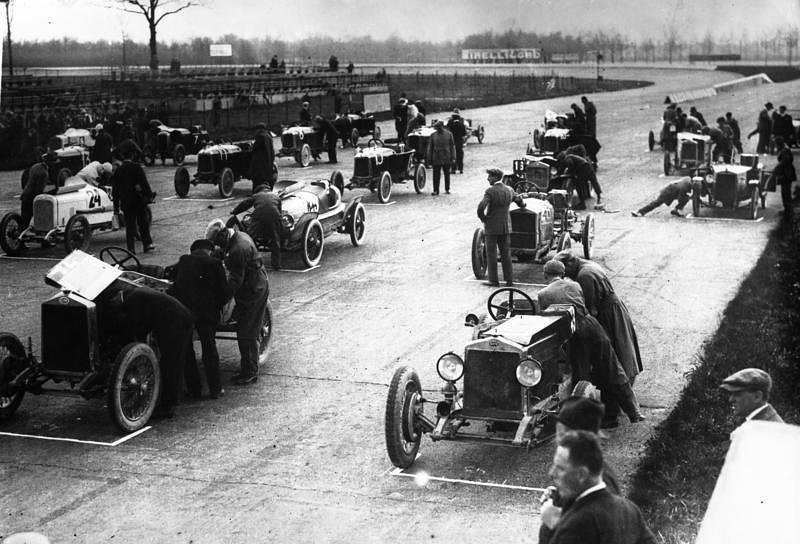
The starting grid of the “1st Cup Fiera di Milano” race held in 1925. Image courtesy of Bundesarchiv, Bild 102-01319 / CC-BY-SA 3.0, CC BY-SA 3.0 de
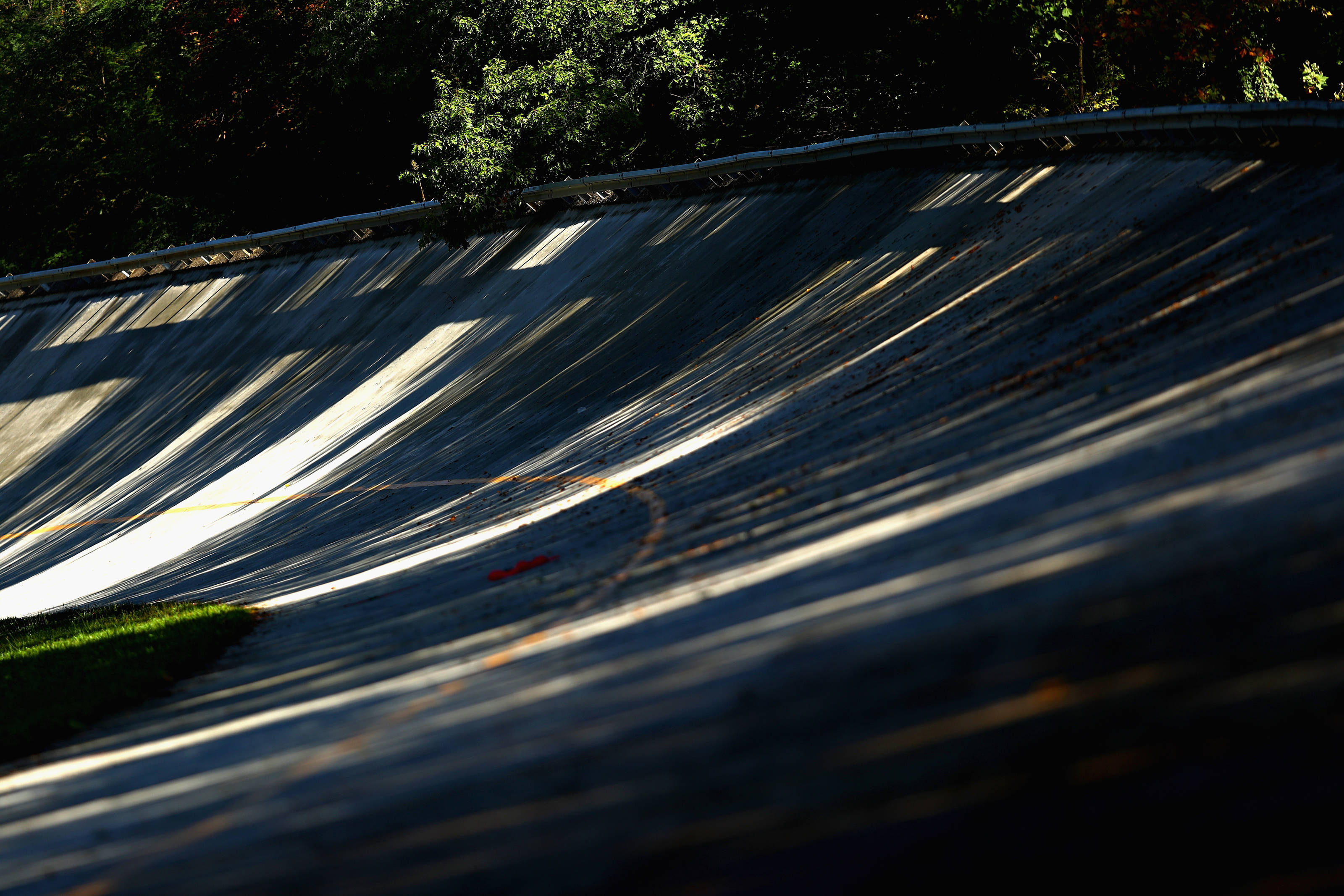
Lurking in the background of the track is an echo of the past; the old banking that was a feature of the Italian Grand Prix at Monza provided scary, high-speed, adrenaline-filled racing and posed an incredible amount of danger for drivers. One mistake or twitch of the back end and the consequences could, and sometimes were, very grave indeed. In 1928, a crash involving Emilio Materassi, took his life along with the lives of 27 spectators, and in 1933, Giuseppe Campari, Baconin Borzacchini and Stanislaw Czaykowski all lost their lives to the old banking. That particular race would be known as “Black Sunday.” After the 1969 race at Monza, the track layout was altered and the banks were disused, they are however a beautiful and mind-blowing attraction for spectators.
Monza now consists of 11 turns, three of which are named after the great Alberto Ascari. Months after being fished out of the harbour at the Monaco Grand Prix, he crashed at the then flat-out corner during a test run and lost his life. This one corner was then turned into a triple-corner chicane and it was named after the Italian driver.
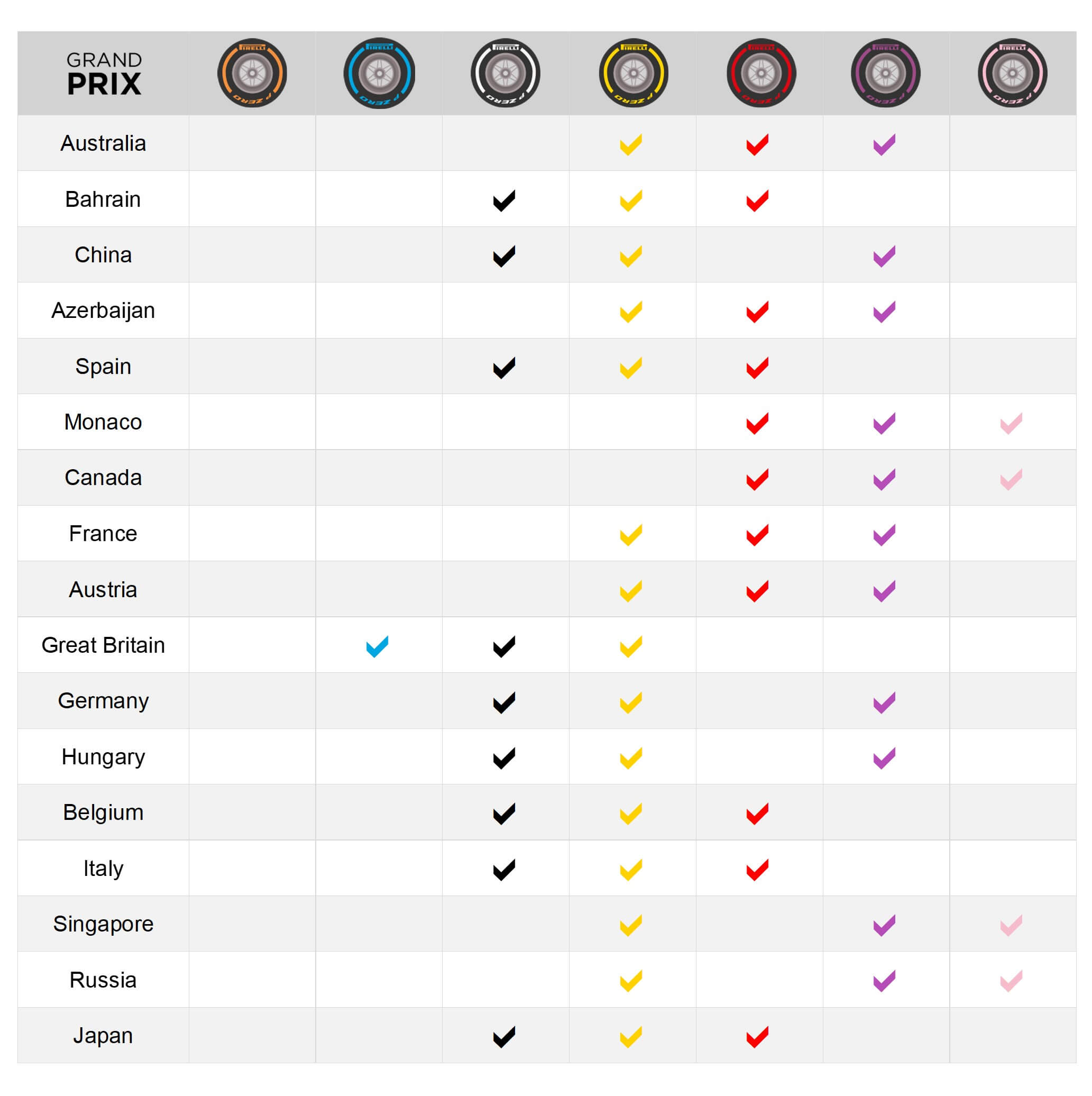
Tyre Selection upto Japan. Image courtesy of Pirelli Media
Monza is very much a power circuit, which over the last few years and even at the start of this year favoured Mercedes. However, some significant gains from Ferrari have now meant that, as Lewis Hamilton acknowledged last time out in Belgium, Ferrari have the power and straight-line speed advantage over Mercedes. Red Bull isn’t expecting their power upgrades to come in time for the Italian Grand Prix, so this could be a real fight for the win between Ferrari and Mercedes.
This power advantage could finally mean victory for Ferrari on home turf. The Tifosi have become restless at not only the lack of Championship success in recent years, but also the lack of success at Monza for Ferrari. Their last win on home soil came eight years ago, when Fernando Alonso beat McLaren’s Jenson Button to victory. Furthermore, Vettel enters this weekend on a high having comfortably beaten Hamilton in Spa – another power track – and closed the gap in the Championship to 17 points.
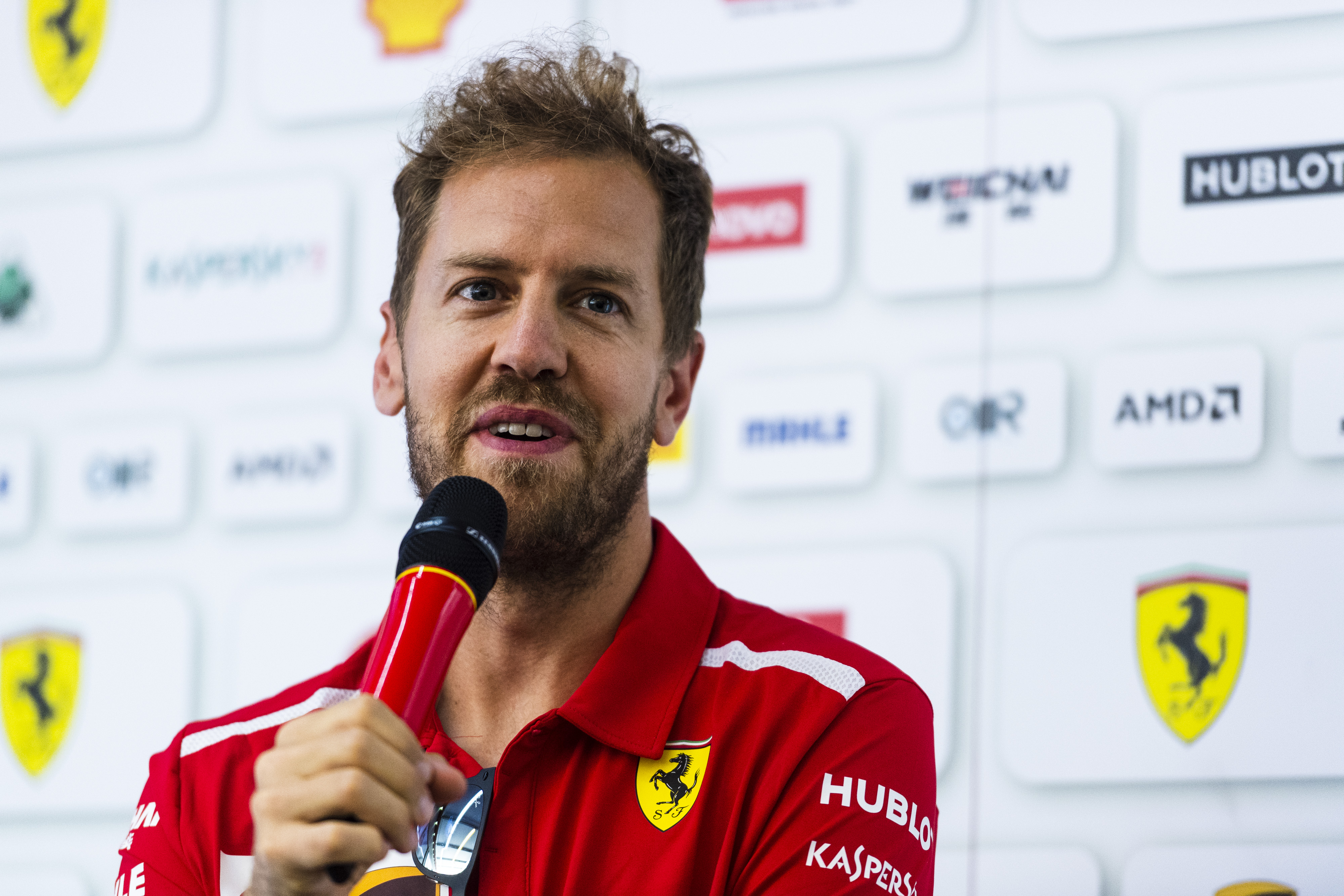
Sebastian Vettel. Image courtesy of Ferrari Media
As a result, the Championship fight is finely poised coming into the final seven races of the season, as Ferrari look to bring the fight to Mercedes at the Italian fortress.
Featured image courtesy of Getty Images / Red Bull Content Pool
Sunday in Silverstone was something of an unprecedented situation for MotoGP, at least since the word “MotoGP” became a reality. Not since Misano 1990 had every single rider in every single class walked away with precisely the same points with which they entered the weekend; and not since Austria 1980 had every World Championship race been cancelled in a motorcycle Grand Prix weekend. That weekend was due to snow. In fact,this weekend we saw the first cancelled races since Indianapolis 2008, when the 250 GP was cancelled because of a hurricane.
The situation in Silverstone was similar in at least one way to all of these events. Indianapolis 2008 was cancelled because of impending rain, and the races in Silverstone were rescheduled in an attempt to avoid the worst of the day’s precipitation. In addition Austria ’80 saw all races cancelled, and Misano 1990 was cancelled due to rain. But none of these perhaps had the controversy behind them as this weekend’s British Grand Prix did (well, maybe Misano ’90, but in a different way). All of the previous situations were brought about purely because weather conditions prevented racing: you can’t race in the snow, you can’t race in a hurricane and you can’t race in monsoon-like rain, but Silverstone 2018 was such a disaster because of the track surface.
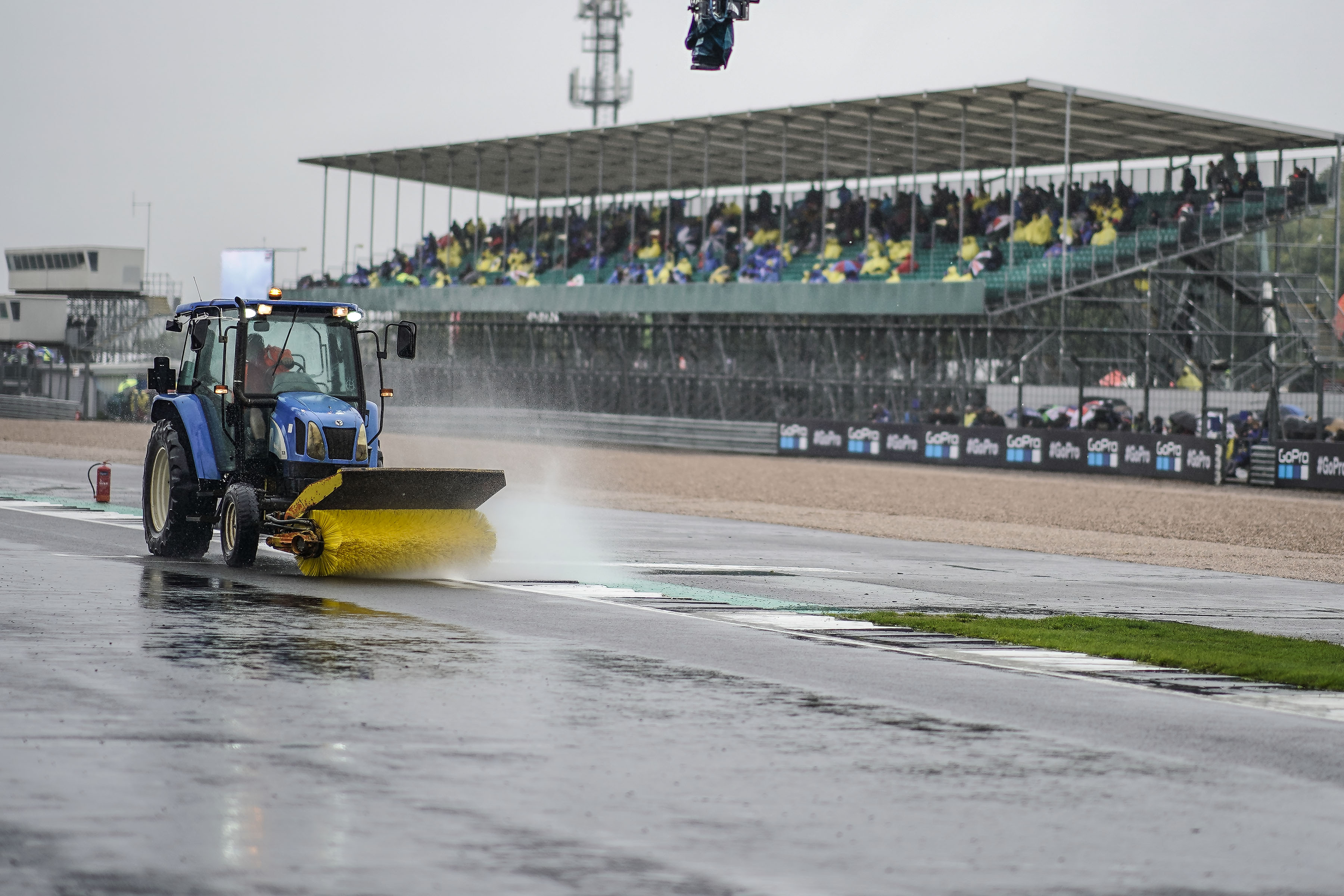
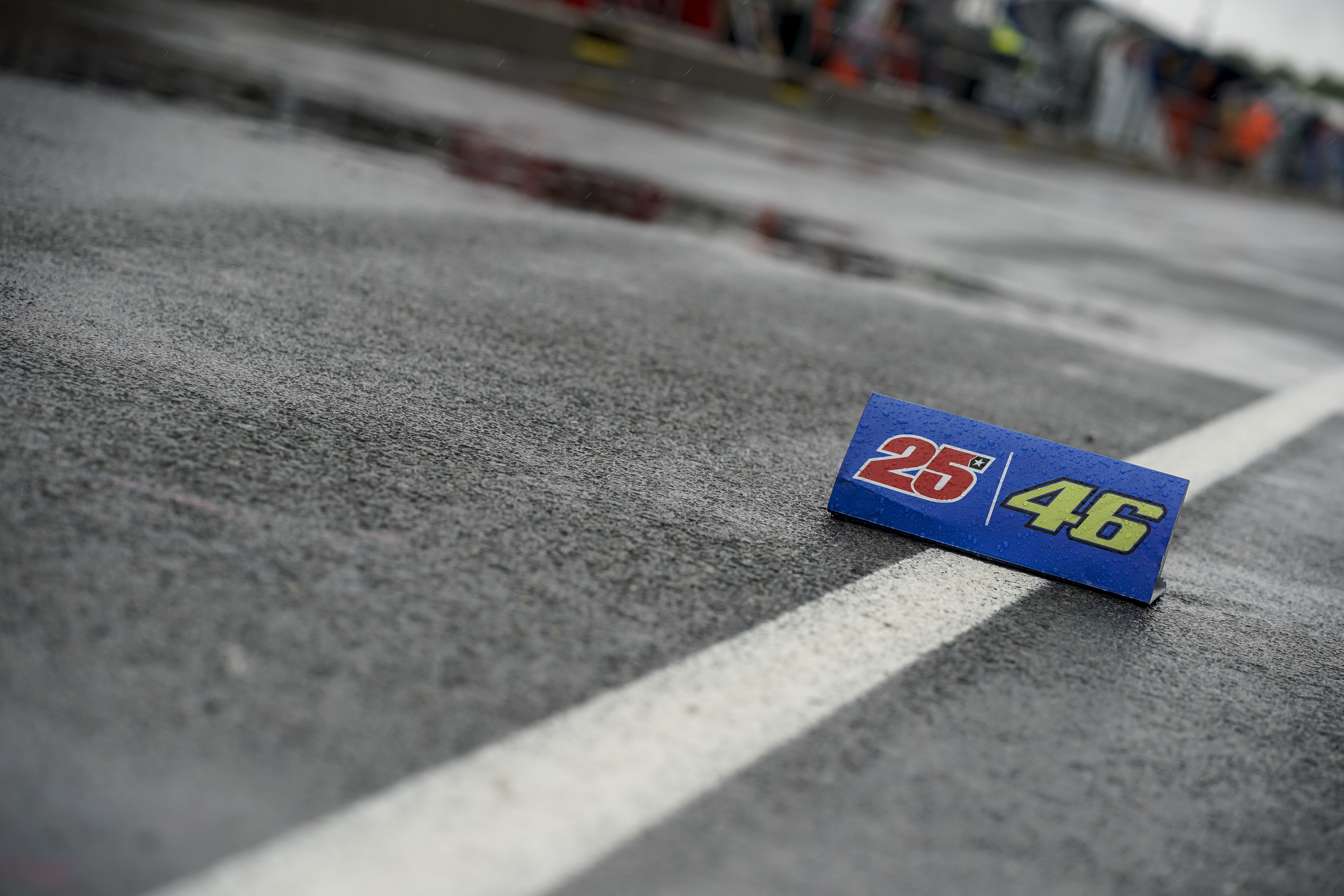
A wet Silverstone tarmac. Conditions that lead to the MotoGP British GP being cancelled. Image courtesy of Yamaha Motor Racing
So, what made Silverstone such a disaster this year? Well, the problem was identified in July, at Formula One’s British Grand Prix. Atypically, it was not F1’s fault, maybe they made it worse, but not significantly – the problem was already there. After the first practice of the F1 weekend back in July, drivers were almost unanimous in opining that the new Silverstone circuit was more bumpy than before, Lewis Hamilton even spoke to Cal Crutchlow about the situation, saying that Silverstone was “the bumpiest he had ever driven”. This sparked worry for MotoGP.
The circuit had resurfaced its entire 3.6 mile track over the winter with the precise goals of improving grip consistency (previously there had been four different surfaces around the track) and erasing bumps. The second point there was of most immediate concern for the riders; Silverstone was not in a state akin to Barcelona or Jerez in terms of grip, but the bumps made riding there quite dangerous, because bumps make everything very unpredictable and difficult to manage, and when in a group it can be hard to pick out where the bumps are, which makes it easy to crash. You can say “the riders should be able to ride through them, they are the best in the world,” but if you cannot see where the danger is, how are you supposed to avoid it? That is the danger of bumps, and in Silverstone they were particularly bad.
The new surface aimed to rectify that, and as far as Franco Uncini (the MotoGP Safety Officer – he homologates the circuits) was concerned, in February it was fine, and it was in March, too. Cal Crutchlow concurred with the 1982 500cc World Champion when he rode a Honda RC213V-S there for a media day, with the opinion that the surface was generally fine, bar a couple of spots that were more bumpy. Uncini had made the same deductions before Crutchlow, which as encouraging because there was agreement. The circuit was not 100% perfect, but it was damn close.
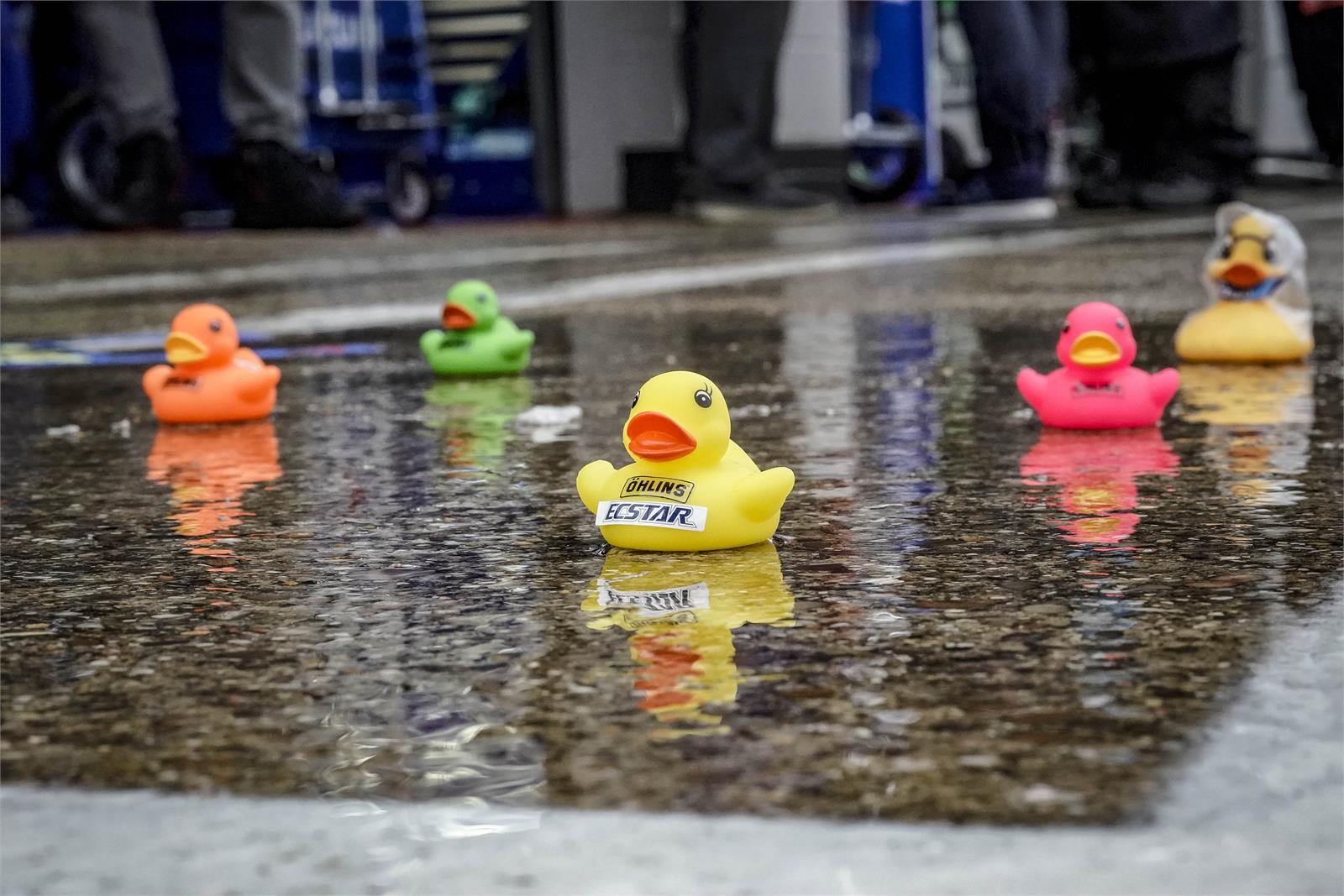
Rubber Ducks at the 2018 MotoGP British GP. Silverstone 2018. Image courtesy of Suzuki Racing
Then, however, something happened. Between March and July, when the F1 race was held, because when the car racers showed up, they came out with comments like Hamilton’s to Crutchlow. Something in that time period happened to make the track more bumpy, more so even than it was before the new surface was laid. There are some possibilities, like the unusually hot summer Britain has enjoyed, but realistically it is difficult to know precisely what made the track deteriorate so much with so little top-level track action.
These bumps became a problem from the beginning of the weekend – even in the dry. Valentino Rossi said that you have to “not care” to negotiate the bumps, whereas Andrea Dovizioso opined that riding around the bumps was the best way. Ultimately, the bike determined the strategy – the Yamaha could handle the bumps well, whereas the likes of the Honda and Ducati couldn’t deal with them so efficiently – especially the Honda.
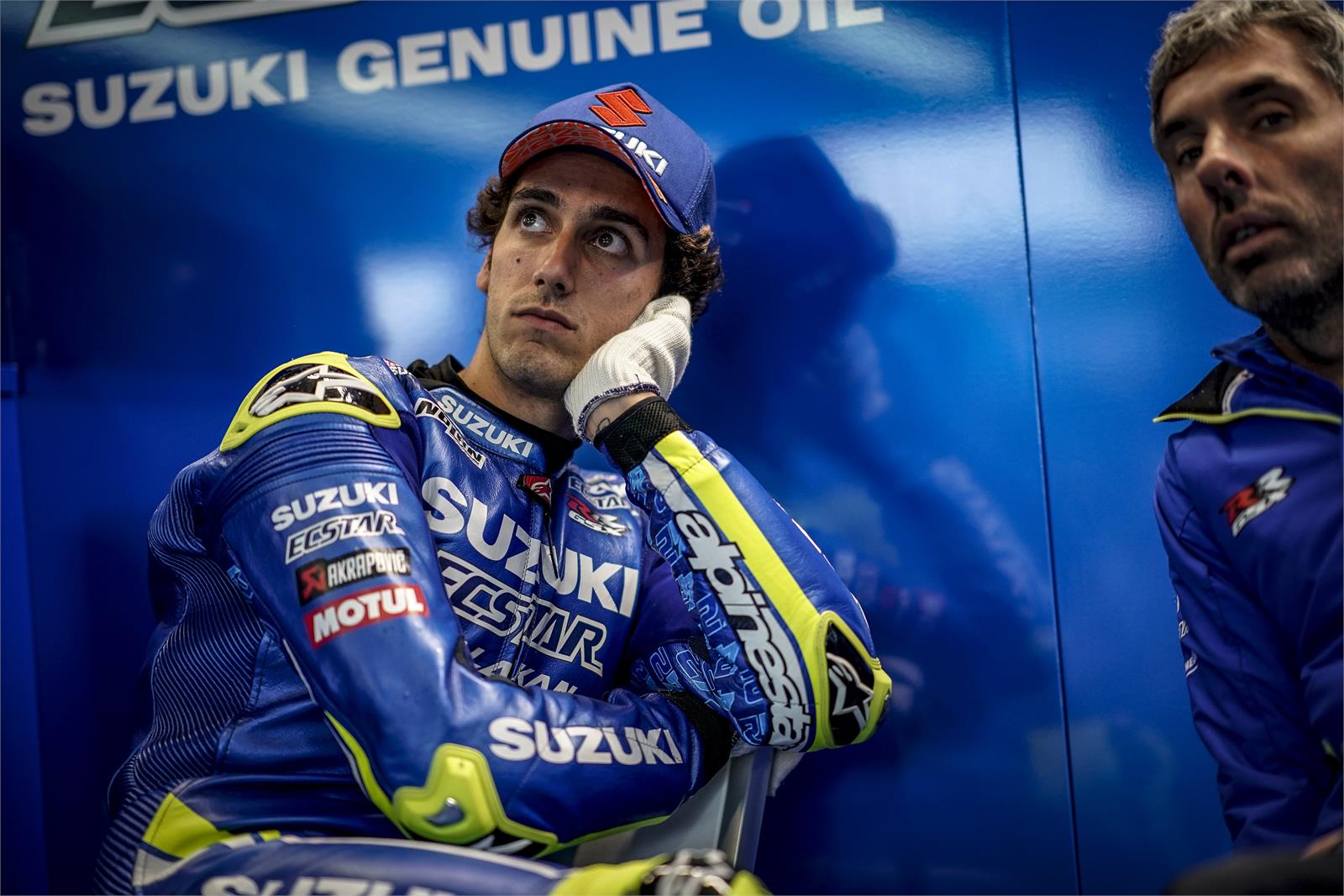
But that didn’t matter come Saturday afternoon and FP4. When the rain came down at the end of the session, it became a disaster between turn seven, Stowe, and turn ten, Club. In these areas, especially in turns seven and eight – particularly the braking areas for these corners – it was impossible to ride. The problem was that the water was pooling in the bumps, so aquaplaning became both inevitable and extreme. In turn seven at least seven riders ran off track or crashed in the space of one minute or so. Alex Rins was first in, and then tried to direct traffic from the gravel trap to minimise risk for the other riders. Jorge Lorenzo, Aleix Espargaro and Marc Marquez all also ran on, and Tito Rabat crashed. Franco Morbidelli also fell a few seconds after Tito, and when the Spaniard stood up, he was hit by Morbidelli’s 160kg bike, travelling at 100+mph. The result was a broken fibula, tibia and femur for the 2014 Moto2 World Champion. Thankfully, he had a successful operation on Saturday night and on Sunday took his first steps since the accident.
The accident for Tito was a direct result of the weather, as neither he, nor any of the other riders who went into the gravel at turn seven in that period, was able to stop the bike. Bradley Smith said he started braking “500 metres before the corner” and still couldn’t stop the bike, because it just aquaplaned. When the bike aquaplanes, the tyre is not touching the asphalt, of course, so you cannot slow down. Rins said that the water in that section was deep enough to submerge a whole finger. You can have the best tyres in the world, but if you have 10cm of water, it is impossible to control.
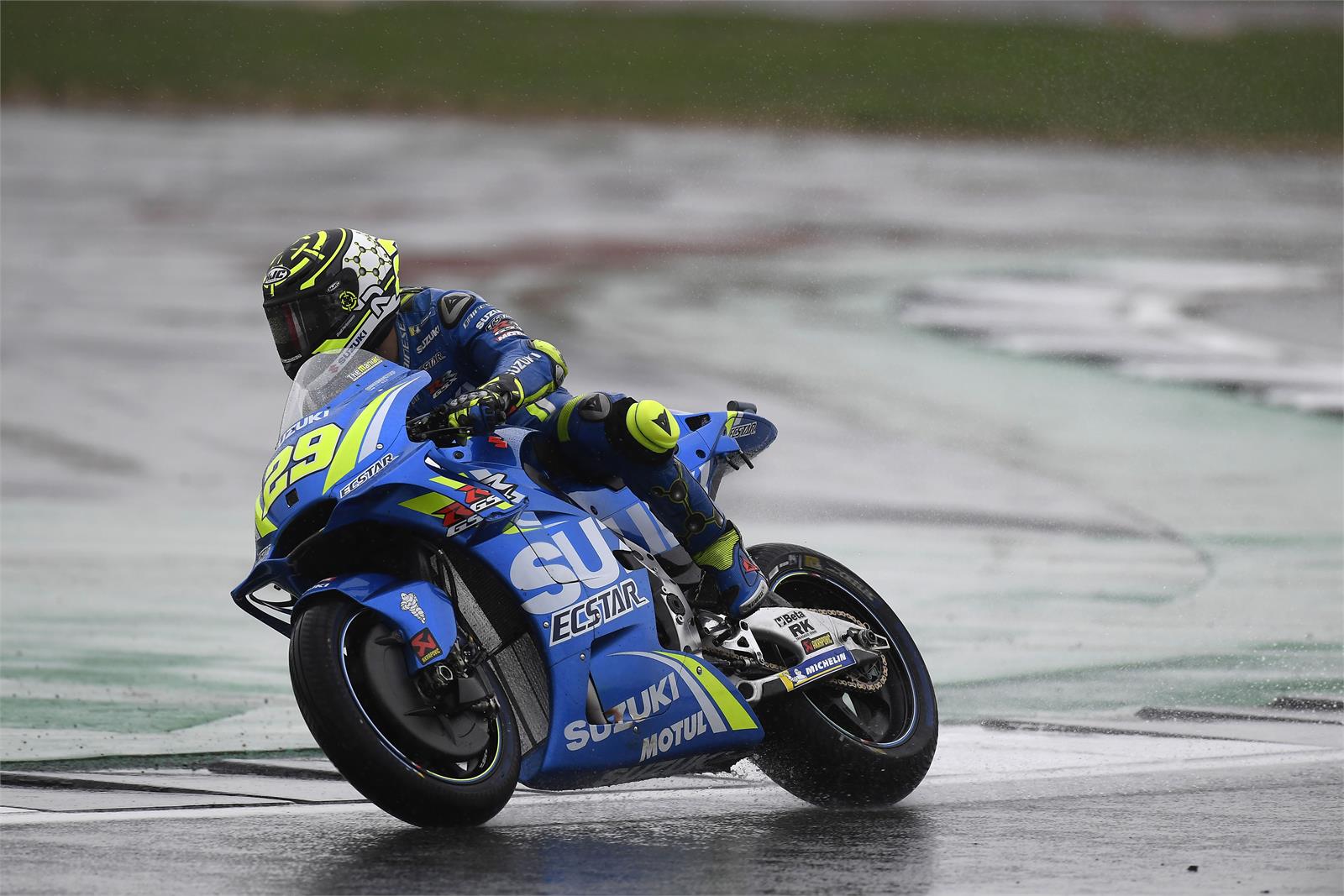
Andrea Iannone riding through the rain and puddles on the track. Image courtesy of Suzuki Racing
Following this, and considering the incoming day-long deluge facing the whole of the UK for Sunday, Race Direction decided, together with the teams and the riders, that rescheduling the races was the best plan for Sunday. MotoGP was moved to 11:30 am, and Moto3 and 2 would follow the premier class race.
This didn’t work. Already in Moto3 warm up on Sunday morning, the rain had arrived, and by the end of the Moto2 warm up, the track had become shiny, as the standing water was starting to gather.
11:30 arrived, and things were terrible. Alvaro Bautista ran into the gravel at turn eight because he was trying to warm his carbon brakes, and it just locked. Then, Maverick Vinales was seen coming out of pit lane, spinning the rear tyre immediately. Alex Rins reckoned that he was spinning the tyre with 15% throttle in third gear on his way to the grid for the initial start time. They were on the limit just for the sighting lap, and so it was no surprise that the start was delayed – just to ride a MotoGP bike in those conditions would have been nearly impossible, let alone race one.
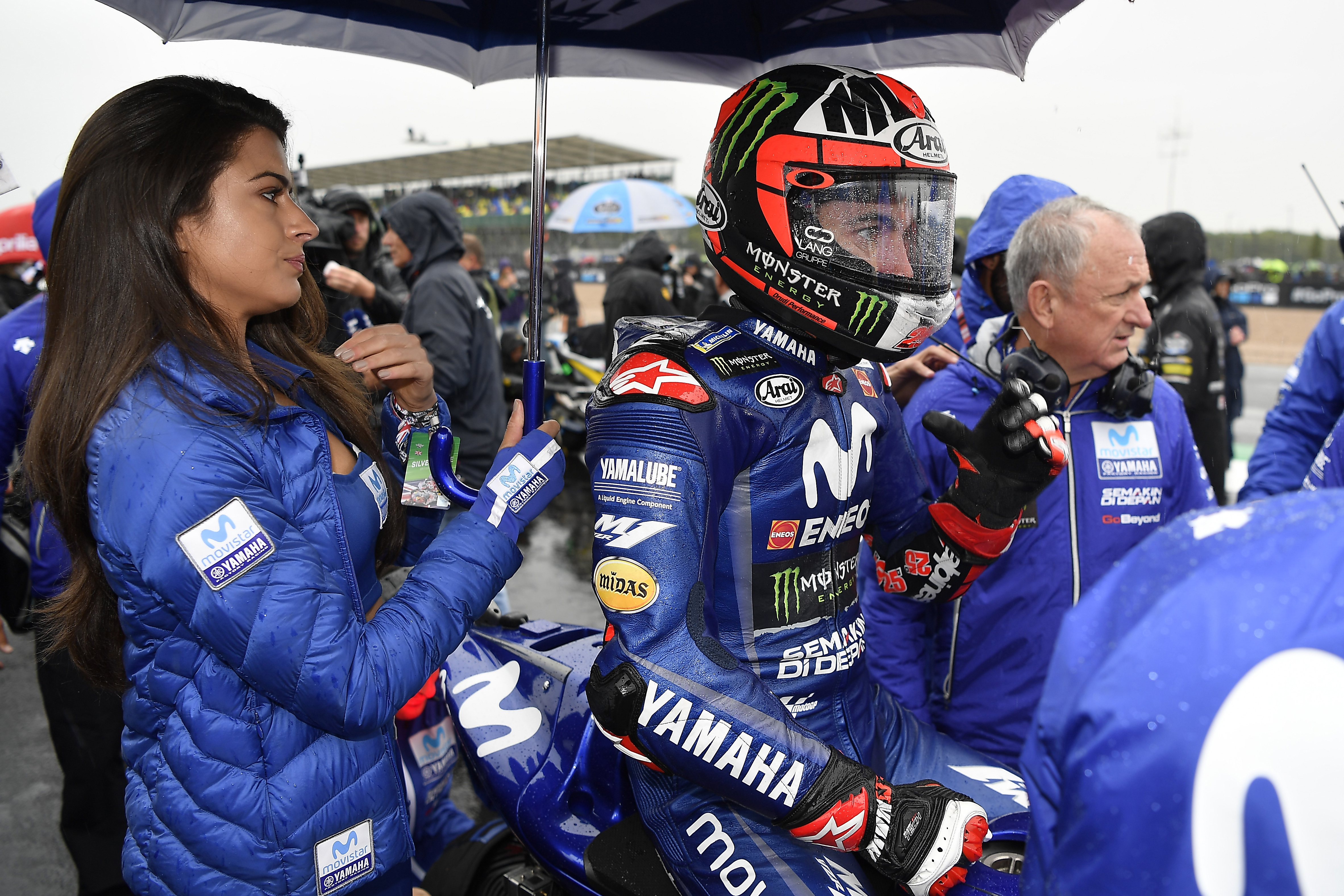
Maverick Viñales on the aborted MotoGP Grid at the British GP. Image courtesy of Yamaha Motor Racing
From there, there were many inspections, and many meetings, before at 4pm the Safety Commission decided that the races should be cancelled, because the track would not be in a good enough order to race whilst there was still enough light to race.
There had been the option to race earlier that was presented to the teams, but they needed warm up (these are 270+hp motorcycles, you need to prepare) and they, as well as the circuit, needed time to prepare the track after the warm up. There are procedures which need to be done for safety in a race meeting, and as a result it was not possible to run any earlier than 11:30.
Then there was the possibility to race on Monday – after all, it’s August bank holiday, everyone is free, right? Wrong. MotoGP relies on a vast number of temporary services, such as security guards, and temporary, rented equipment, such as generators, that have been rented for Thursday through Sunday, not through Monday. On top of that, the people who work in the paddock who pay to get there would have to cancel and re-book flights should they be necessary, which is potentially beyond their realistic means – this includes freelance journalists, photographers and such like. Additionally, and arguably more importantly, the teams cannot afford to stay one more day, especially the private teams who are tight on budget as it is, and furthermore the TV companies do not have the time slots available to them to be able to air races on Monday. It happened in Qatar in 2009, but it happened in Qatar in 2009 because the Losail International Circuit could afford to make it happen, Silverstone couldn’t.
But how did we arrive in this situation in the first place. It has already been explained that the track was resurfaced over the winter, and that it initially was good, and later became not-so-good with the bumps. But the bumps were just one part of the problem.
With a new surface there is one guarantee: for the first year or two, the porousness of the surface will be poor. Think Sepang’s new surface, which takes basically half a day to dry out from just a small shower. It happened to F1 in Korea back in 2010 – the surface had been down for a matter of weeks, so a downpour before the race halted proceedings by an hour and more. The issue was more extreme, though, this weekend in Silverstone, because instead of having poor porousness, it had none. A light shower would be okay, as we saw in Moto2 FP2, that was manageable for the riders; but a deluge like we saw on Saturday, or the prolonged downpour of Sunday was too much for the track to drain, and even drainage ditches and cuts in the track could not help the situation. After so long, the water just started to build up, until you basically ended up with something resembling a lake – and this was after two hours.
The day-long drenching the new Silverstone surface took today was well beyond its drainage capabilities, and mixed with the pooling in the bumps, as well as the polished parts of the track (from cars bottoming out at the end of straights when under maximum loading, causing the abrasiveness of the stones in the asphalt to disappear) it became an impossible situation for the riders, and an equally hard one to call for the Race Direction.
Alex Rins, like the fans waiting for information from MotoGP Racing Control. The 2018 British GP. Iage courtesy of Suzuki Racing
It is at this point that it is important to point out that in 2011 there was an almost identical situation, with rain all day, and all three races went ahead, and just last year in BSB there was a race in biblical conditions, but everyone went out, it was deemed safe enough to ride, although there were only seven finishers. Today was normal rain, nothing spectacular, just normal rain, over a long period of time, which is common in Britain, and it was deemed unsafe.
So, was it Race Direction’s bad decision, did they listen too much to the riders? Well, no. Firstly, it is my opinion that the decision to continue the race last year in British Superbike when so many riders were crashing was a bad one, because it was clearly unsafe (although in the same moment, BSB goes to tracks like Cadwell Park and Oulton Park, which are dangerous tracks, so the standard is maybe lower). Secondly, in 2011 the surface could deal with the water, so aquaplaning was less.
The fact that the new surface could not deal with the water on Saturday, or Sunday, shows that the surface was the issue, and therefore two groups of people are at fault. One is Aggregate UK, who provided and laid the surface over the winter; a surface which was produced and designed in the UK, yet could not absorb any water whatsoever. Second, you have to put some blame at the door of Silverstone, because they employed the services of Aggregate UK. Ultimately, Aggregate UK did a terrible job, they laid a surface which has no drainage and is in fact worse than the one they replaced, and Silverstone have a right to feel cheated by them, as do the fans, teams, riders and the Championship.
In a press conference after the decision to cancel the races, Franco Uncini said that there have been demands for a new surface to be laid at Silverstone for next year, and before that there will be an investigation into why exactly the circuit could not absorb any water. How exactly Silverstone manages to afford another full resurfacing job just a few months after the last one remains to be seen, and it remains to be seen if it is even possible. Once the new surface has been laid, there are intentions to test the track in the wet although there have been admissions from Mike Webb (Race Director) that after the experience of artificially wetting the Losail track earlier this year, it is difficult to see how that could happen.
Ultimately, it was a combination poor asphalt being poorly laid, a remarkable British summer which left the track unprepared for the wet (Saturday and Sunday were probably the worst two days this new surface has seen, weather-wise) and a day with no break in the weather which conspired to create this British MotoGP disaster, and at the moment it is unsure how it can move on from this.
One thing, though, is for sure. Silverstone want to continue to host the British Motorcycle Grand Prix, and MotoGP are keen to continue to have a British Grand Prix. Over the next months we should see whether the British Grand Prix will continue in the near future, and whether it will continue at Silverstone.
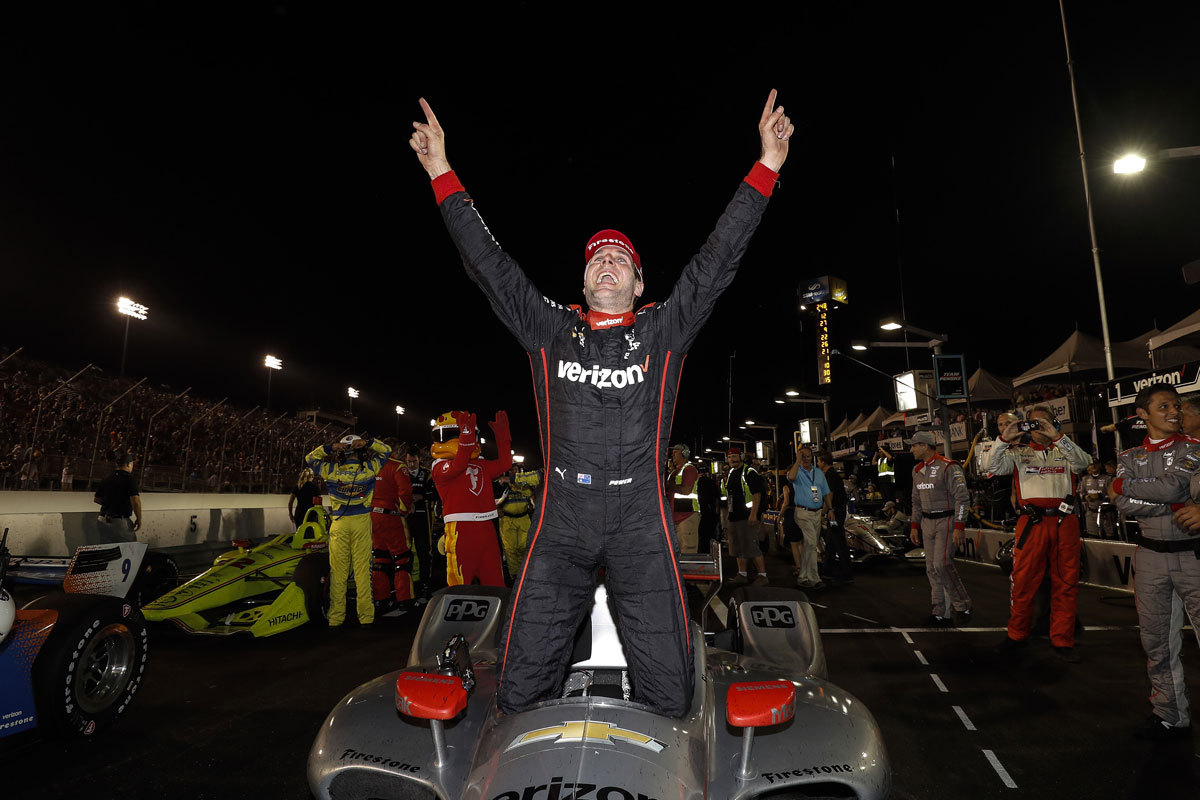
Will Power took his fourth win of the season after a close strategy call saw him take the lead from Alexander Rossi in the closing stages, moving the Australian up to third in the championship. Championship leader Scott Dixon saw his advantage cut by another three points to 26 after he was unable to pass Rossi on the last lap.
Will Power wins the Bommarito Automotive Group 500. Image courtesy of Team Penske
Power didn’t have it all his own way, it was Dixon who took the pole, by virtue of being the championship leader after qualifying was rained off, and Power didn’t lead until 150 laps of the race had past. However, once Power was in the lead, he looked fairly untouchable – that was until Ryan Hunter-Reay caused the second caution of the day, the first coming courtesy of Sebastien Bourdais. This came at a time when it was very touch and go as to whether the drivers could make it to the end of the race with the fuel they had after the stops under the caution.
There were two options: push, burn the fuel and accept that you have to come in for a splash-and-dash or stretch out the fuel to make the end of the race, sacrificing pace. Power, Dixon and the like went for the first option, Rossi, true to his 2016 Indy 500 performance, opted for the latter. It very nearly didn’t work out for Power, but he came out of the pits just close enough to Rossi to be able to get past him – Dixon was not so fortunate with Rossi aided by traffic. Regardless of that, Power was the one who took the victory, putting himself within 70 points of leader Dixon with just two rounds to go.
Rossi remains second in the championship after coming home second on the road with his ambitious strategy not quite paying off. Rewind to earlier in the race and Rossi was trying for a move on then second-placed Power when he drifted high, missing the wall by the narrowest of margins. It was the save of all saves, not just for the Gateway race but also for the championship – a DNF at this stage of proceedings would spell disaster. When the questions over fuel mileage surfaced after the final caution, you could be fairly sure, given his previous form, that Rossi would hang it out until the end of the race, even if no one else did.
For a while, it looked like Rossi’s Andretti teammate Zach Veach might be in for a surprise result when he took the lead following the fuel stops for both Power and Dixon. However, it was too good to be true – Veach had pushed too hard and was forced to pit with just a few laps remaining however, his fifth-place finish is nothing to be ashamed of!
For championship leader Dixon, this race could’ve gone a lot better, given he started on pole, but, equally, it could’ve been a lot worse. This continues his so-so run of races since his win at Toronto, presumably with the championship firmly in mind. Dixon can afford to give two or three points away to Rossi but what he can’t afford is a DNF – it’s a smart move from IndyCar’s ‘Iceman’.
The often-forgotten Penske of Simon Pagenaud had a fairly decent race, finishing in fourth, but it was a tail of what could’ve been after a wide moment cost the Frenchman a sizeable amount of positions. He reckons he would’ve been in the lead battle had that moment not happened but fourth is what he got out of it in the end. The #22 Penske is long out of the championship but insists his future at the team is not under question, despite various silly season rumours surrounding him.
The other Penske of Josef Newgarden had a less than good day, finishing down in seventh and losing yet more ground in the championship – dropping down to fourth. It was a very frustrating race for Newgarden, he couldn’t match the more fuel-efficient Hondas and that was pretty much that for the final stint. It certainly wasn’t the repeat of last year’s victory that he’d hoped for with his gap to the championship lead now large but not insurmountable.
Will Power, Alexander Rossi and Scott Dixon on the Bommarito Automotive Group 500 podium. Image courtesy of Team Penske
Another one to struggle was Hunter-Reay who is now just a few points away from dropping out of championship contention after two straight DNFs. If the crash with Robert Wickens at Pocono hadn’t extinguished his championship hopes, Gateway has with a loss of fuel pressure being cited as his reason for retirement.
Speaking of Wickens, just before the race got underway Schmidt Peterson released the promising news that the Canadian is now breathing unaided and speaking with his family. It’s a long road to recovery for Wickens, but at least there is one. Teammate and close friend James Hinchliffe struggled this weekend, clearly shaken by Wickens’ crash and sporting finger-less gloves as a result of his injuries sustained in that crash.
With Wickens still firmly in everyone’s minds, the paddock moves onto the penultimate race of the season at Portland which marks the end of the last triple-header of the season.