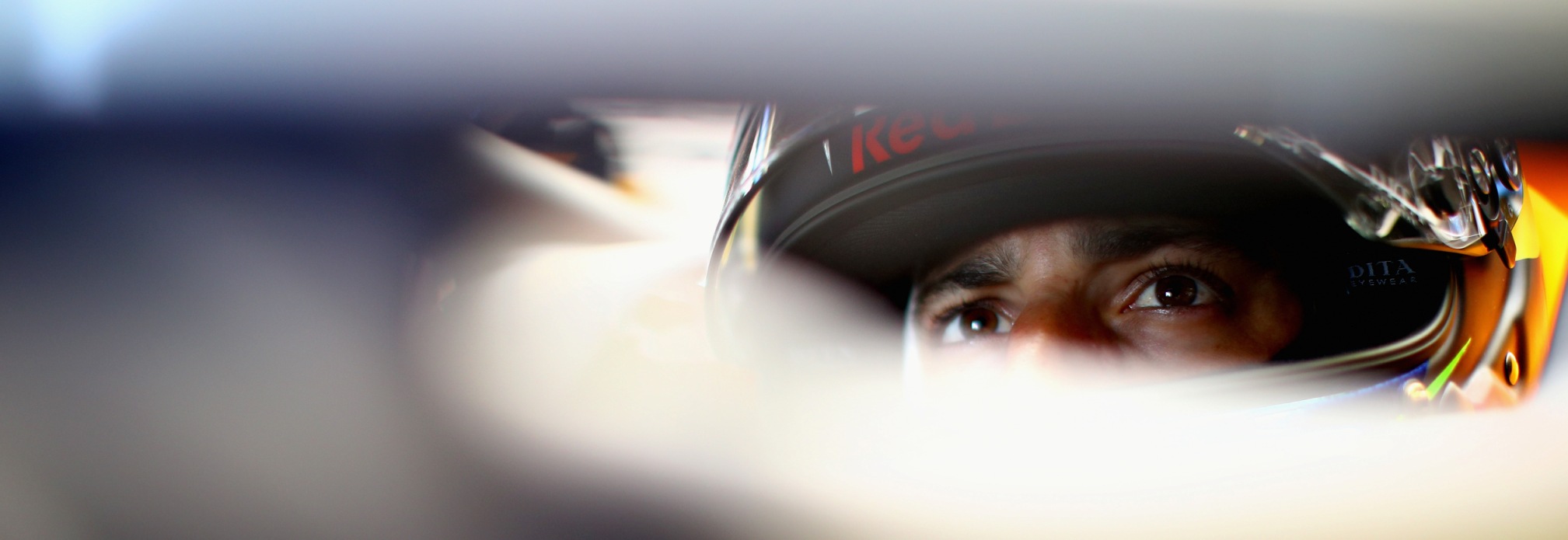
You might have seen that I went a bit viral this week, with my commentary of the England v Tunisia World Cup match. However, despite its players’ fine coiffures and fancy footwork, football is not my sport of choice. I much prefer motor racing. I’ve been a big fan of Formula 1 and other motorsport since I was a young child watching battles between Michael Schumacher and Mika Hakkinen. So, what’s the appeal? After all, there’s no diving in F1 (apart from Piquet Jr that one time, perhaps); the largely sub-par haircuts are hidden under helmets (although Marcus Ericsson and Kevin Magnussen are putting in valiant footballer-esque efforts); and, sometimes, the races are undeniably boring (recent visits to Canada and Monaco don’t so much spring, but limp, to mind).
However, some races have more than their fair share of craziness. Two out of three visits thus far to Baku have resulted in bizarre crashes, last-minute drama and surprise podium appearances (Well Done Baku, indeed). Meanwhile, even in less exciting races there’s usually some drama to discuss, whether it’s a first lap clash or a teammate rivalry. Just like football then, not every race is exciting, but there’s usually still something to talk about.
In place of the referee and VAR we have the all-powerful stewards and their sometimes questionable decisions, and there’s just as much fruitless protesting – only we get to hear it. This has given us gems such as “When did I do dangerous driving?” from an aggrieved Sebastian Vettel, who surely must have known that driving alongside, and then into, Lewis Hamilton under a safety car just might be considered dangerous.
Instead of aerial duels we have, well, aerial duels, with more than a few cars being launched into the air over the years. Even when cars don’t make it off the ground there’s plenty of dramatic crashes and clashes. From Grosjean’s repeated trips into the wall this season to the numerous clashes between Force India teammates Sergio Perez and Esteban Ocon last season, there’s always material for a heated discussion about who was at fault or how an incident could have been avoided.
From a personal standpoint, this season hasn’t been the most enjoyable for me, mainly because I’m a Williams fan, and, unfortunately, they’ve produced a car so terrible it’s often slower than last year’s model. My second-favourite team, Force India, are going through some testing times as well, with poor results on track and financial problems away from it. They have, however, enjoyed a podium this season, with Perez standing atop the third step at Baku, so that has buoyed my spirits somewhat. However, it’s another reminder that, just as in football, you have to take the lows and the highs with your team of choice, and supporting a team or driver adds another level of emotion and intrigue into the sport.
So, what else might we be missing in Formula 1? Football has their transfer season, and we have ours. Will Fernando Alonso stay or will he go? Will Daniel Ricciardo accept a cool 20 million to drive for McLaren? Will Robert Kubica ever return to an F1 race seat? These questions and more keep discussions interesting even when the racing is not.
So, while my forays into football commentary have seen my tweets go viral, and years of tweeting about motorsport have done nothing of the sort, Formula 1 remains the sport closest to my heart. And while I might watch a few more football matches than I used to, nothing will hold my attention like Formula 1 has done for so many years of my life.
This weekend, the 2018 Superbike World Championship heads to California, and the Laguna Seca circuit, home of the famous “Corkscrew”. Negotiating turns eight and nine efficiently this weekend will be critical to achieving a good result, but the puzzle of Laguna Seca is not only limited to its most famous section. Coming over the crest of a hill at turn one on full lean angle and at around 160mph gives a breath-taking start to the lap, which leads straight into the second turn at the double-apex Andretti Hairpin. The complexity of this section means mistakes are inevitable across the weekend, so minimising having a setting to give good confidence when braking on angle is essential for this part of the track. Then the circuit flows right into turns three and four. Three is merely a kink, but it is important to take a good line to be able to make a good turn four. At the same time, in the race, the layout of this part of the track means that the fastest line also leaves you open to a pass, so finding the right compromise will be important in the early laps.
Turn five is a fairly simple, flat right hander, but the radius combined with the relative lack of camber means that it is easy to get sucked in, but the important thing here is the corner exit, because there is then a reasonably long run to turn six through the un-numbered right kink. There is a lot of camber to offer a lot of support in turn six, meaning there is potential for a pass. Turn seven is very fast, on the left side of the tyre. As Always the riders are on the limit of the track boundaries on the exit, and track boundaries in Laguna are enforced not by the Race Direction but by the run-off areas themselves, which are largely gravel – rest easy Mr. Haydon. After the run down the Corkscrew, it is the tricky Rainey Corner, where the riders push the front hard as the downhill run continues before another heavily cambered corner at the penultimate turn. Finally, the last corner is the best overtaking spot, as highlighted by Eugene Laverty in 2013, but as Casey Stoner showed in the MotoGP race back in 2008, it is also quite easy to make a race-deciding mistake at turn twelve.
Image courtesy of Honda Pro racing
Chaz Davies best mastered the Californian circuit in race one last year, which was a remarkable victory, only two weeks after he was run over by Jonathan Rea in Misano race one. This year, it is not physical issues which have the potential to hinder Davies this weekend, but rather problems with the bike. Davies has struggled since Imola, and especially in Donington and Brno. In Donington, Davies suffered his worst weekend of the season, missing the podium in both races; then, in Brno he suffered again, but with some crashes in race two he was able to make the podium. Laguna has been a good track for both Davies and the Panigale in recent seasons, and the Welshman will be hoping to make a return to the top step.
It was Jonathan Rea who took victory in the second Laguna Seca race last year, and the form he is in at the moment would suggest another double could be coming the way of the new ‘most victorious’ rider in World Superbike history. He took that record from Carl Fogarty in race one in Brno two weeks ago, but contact with his KRT teammate Tom Sykes left him as a spectator from lap three in the second race. The frustration from the incident was put to one side, though, as he put pen to paper on a new two-year deal to pilot the ZX-10RR until 2021. As for this weekend, Rea and Davies have been the two to beat around Laguna since 2015, and with the Welshman currently in a difficult moment, this weekend could well be a Johnny Rea domination.
But maybe Marco Melandri can take it to the reigning World Champion. He should have won race two in Brno but made a mistake at turn three which put him out of contention. Melandri made the podium last year in race two, and may prove to be the only rider with any hope of stopping Rea taking yet another double. However, if his instability issues reappear this weekend, Melandri could have a bigger problem in Laguna than anywhere else – few places require total confidence, especially in the front end, as the Weathertech Raceway.
What about Sykes? Well, he took two wins in Laguna – one in 2013 on his way to the championship, and the other in 2014 when he shared the winning that day with Melandri, the last time the Italian won in Laguna. He took a pair of second places in 2015 behind Chaz Davies and in front of Rea both times, before he took a third US win in 2016. A podium was followed by a crash two weeks ago, and with his record in Laguna Seca, this weekend could offer an opportunity for Sykes to expand on his solitary victory of 2018 so far.
Perhaps the biggest question for this weekend is: what can the Yamahas do? Three race wins out of the last four races, across both riders, and including a double for Michael van der Mark in Donington one month ago leave the R1s under significantly more pressure to perform and achieve big results, especially with the Ducati riders having fairly large question marks over the heads of their competitiveness, as well as Sykes. The Pata Yamaha riders could be the biggest contenders to Rea this season, ad they have to be in a good position to be able to try to challenge the championship leader.
The Aprilias could also have something to say this weekend, with Eugene Laverty making good progress at Brno a couple of weeks back, taking a sixth in race one and a fourth in race two. He was backed up, too, by Lorenzo Savadori who, despite having a bonfire underneath his rear tyre for most of both races, managed to shadow his Milwaukee Aprilia teammate to take seventh in race one and fifth in race two. Coming here, Laverty was confident of being able to achieve podium results, and the progress in the last races would point towards being able to get near that. Maybe they are quite far away, still, but with some luck they might be able to get themselves on the box. Laguna has been a good circuit for Laverty in the past. He only has two podiums, but has only ever raced there once on competitive machinery, in 2013 (when both podiums came), including a stunning win in the second race that year.
There are also three Americans on the grid this weekend: the two WSBK regulars, Triple M Honda’s PJ Jacobsen and Red Bull Honda’s Jake Gagne; and the wildcard Josh Herrin on a Yamaha.
After a much-needed weekend off (for some at least) the IndyCar paddock are back in action, this time at the road course of Road America in Wisconsin. We are now over half-way through the season with clear title contenders starting to emerge but, as always with IndyCar, it’s still anyone’s game.
Last time out was the night race Texas Motor Speedway where Scott Dixon took all the glory with a dominant win, giving him the championship lead after the previous leader, Will Power, came to blows in a collision with Zachary Claman De Melo which was ultimately the former’s fault. The as-yet miserably unlucky Simon Pagenaud finally got his break with a second-place finish ahead of Alexander Rossi who was once again risking it all with daring overtakes.
Championship-wise, Dixon leads the pack with a 23-point advantage over Rossi who in turn has another 13 points on Indy 500 Champion Power. Ryan Hunter-Reay is the only other man who remains within a race-wins distance of Dixon, being 49-points back. Reigning champion Josef Newgarden is 68 points off the lead and then it’s a sizeable jump back to Graham Rahal and rookie Robert Wickens. Time is starting to become of the essence with a championship looking more and more unlikely for Newgarden or anyone currently behind him however, this is IndyCar… anything can happen!
Josef Newgarden At Texas. Image courtesy of media.gm.com
The last running of Road America was won by Dixon in what was a relatively even race for both Honda and Chevrolet, with the latter looking to have the slight edge – whether that will be the case this year remains to be seen. Following Dixon home was the eventual champion Newgarden who headed the Penske quartet of himself, Helio Castroneves, Simon Pagenaud and Will Power.
Other than a few minor spins and brushes of the wall, the only major incident was when Tony Kanaan hit the wall quite heavily at Turn 11 following an unsuccessful attempt to pass Rossi. The grass margin between the track and the rather unforgiving walls helped quite a few drivers last year and, with no rain scheduled, it should do again this year.
Road America is, as the name suggests, is a road course so qualifying will be split into the three normal parts starting with two groups of twelve, followed by a single group of twelve and then the all-important Firestone Fast Six.
There are just two driver changes for this weekend; Jordan King is back in the #20 Ed Carpenter Racing car, taking over from the boss while Force India Junior Driver Alfonso Celis Jr. will be making his IndyCar debut in the solo Juncos entry.
With nine races already done, there are eight to go, including Road America, so every race is getting that bit more important for the championship contenders. The usual lot of Andretti, Penske and Chip Ganassi should be strong along with Schmidt Peterson who will be hoping for a return to their better form after a run of harder races for the squad.
After the unsociable times of the night race at Texas, this weekend’s IndyCar times are much more UK friendly with all the practice and qualifying sessions live on IndyCar’s streaming channels and the race being shown live on the BT Sport/ESPN channel. There will also be commentary for both qualifying and the race on our Twitter channel if you’re unable to watch them. The timings for the weekend are as follows:
Most Successful Driver: Alain Prost (4 x Wins – 1983, 1988, 1989, 1990)
Paul Ricard was a famous pastis, and often saw sport as an effective tool in marketing. He was the first commercial sponsor of the Tour de France. He decided to invest into a track and saw it as a huge gap in the market. This track was built in 1969 and first used in 1970. Formula 1 had a contract from 1971, it was used on and off until 1990 generally sharing with Dijon.
Paul Ricard sadly passed away in 1997 and some of his assets were sold on. In 1999 Excelis, owned by former chief executive of Formula 1 Bernie Ecclestone brought the track.
The track had serious investment placed into it, as it hadn’t been used frequently. It was developed into one of the most advanced test tracks in the world. It was recently used for Formula 2 and their pre-season testing programme. The most recent use for Formula 1 though was for wet tyre testing in May. Pirelli manually drenched the track to get knowledge on a new wet tyre they were researching.
France Gp tyre and circuit layout courtesy of Pirelli
The majority of track when first opened was the Mistral Straight, it was 1.1miles long. Elio de Angelis in 1986 testing had a horrific crash which resulted sadly in his death. The track was not at fault, it was a failure on the car, but the straight was shortened to make it safer to prevent such high speeds. They ran on a shorter track for the Grand Prix for the remaining 5 years, 1986 to 1990.
The track has been modified further for 2018, Mistral Straight’s length is what it was prior to de Angelis’ death but they have placed a chicane in the middle of it. This is to keep it safe with speeds down as well as with slipstreaming and DRS to create a further overtaking opportunity.
The track is great for the F1 fans due to the high speeds and its flowing nature. Great for the paddock too as there are three French drivers on the grid, Gasly, Grosjean and Ocon.
Looking at the circuit it should suit Mercedes better especially if the new engine is ready. With having a slight advantage on the straights expect to see Force India and Williams closer in the midfield battle.
The French Grand Prix returns to Paul Ricard this week, ten years after the last race in the country was held. Spare a thought for all the teams, who will no doubt be bracing themselves for the prospect of Formula One’s first ever triple-header, with the French, Austrian and British Grand Prix all taking place over the coming weekends.
Last time out in Canada was something of a shock to the system for many. Past form would have suggested Mercedes were set to dominate the weekend, but that was not the case at all. It may not have been the most exciting race in the world – it was really so very, very far from that – but Sebastian Vettel was sublime all weekend and he cruised to victory from pole position, followed home by Valtteri Bottas and Max Verstappen. With Lewis Hamilton in P5, it means that Sebastian Vettel is now in the lead of the championship, by just one point.
Ferrari won the last French Grand Prix – which was held at Magny Cours in 2008 and was won by Felipe Massa – and Kimi Raikkonen is one of only two drivers on the current grid, the other being Fernando Alonso, who have won the Grand Prix before. The power unit upgrades Ferrari introduced for Canada proved fruitful, and with Paul Ricard’s long straights you can expect the team to go very well again this weekend.
Mercedes, meanwhile, are set to finally introduce the power unit upgrades that were originally meant to be brought in for Canada, but were ultimately delayed because of quality control issues. There is no getting away from the fact that they were very underwhelming in Canada, and will definitely be grateful for the upgrades in France given the nature of the track.
Max Verstappen finished P3 in Canada – the first race this season that he has put in a weekend without incident – continuing Red Bull’s tradition in the hybrid era of performing better there than otherwise might be expected of them. With Daniel Ricciardo also finishing in the top five, and both drivers happy with the upgrades introduced, there is no apparent reason to suggest that Red Bull won’t be able to replicate that sort of performance in France.
Force India’s Esteban Ocon’s first win in a single-seater was actually at Paul Ricard, and he believes that he is potentially on for a good result this weekend. “On paper, the track should suit us,” he said, “with a long straight and some slow corners where we can use our car’s mechanical grip really well. It’s a track which will be new for everyone and we’re usually good at finding a set-up quickly, so I’m not too worried.”
Renault are currently enjoying their best start to a season since they returned to F1 as a works team in 2016, and they head into their home race having been bolstered by the power unit upgrade they brought in Canada. They are a respectable P4 in the WCC, 16 points ahead of McLaren. If both Renault and McLaren perform in France as they did in Canada, expect that gap to grow considerably.
Last time out at the Canadian Grand Prix, Haas introduced a new front wing and floor plus a revised bargeboard, and they are optimistic that these will suit the layout of the Paul Ricard track after two consecutive races of not getting either car into the points. This will actually be Romain Grosjean’s first home race in F1 – his rookie year was in 2009, a year after the last French Grand Prix took place – so expect him to be especially keen for a good result.
Both Toro Rosso drivers are similarly optimistic about what they might be able to achieve in the race. Pierre Gasly, for whom this is also a first home race in F1, has either won or at least gotten on to the podium every time he has raced at Paul Ricard, and Brendon Hartley, who crashed out of the last race in Canada along with Lance Stroll after contact between the pair, has said: “Paul Ricard is a circuit I know well, although not in a Formula 1 car. We did a lot of testing there with WEC in the LMP1 car and I won the LMP2 category in 2013. It was always a popular track for endurance testing and I’m also pretty handy round there in the night-time, although that’s not going to come into play in a Formula 1 car!”
Circuit Gilles-Villeneuve, Montreal, Canada Sunday 10 June 2018. Fernando Alonso, McLaren, and Stoffel Vandoorne, McLaren, on the grid. Image courtesy of Andy Hone/McLaren ref: Digital Image _ONZ4265
Speaking of the World Endurance Championship, there is no doubt that the majority of the off-track spotlight will be on McLaren’s Fernando Alonso, fresh from winning the 24 Hours of Le Mans alongside his #8 Toyota co-drivers Sebastien Buemi and Kazuki Nakijima. However, it may be a case of coming back to reality with a bump for Alonso, as well as for team-mate Stoffel Vandoorne. They struggled around Canada – Vandoorne finished two laps down in P16 and Alonso retired – and with Paul Ricard’s long straights it may unfortunately be more of the same for the Woking-based outfit.
Charles Leclerc is on a very impressive run of performances at the moment. In Canada he finished ahead of Gasly, both Haas cars, the McLaren of Stoffel Vandoorne, Sergey Sirotkin and even Sergio Perez in the Force India, and managed to hold off Fernando Alonso in several wheel-to-wheel duels before the Spaniard retired from the race.
Williams’ Lance Stroll is a lot more muted about the track than some of his rivals. “I know [it] from when I drove in Formula 3. I had a good time there and won a race, but I have to be honest because I can’t say I like it,” he said in Williams’ race preview. “It is just run offs everywhere and I am not a big fan.” As mentioned, he crashed out of the Canadian Grand Prix on the first lap – that just about sums up the luck he and the Williams team have been having this year – but maybe don’t expect the French Grand Prix to be the best place for a turn in fortunes.
Featured Image courtesy of Getty Images / Red Bull Content Pool
This weekend sees, for the first time ever in Formula One’s 68-year history, three race weekends on the bounce, starting at the returning French Grand Prix. Ahead of the weekend, let’s take a look at what the upcoming French GP means to our sport.
In a word; everything. Paris was where motorsport was born; the first ever motor race was held in France, and it was from there that the idea of championship racing in single-seater race cars was formed. F1, without France just, well, wouldn’t be what it is today.
It also sees a look back to the hallmarks of, unforeseen to us back then, a great rivalry in F1 today. In the last race in France in Magny Cours in 2008, Lewis Hamilton was given a penalty for an overtake on… yep, you guessed it, a young German by the name of Sebastian Vettel.
It would have seen a dominant win for Kimi Raikkonen. However, with a massive lead, his exhaust came loose. It saw a remarkable scene of the exhaust pipe bouncing along the ground, causing a severe drop in power and the risk of the Ferrari donkey imploding. He was caught and passed by team mate Felipe Massa, and Ferrari remarkably still managed a one-two finish.
This weekend will be the home Grand Prix for Pierre Gasly, who has made an extremely impressive start to his F1 career, Esteban Ocon of Force India, and Romain Grosjean for Haas; what a time this would be to score his first points of the season and end his draught. It will also be Renault’s home Grand Prix, headed by French boss Cyril Abiteboul and advised by Alain Prost, this will be a big weekend for them. Look out also for the continuation of their exciting battle with Force India and McLaren for fourth in the Constructor’ Championship.
This weekend, however, the race will be staged away from Magny Cours; at the Circuit in Le Castellet in South East France; just a short trip away from the beautiful city of Marseille. Paul Ricard last hosted a Grand Prix way back in 1990, won by home hero Alain Prost.
So who are the favourites? On the face of it: Mercedes. Paul Ricard is very much a power track that will suit themselves and Ferrari very well, but perhaps more Ferrari with the location and the increased heat that is expected to suit their car. Looking at it now, it does not really appear as though Red Bull will be troubling them all that much, but as Murray Walker once said, anything can happen in Formula One, and it usually does, so let’s wait and see.
Formula One has come a long way since then; heroes have come and gone, circuits have opened and closed; while some things have stood the test of time.
Most of all, it represents a trip back to F1’s roots; a chance to appreciate the humble beginnings of what is now a global empire, and despite the changes since the takeover by Liberty Media, some things can never change. It’s good to have you back on the calendar, France.
Featured image courtesy of Getty Images / Red Bull Content Pool
Red Bull and Renault started off as the perfect love story; good performances, good results, the first win and one-two in 2009, and just the four championships in a row.
However, this wasn’t to be the fairytale ending. The partnership between the Austrian team and the French engine manufacturer has ended up as a splattered mess all over the carpet, and now Red Bull, following three-and-a-half years of arguments, will now embark on a new relationship.
Truth be told, it isn’t by choice. If you run through the list of options that Red Bull had for engine suppliers, you’ll find that Honda was the only name on it. Aston Martin, who not only have shares with the team but are now also incorporated in the name, are not expected to be able to supply engines until 2021. With the big engine regulation changes coming into force in three years, it would be a wasted investment for them, not mentioning the difficulty of coming into the sport and making an engine straight away, such are the technical and financial complexities of building modern day Formula One engines.
Honda, therefore, will be supplying engines next year to Red Bull. The question is, will it work?
Well, despite the torrid three seasons Honda experienced supplying McLaren, there is promise in that Red Bull junior team Toro Rosso have been using Honda engines this season, and have actually been a fairly competitive midfield team. Their relative performance has not really changed from last year. Couple that with the much tighter chassis that McLaren run compared to the Austrian and Italian Bulls, and Red Bull might just be alright.
Furthermore, it looked from the outside as though Honda, when supplying McLaren were frankly incompetent, but with the news breaking out about McLaren employees forming a rebuke against the team’s management and even contacting former team Principle Martin Whitmarsh for support, it seems that a big part of the blame perhaps did have to fall to McLaren, with stubborn management an apparent lack of willingness to work with others. Let’s not forget that, under Renault power, McLaren have actually not improved much at all.
So what happened with Renault? Well, it was all going smoothly until the end of the V8 era. The V6 turbo engines proved all too much for Renault; lack of performance and reliability led to limited and frustrating running in pre-season in 2014, and it all went downhill from there.
After 2015, Infiniti, who were also working technically with Red Bull, parted ways with the team, and Red Bull, having salvaged some sort if supply deal with Renault, opted to replace the Renault name with Tag Heur on their cars.
A series of reliability issues for Max Verstappen and Daniel Ricciardo last year was the final straw. The inevitable happened, and Red Bull will now be racing with engines from the Japanese manufacturer from next season onwards.
Who exactly will Honda be supplying? We know Max Verstappen will be one of the names, having signed a new contract With Red Bull late last year, but the other is less secure. Daniel Ricciardo, despite winning 2 races so far in 2018, is strongly considering a move elsewhere – perhaps to Ferrari to team up again with Sebastian Vettel if and when Kimi Raikkonen retires, which may well be at the end of this season. That could then see a move up to Red Bull for young Frenchman Pierre Gasly, or maybe Carlos Sainz, who is on loan at Renault from Red Bull.
Honda, you have to feel, is very much a short-term solution for Red Bull as they wait for Aston Martin’s arrival, but let’s see what they can manage next season, and whether Honda can repair their reputation so badly damaged by their time with McLaren.
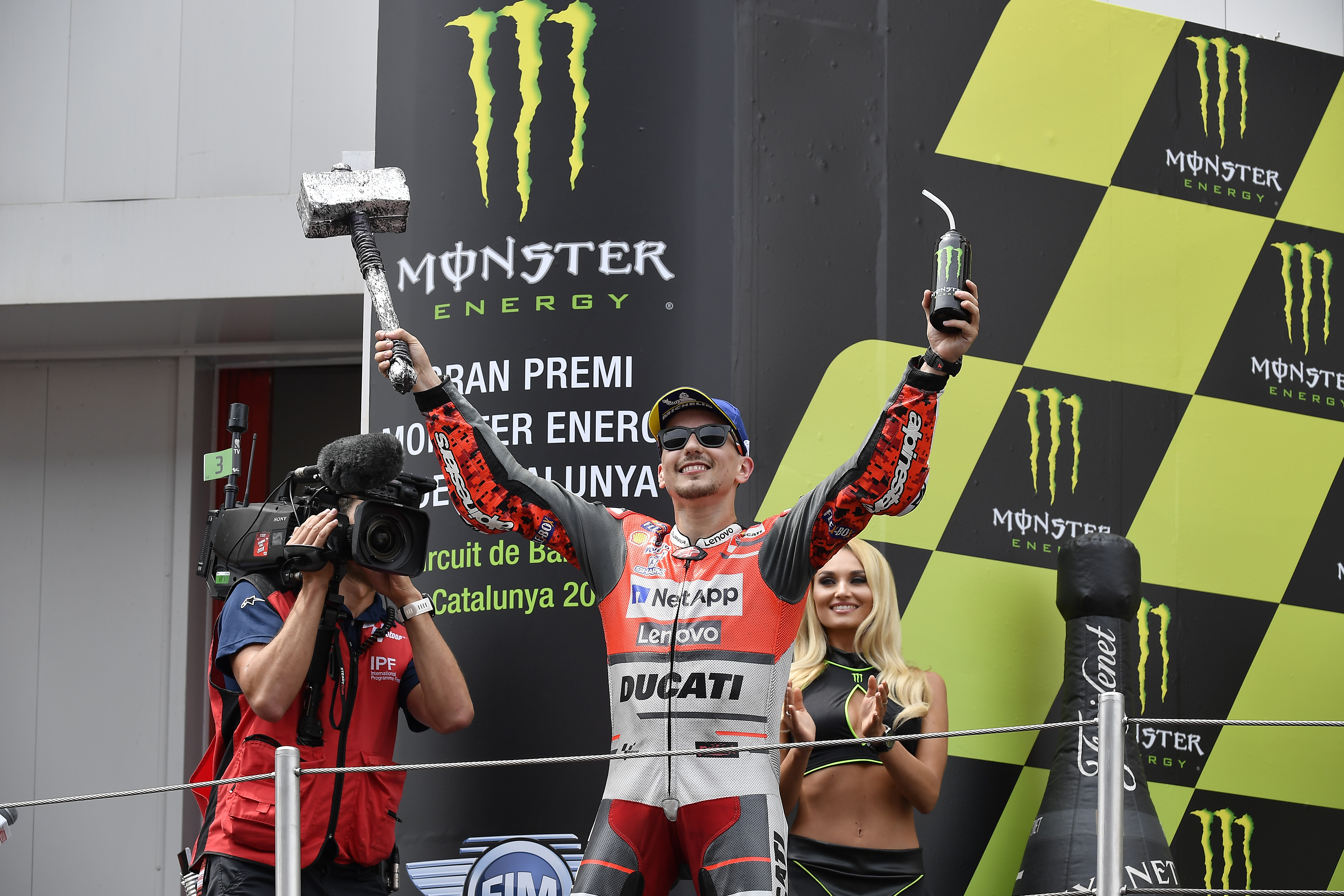
Jorge Lorenzo qualified on pole position for the Catalan MotoGP, with a stunning final sector on Saturday afternoon. It was his first Ducati pole and gave him the perfect opportunity to put his superior pace to use, and demolish the field as he had done two weeks previously in Mugello. His only real threats came from Marc Marquez and Andrea Dovizioso, who had shared similar pace with each other across the weekend and had the potential to upset Lorenzo’s rhythm.
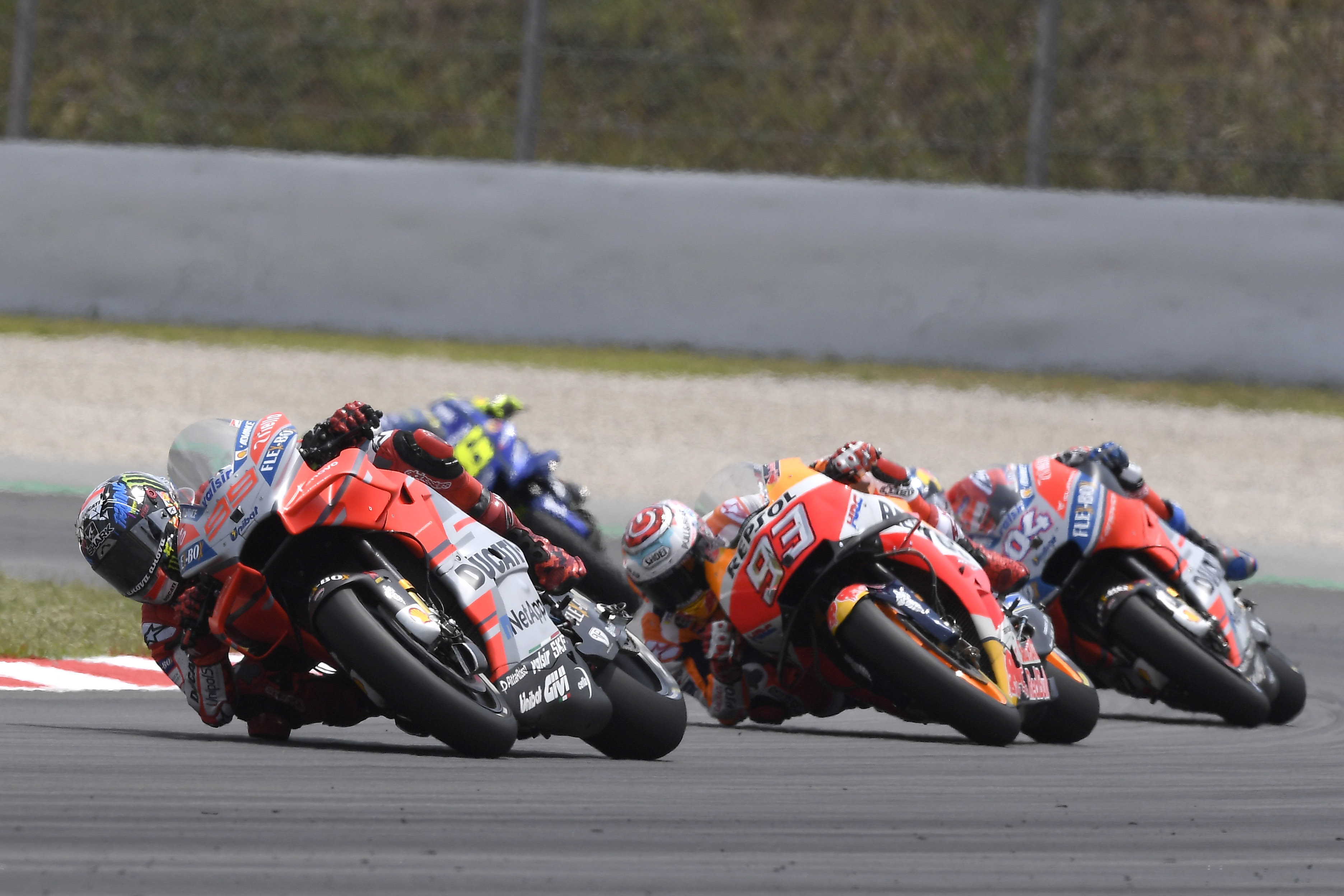
Jorge Lorenzo ahead of Marc Marquez and his teamate, Andrea Dovizioso . Image courtesy of Ducati media
Marquez made a great start, whereas Lorenzo did not, and made it into first place, with the buffer of Andrea Iannone’s Suzuki between him and Lorenzo. However, the number 29 ran wide when trying to pass Marquez for the lead on lap one in turn 10, allowing Marquez back through and the #99 Ducati into second place as well. This let Lorenzo line up perfectly a pass into turn one. Marquez defended the inside as hard as he could but Lorenzo was unstoppable on the brakes.
From there, Marquez tried to stay with Lorenzo and, despite looking at ease, he was clearly on the limit because, when Dovizioso crashed behind him at turn five on lap nine, he dropped the pace and let Lorenzo go by two seconds, preserving his second place and the twenty points that come with it.
Jorge Lorenzo’s pace in this race was incredible. Between lap seven and thirteen, his lap times were separated by less than one tenth of a second, and over the whole race only 1.2 seconds separated his fastest time from his slowest. This was vintage Jorge Lorenzo and when he rides like that, there is no one person on the planet who can stop him.
Of course, demolishing the best riders in the world two races running opens up inevitable questions about a World Championship challenge. Can he do it? Probably not, but possibly. Over the past two races we have seen that Lorenzo has the pace to win races, the problem is that they were both at circuits he adores. We haven’t yet seen how he might go at a circuit he is less suited to. Another problem is that he is forty-nine points behind Marc Marquez in the championship, and it’s perhaps fair to say that taking two race wins out of Marquez and with twelve rounds left is not so easy. Furthermore, Lorenzo is not as consistent as Marquez. Where a bad weekend for Marc in the remaining races might be a fourth or a fifth, it could be a lot worse for Jorge, especially if the track conditions are neither wet nor dry. Speaking of which, Assen is next, the birthplace of Jorge Lorenzo’s wet weather demons, courtesy of the crash he suffered in the Thursday practice at the Dutch TT back in 2013 in which he broke his collarbone. In the years since 2013, Lorenzo has only managed to podium in Assen once, in 2015 on his way to World Championship number five.
After Assen comes Sachsenring, another of Lorenzo’s weaker circuits; and the other thing that Assen and Sachsenring have in common is that Marc Marquez loves them both: he has five wins in Holland and is unbeaten since 2008 in Germany. However, if Jorge can somehow keep the gap to Marquez below fifty points after the next two races, the ones which come after the summer break are far more favourable: Brno suits, both him and the bike, as does Austria. He goes well in Silverstone and the Desmosedici won there last year in the hands of Dovizioso.
Misano is the perfect place to be an enemy, Lorenzo’s favourite role! Aragon is one of his best circuits during the season and he is the only one, other than Marquez to win there since 2013. In Japan too, Lorenzo moulds Motegi into his circuit by focussing on corner exit and acceleration from low speed, Phillip Island again suits his style, so long as it does not provide changeable conditions. He has always enjoyed Sepang and he was under the lap record there in this season’s winter test and lastly Valencia is another of his best circuits. Thailand is a question mark, but in theory the Ducati should work quite well there. So, Lorenzo can fight for the championship, but the next two rounds can eliminate that possibility.
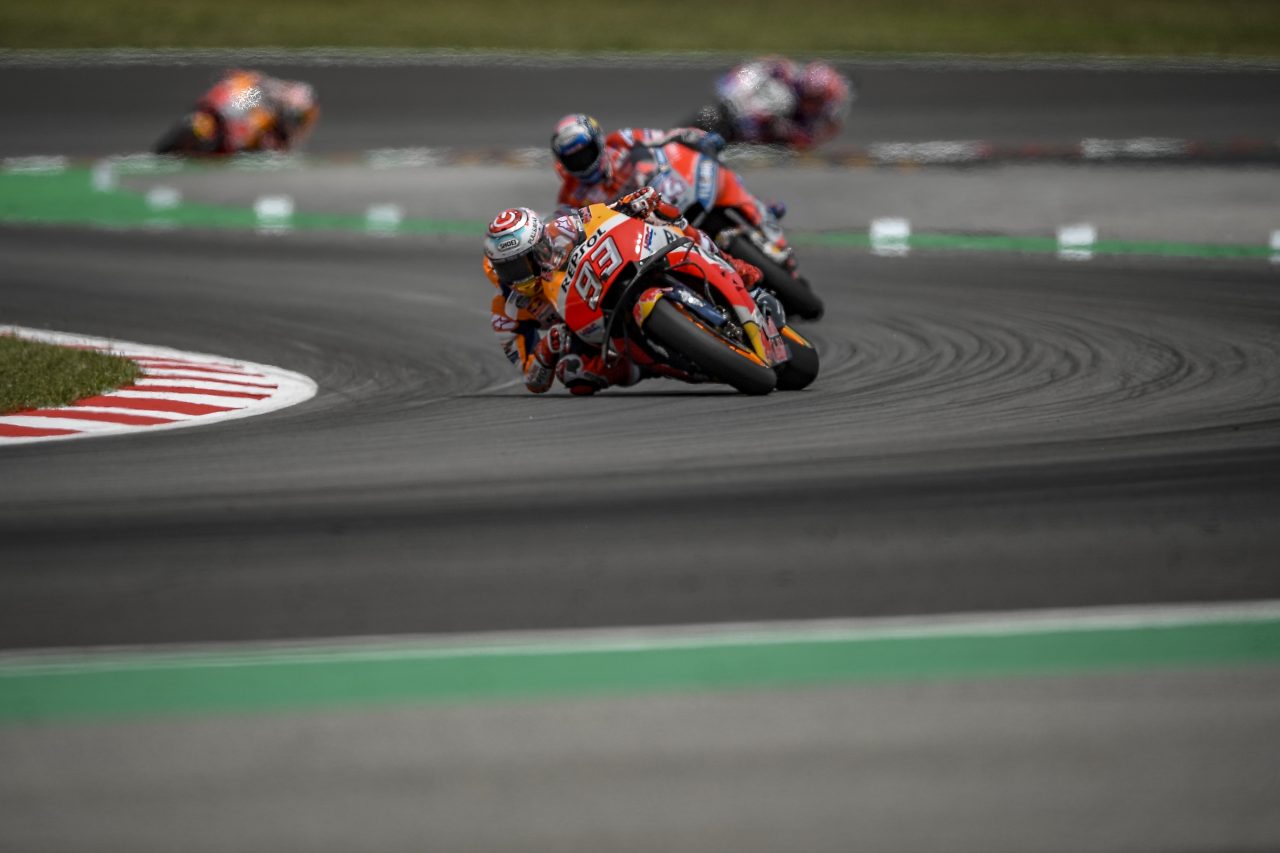
Marc Marquez unable to keep with the pace of Jorge Lorenzo. Image courtesy of Honda Pro racing
For Marc Marquez, the race was perfect. He missed the win, but that does not matter. After Mugello, Andrea Dovizioso had closed down the Spaniard’s advantage in the championship to 29 points – a recoverable margin. But after Barcelona, Dovi is precisely as far back as Lorenzo: 49 points. Furthermore, Marquez’s advantage over the factory Yamahas increased to 27 over Valentino Rossi, with Maverick Vinales a further eleven back. With Assen and Sachsenring being races Marquez can definitely win, he could have the title all but won by the summer break.
Valentino Rossi’s race proved uneventful and yet it exceeded expectations. He did not have the pace of either of the factory Ducatis or Marquez, but the crash of Dovizioso allowed the number 46 to recover a podium position, more than he could have expected. In Assen next time out, it will be almost precisely one year since he or Yamaha last won a Grand Prix, but despite this the Italian is still in mathematical championship contention. There still needs to be more found from Yamaha with the acceleration of the M1, and what they tried in the Monday test after the race did not aid that, but with what he has there is no questioning the great job Rossi is doing, and in Assen you can never discount him.
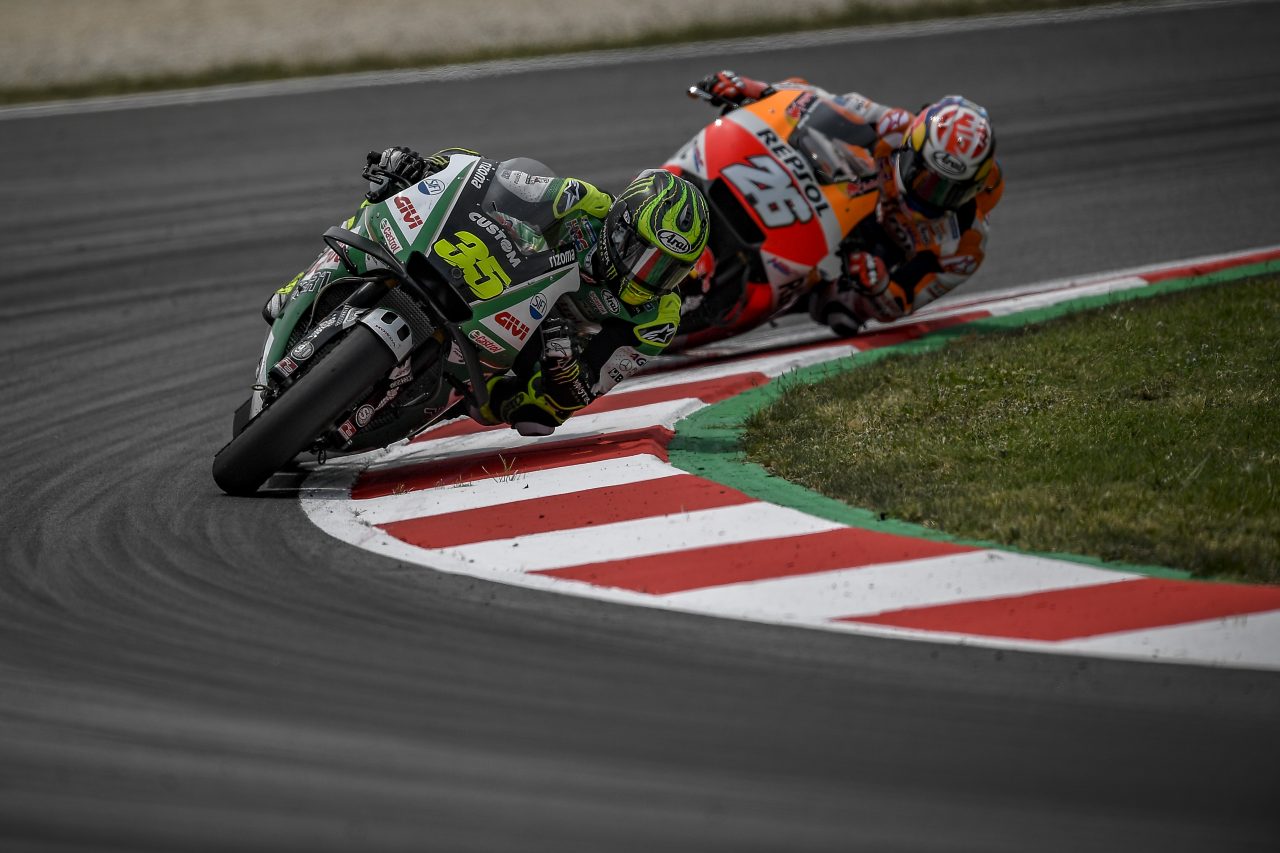
Cal Crutchlow ahead of Dani Pedrosa. Image courtesy of Honda Pro racing
Cal Crutchlow finished fourth. He was embroiled in a mid-race battle with Dani Pedrosa and Danilo Petrucci, but upped and left just quick enough to evade the attentions of Johann Zarco and Maverick Vinales when they turned up in the fourth-place battle with just a few laps to go. In truth, it seemed that Cal could have finished on the podium in the first part of the race. He took over one second out of Valentino Rossi when he was chasing down Pedrosa and Petrucci, and dealt with the number 9 quickly, only for his charge to be halted by Pedrosa, whose defence was very strong. Crutchlow also ran wide in turn 10 at one point to hand the fifth position back to Petrucci, and that meant that it was only with seven laps to go that he passed Pedrosa for fourth place. He duly departed, but was too late to do anything about Rossi. Anyway, a fourth place finish from eighth on the grid was a good result for Crutchlow, especially as he went against the Honda grain by using the soft rear tyre.
Dani Pedrosa did a similar thing, using medium tyres front and rear, rather than the hard-hard combination which was more expected from the Hondas. This worked for him in the beginning of the race, because he had enough grip, but also enough support, to make a good pace. However, by the end of the race, he had no rear grip left – edge grip nor drive grip – so he had little to fight Crutchlow with. Even still, he positioned the bike very well, which is why it took Cal so long to get by the number 26, but in the end tyre grip won out, as usual, and Pedrosa wound up in fifth place, just ahead of Maverick Vinales.
And what a disappointing race it was for Vinales. Through the weekend he had spoken about how he had worked to be more comfortable in the race, how he felt he had found something for the first five laps. But he had no chance from the start, from which he put the M1 in reverse and fell through the pack to the back end of the top ten. Whilst his teammate, Valentino Rossi, and also Johann Zarco, are able to be aggressive in the first laps, Vinales is not, and this issue must be fixed if he is to win races. This is not a new thing, though, it was the same last year: in Qatar, he did not get going until halfway through the race. It was the same story in Argentina. In Assen he crashed trying to recover from a bad qualifying and a poor start and he could have won in Phillip Island had he started better. The difference is that now, these poor starts ruin his whole race because he cannot overtake – whereas he was able to still come through to the podium or even win in 2017 after a bad start, in 2018 he can go nowhere. The worst thing for Vinales is that it is only him having the problem, and whilst he is suffering with this, the other side of the Movistar Yamaha garage is enjoying its fourth podium of the year and third in succession. Something has to change in the #25 box, and quickly.
One positive for Vinales, is that he was three seconds clear of Johann Zarco at the end of the race, which didn’t look remotely likely before Le Mans. Since then, though, the Frenchman has become a little bit invisible. It was somewhat expected in Mugello, because Johann struggled there last year, but in Barcelona, he finished fifth last year, so only seventh place this year seems a bit odd. But, next up is Assen, and for Johann that is the scene of his first MotoGP pole position which he took in wet conditions last season. Hopefully for him he can have another good weekend this year in Holland to get his season back on track.
Danilo Petrucci had a strong start to the race, but suffered towards the end, no doubt with tyre wear, and could only manage eighth place. seven seconds behind him was Alvaro Bautista who scored his fourth successive top ten finish with ninth place, a couple of seconds clear of the factory Suzuki of Andrea Iannone who had a bizarre race, going from challenging for the lead on lap one to being 24 seconds away from the win by the end, and down in tenth place.
Pol Espargaro. Image courtesy of Markus Berger/KTM media
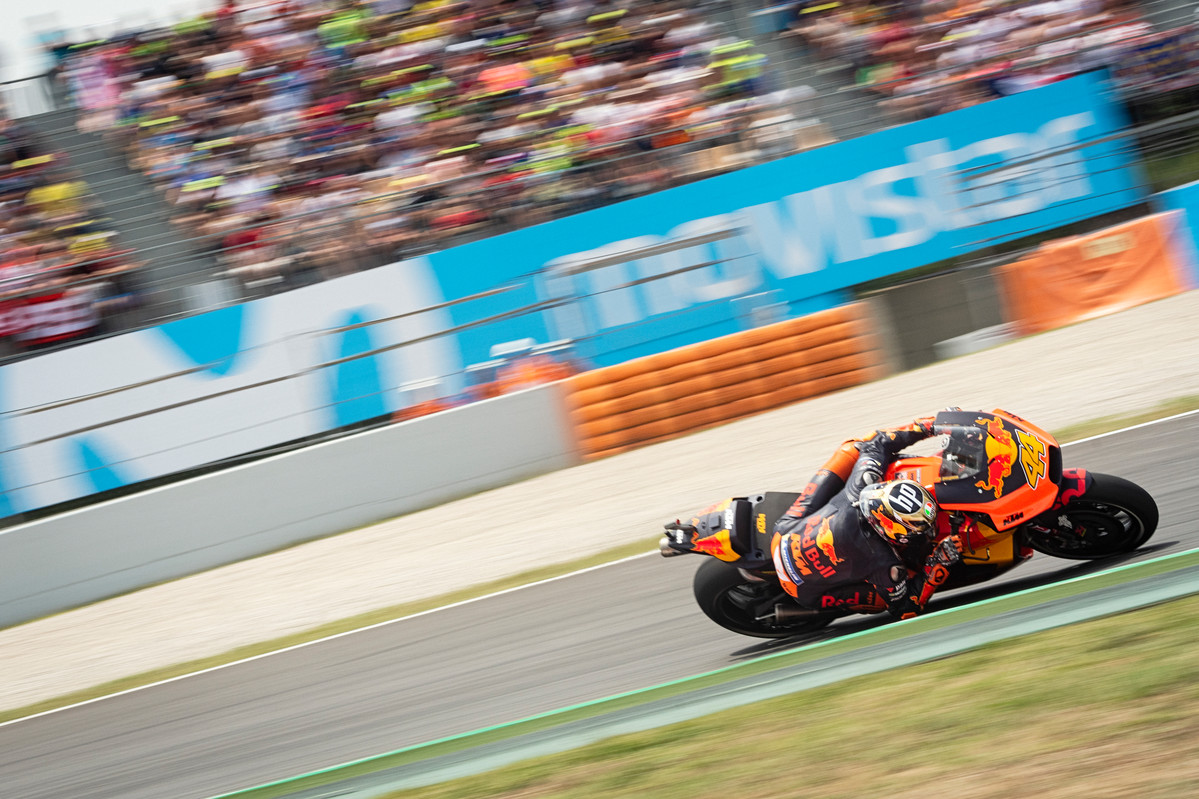
Pol Espargaro took KTMs best result of the season in eleventh place, ahead of Scott Redding who had a good race to twelfth – a good result after probably his best weekend on the Aprilia. Thirteenth went to Karel Abraham, who was the final finisher. Franco Morbidelli was fourteenth, but classified three laps down.
Only fourteen classified finishers leaves plenty of retirements: Mika Kallio was the first to go on lap one; then Sylvain Guintoli crashed out two laps later; Tom Luthi went one lap after Guintoli; Aleix Espargaro crashed one lap after Luthi; then came Simeon’s exit with seventeen to go; one lap before Dovi crashed; then Rins retired with thirteen laps left; two laps later Taka Nakagami folded the front in turn five whilst trying to pass Bradley Smith, and took the British rider with him; Jack Miller crashed with seven to go; Tito Rabat’ Ducati blew up one lap after Miller bowed out; and finally Hafizh Syahrin had a strange crash at turn four.
A race of attrition, then, in the premier class for the Catalan GP, but it was Jorge Lorenzo who came out on top. Can he continue this form in Assen, or will Marquez reclaim his authority in the 2018 World Championship?
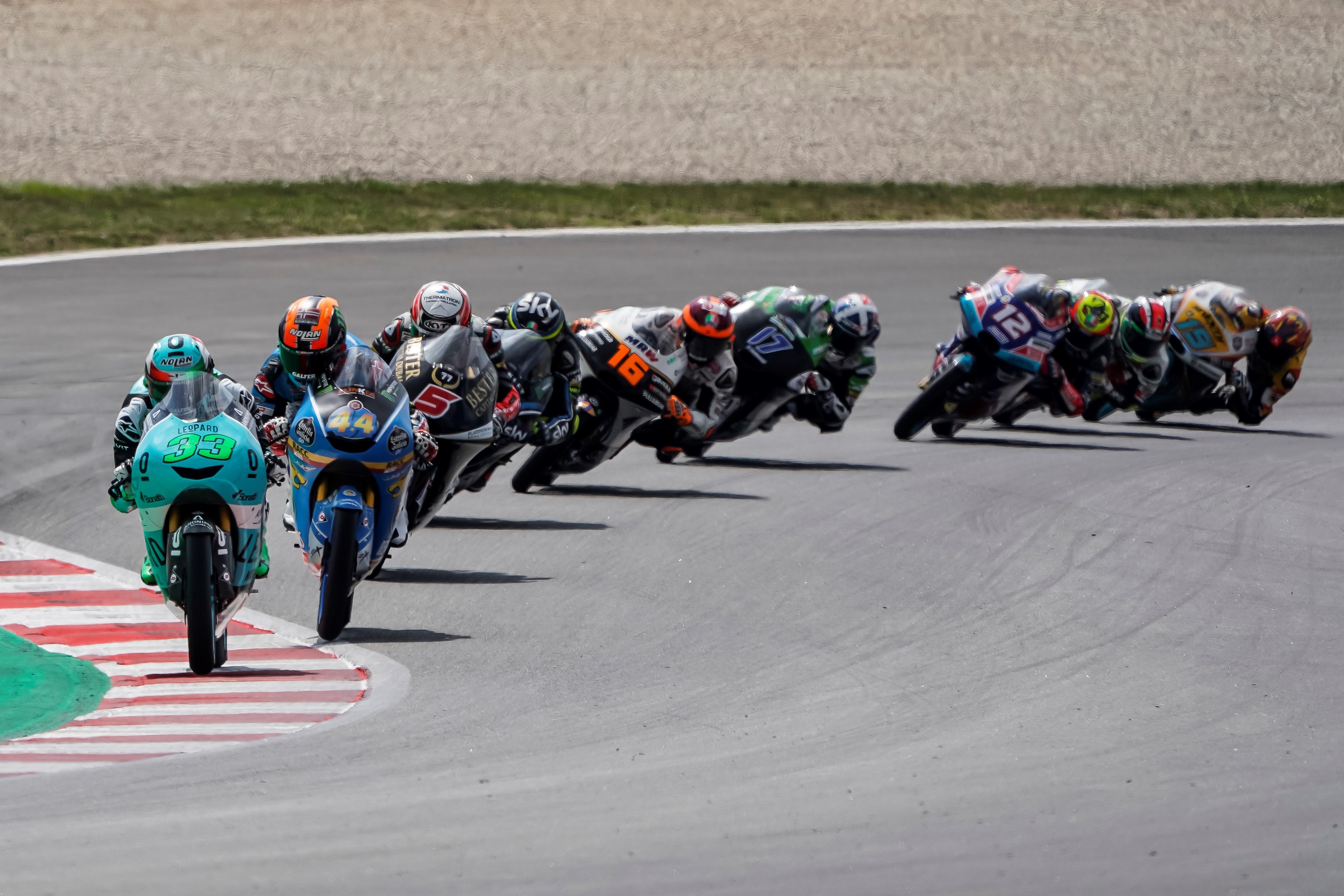
The seventh round of the 2018 Moto3 World Championship looked, in the early phases, to be a fairly straightforward, uneventful affair, at least in the fight for the lead. Jorge Martin bolted immediately, only Tatsuki Suzuki able to go with the Spaniard. It looked set, Martin would win, eventually breaking the Japanese, and assume the championship lead.
Moto3 2018: Round Seven – Barcelona, Catalunya image courtesy of hondanews.eu
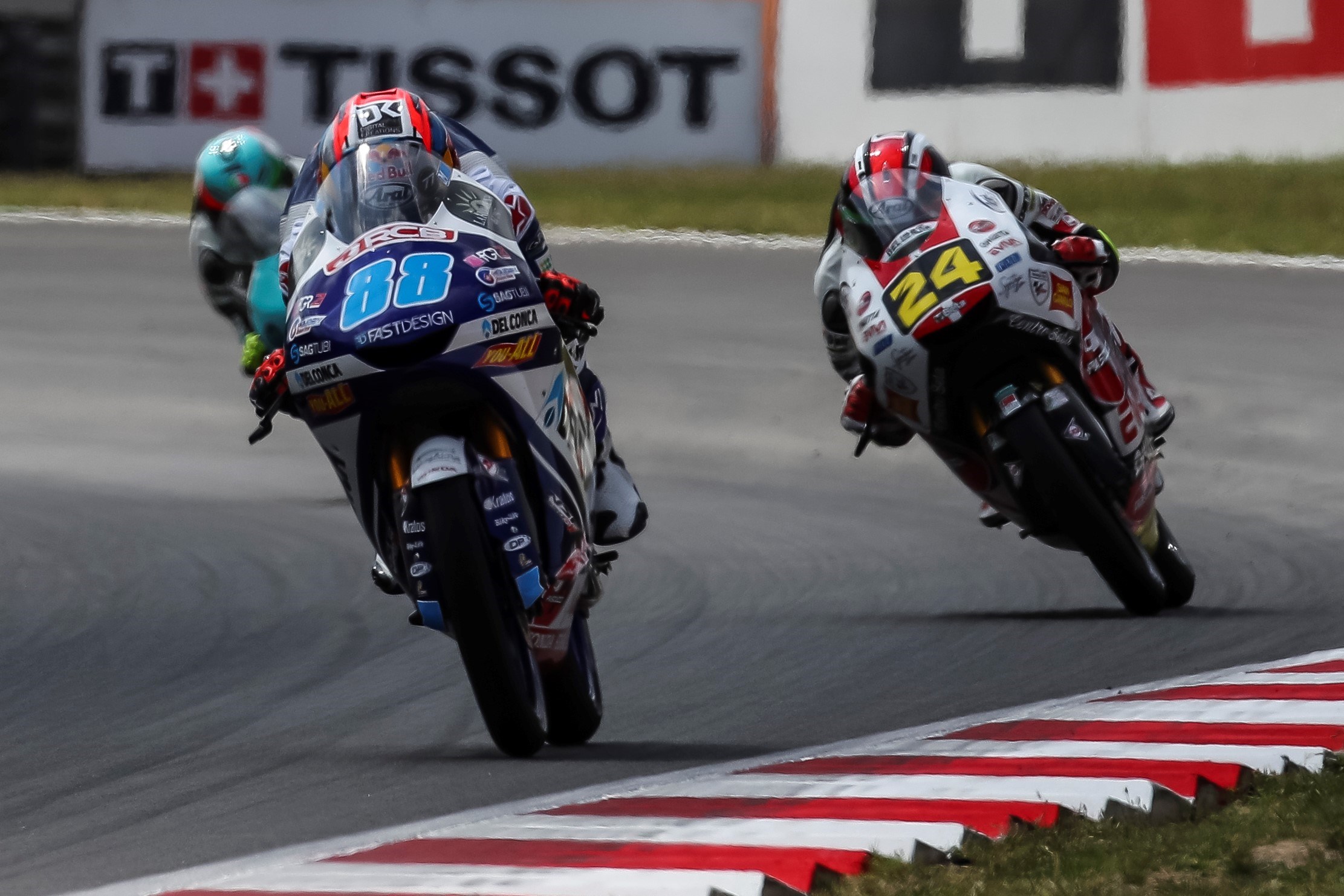
But it did not go like that. It was not Suzuki who faltered, it was Martin, crashing at turn nine on lap nine. He tried to re-join but the bike wouldn’t allow it. Suzuki duly fell back to the chasing pack of about ten or eleven riders, unable to maintain the pace Martin had previously been setting which had been good enough to pull the pair clear.
The drama was not done there, though, as Aron Canet and Albert Arenas came together into turn four with six laps to go and took down Nicolo Bulega in the process. Bulega had returned to the front-running pace this weekend, and felt he had the potential to win the race. When he was taken out, he was angry and expressed that to Canet and Arenas who at the time were both lying on the floor; Canet eventually carried away on a stretcher whilst Arenas was able to walk off. Bulega’s anger at the incident was understandable; he had finally gotten back to the front of a Grand Prix after spending all of last year at the back end of the top ten, and all of this year fighting for last, and crashing. That said, putting that before the safety of your competitors when they are clearly suffering is not perhaps the best way to go about things. Canet and Arenas were both largely unharmed in the incident, as was Bulega, and that is the most important thing.
The craziness did not end there: Jaume Masia made contact with John McPhee as a result of avoiding Marco Bezzecchi at the end of the pit straight. Masia lost control and collected Andrea Migno when he fell. Again, both riders were okay, but this time there was less anger in the gravel trap, and Masia was as apologetic as was to be expected, which Migno acknowledged.
That left five bikes in the leading group: Enea Bastianini, Marco Bezzecchi, John McPhee, Gabriel Rodrigo and Tatsuki Suzuki.
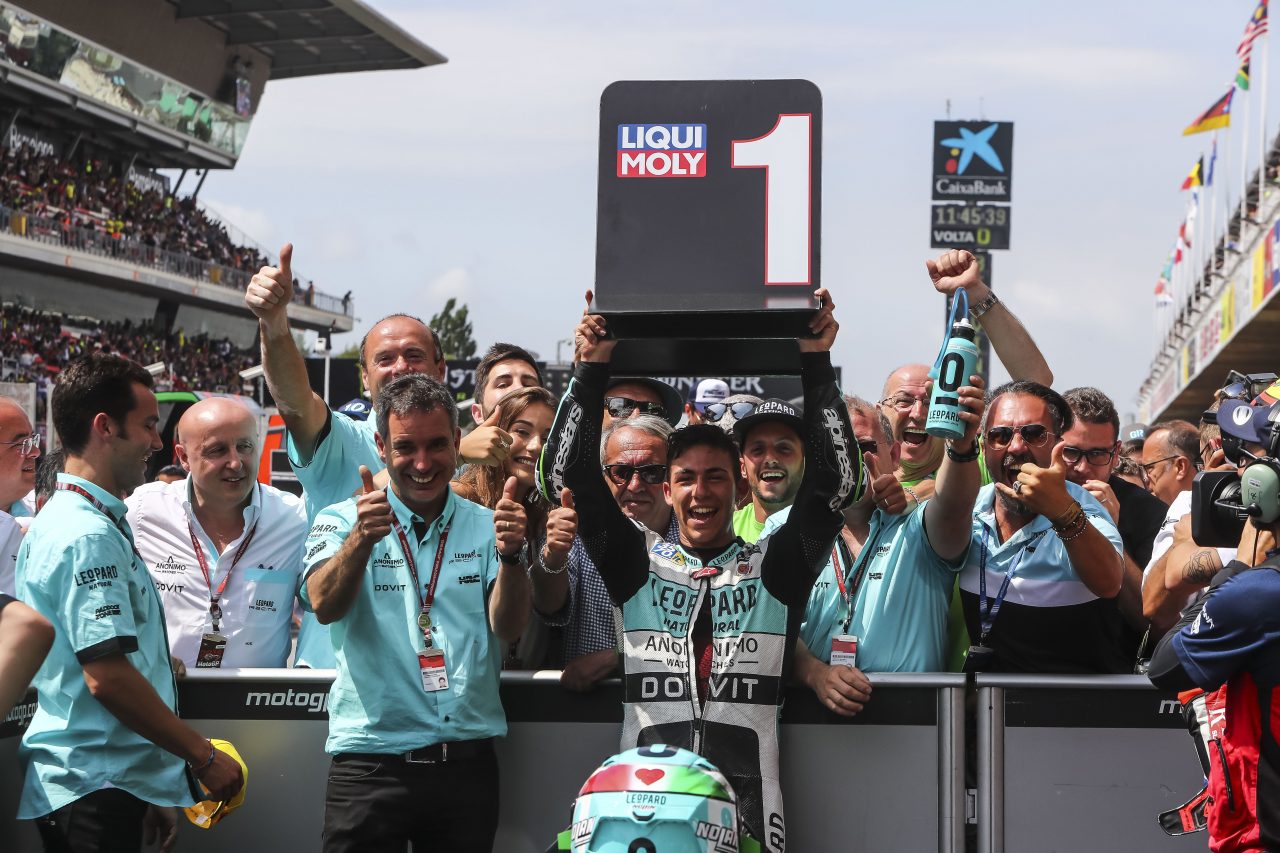
They had six laps to sort themselves out, and in those six laps it was Bastianini who took charge, and broke away just enough in the final stages of the race to put himself out of danger into the final corners, as he took his first win of the season, and first since Motegi 2016 when he beat Brad Binder with some stunning late-race pace. This win was different, though, for Enea, because it was his first outside of Gresini, and it also brought him into championship contention. He climbed up to fourth in the championship, and now sits thirty-five points behind table-topping Bezzecchi, but, perhaps more importantly, twelve points behind Jorge Martin who still surely has the be the championship favourite. There are another four points in front of Martin to Fabio Di Giannantonio, but the Italian’s poor weekend in Barcelona showed a weakness in his season which could cost him in November.
Bastianini celebrating his win. Image courtesy of HondaProRacing
So, Bastianini is back in the championship hunt with this victory, but it is Marco Bezzecchi who remains atop the standings after he snatched second place from Gabriel Rodrigo on the line. It had been a tough weekend for Bezzecchi, struggling to find a good feeling with the PruestelGP KTM across all three days, but he still managed to arrive in the podium, showing his strength and potential in this season – even when things aren’t quite correct, Bezzecchi manages to be there and score important points for the championship. His strength is his consistency, and this is highlighted by the statistic that the Italian has finished on the podium in every race which he has finished. Bezzecchi is in the championship hunt 100%, it’s just hard to believe he can be there at the top until the end.
Third place went to Gabriel Rodrigo, who claimed his first podium of his Grand Prix career. There is no doubt that Gabri deserves this, he has been challenging near the front for a few seasons now, only for crashes to take him out of contention. Unfortunately, crashes are still a big part of his racing, but if he can find a way to finally phase them out somewhat, he can be a regular podium contender.
John McPhee took fourth place, his best result of the season, and it shows what he can achieve when he makes a good qualifying. As he becomes more in tune with the CIP-Team Green squad, surely results such as these will only become more recurrent for the Scot, as he surely looks to find himself a Moto2 ride for next season.
The only man who could match Jorge Martin’s pace at the start of the race, Tatsuki Suzuki, could in the end only manage fifth place. Still, it is a much better result than he picked up in Mugello, and also his best result of the season – his previous best being sixth in Le Mans. Kaito Toba led the second group home, with a sixth place finish, his career best, ahead of Di Giannantonio who recovered from running off track at turn five to finish seventh and move into second in the championship. Alonso Lopez came from the back of the grid to finish eighth in the second of his four home races; Dennis Foggia took his first top ten finish as a full-time Grand Prix rider with ninth palace which is a good result from a difficult weekend; and Raul Fernandez rounded out the top ten, which is very impressive from the Spanish wildcard – surely we will see him in the GP paddock full-time next season.
Eleventh place went to Jakub Kornfeil, ahead of Makar Yurchenko, Adam Norrodin, Nakarin Atiratphuvapat and Livio Loi rounded out the points. Philipp Oettl was sixteenth and the seventeenth and final finisher was Lorenzo Dalla Porta.
Darryn Binder was the first retirement on lap one. He was joined on the side lines by: Kazuki Masaki, Jorge Martin, Marcos Ramirez, Ayumu Sasaki, Tony Arbolino, Albert Arenas, Aron Canet, Nicolo Bulega, Andrea Migno and Jaume Masia.
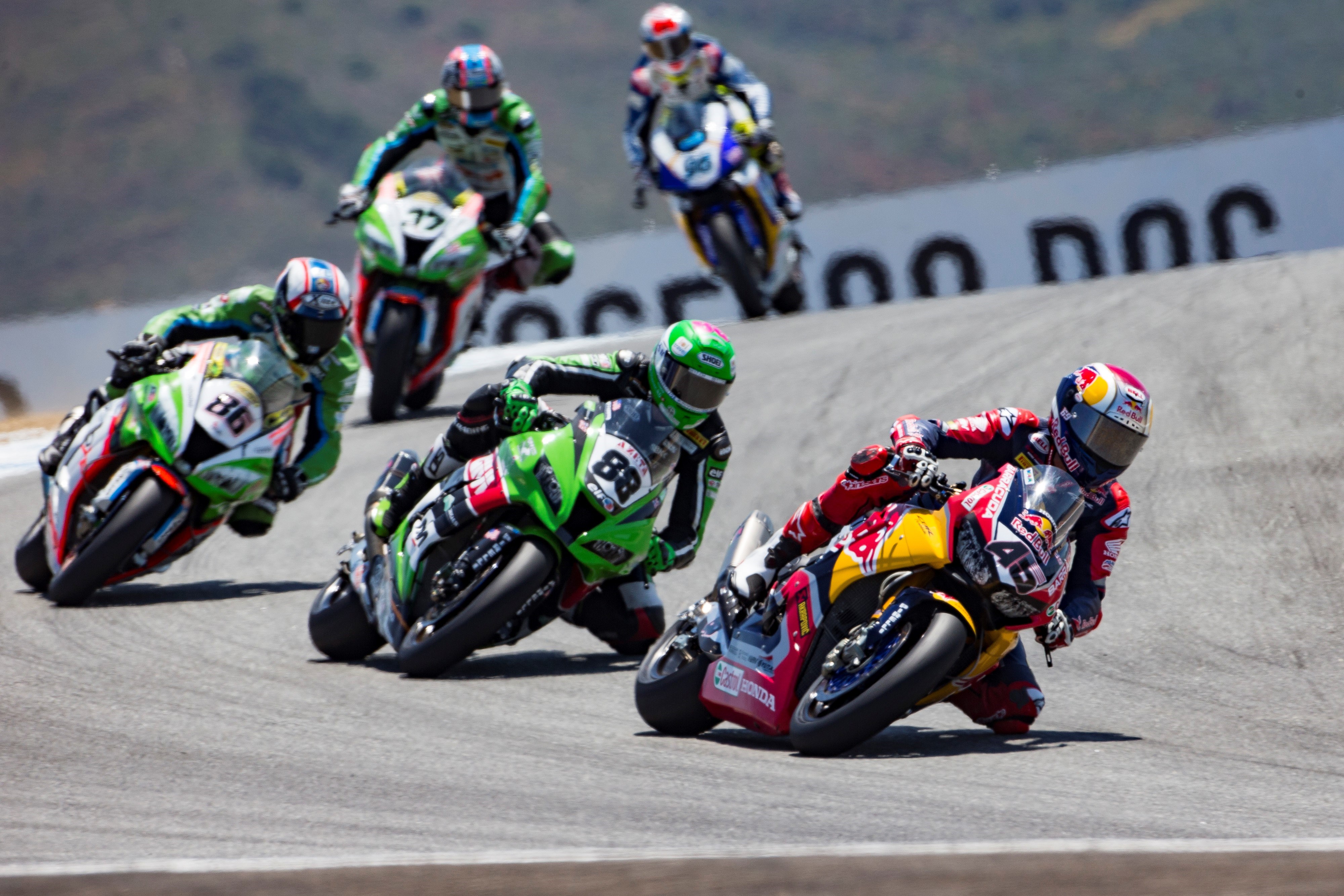
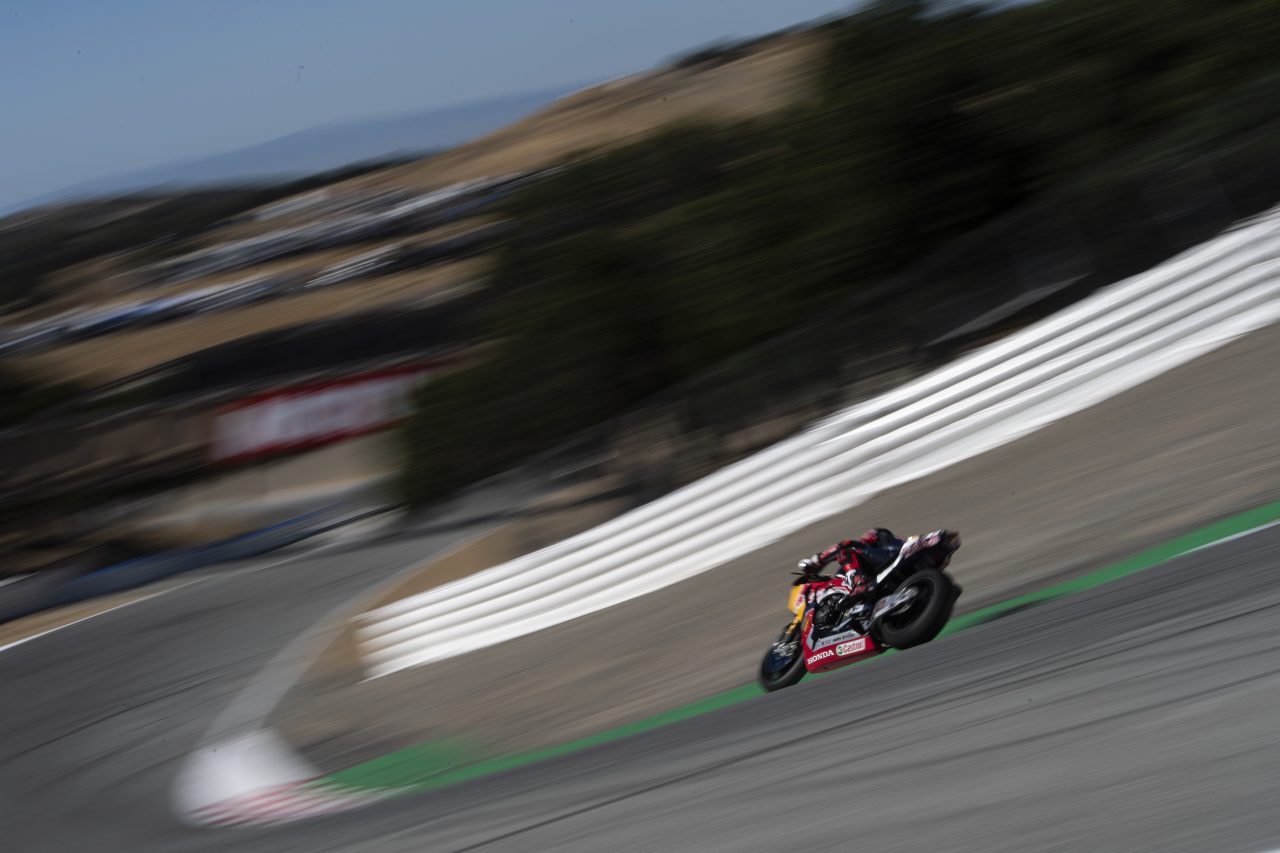
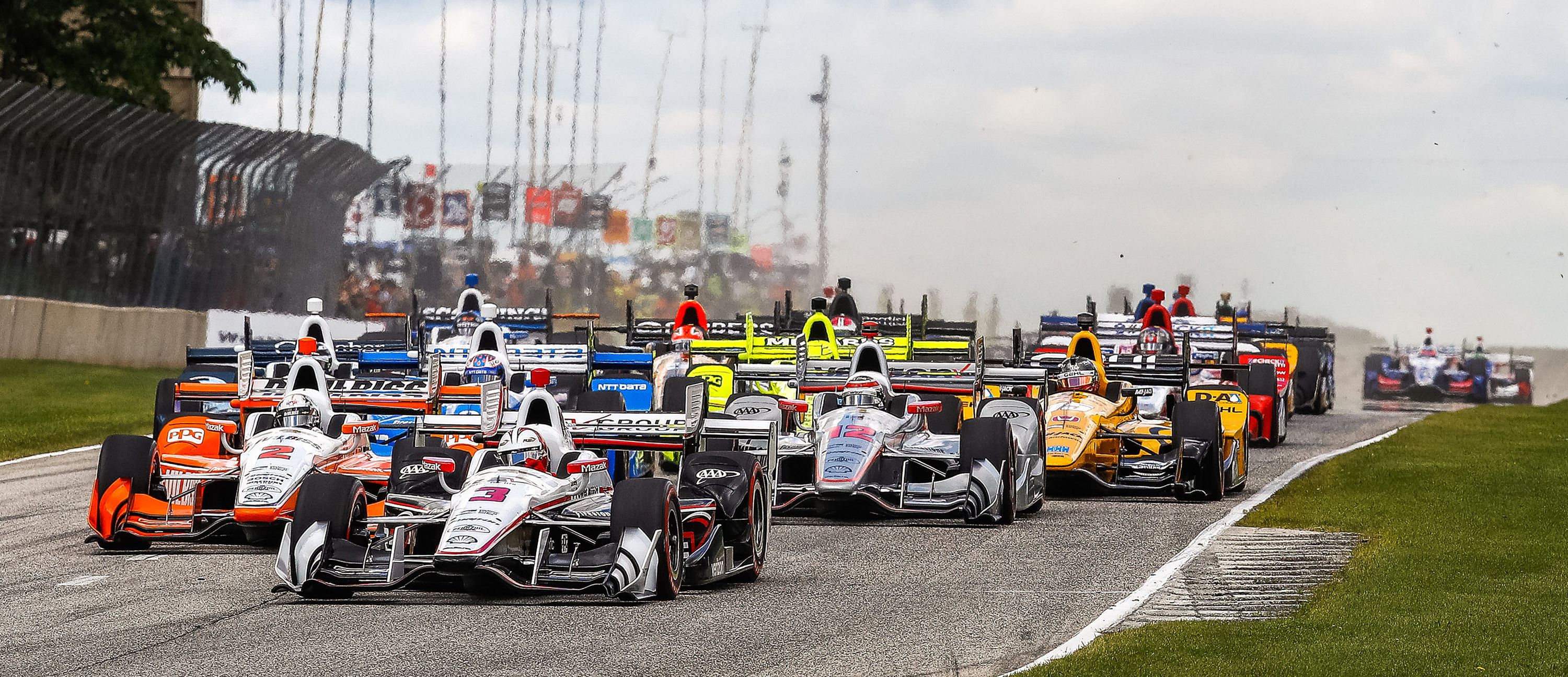
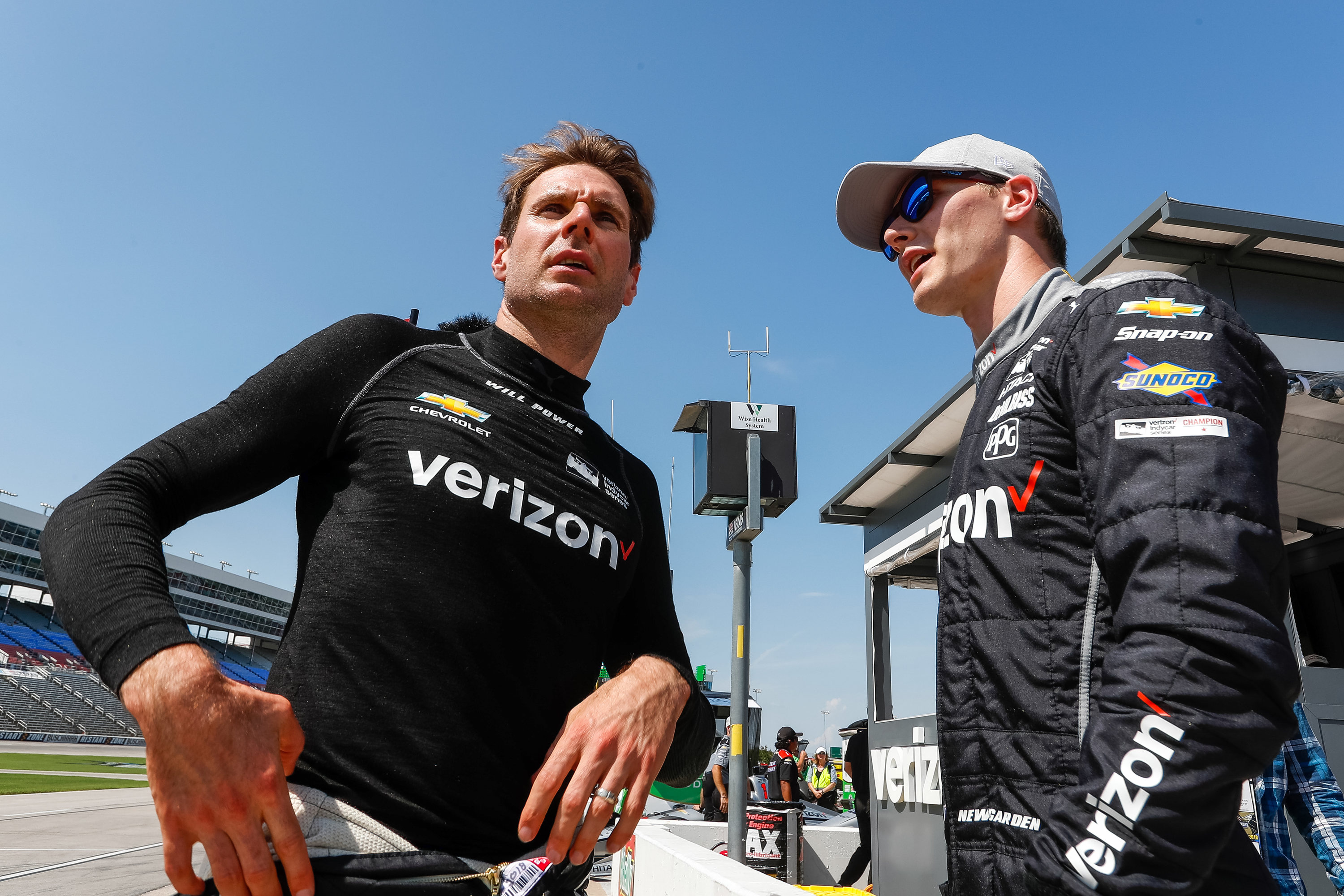
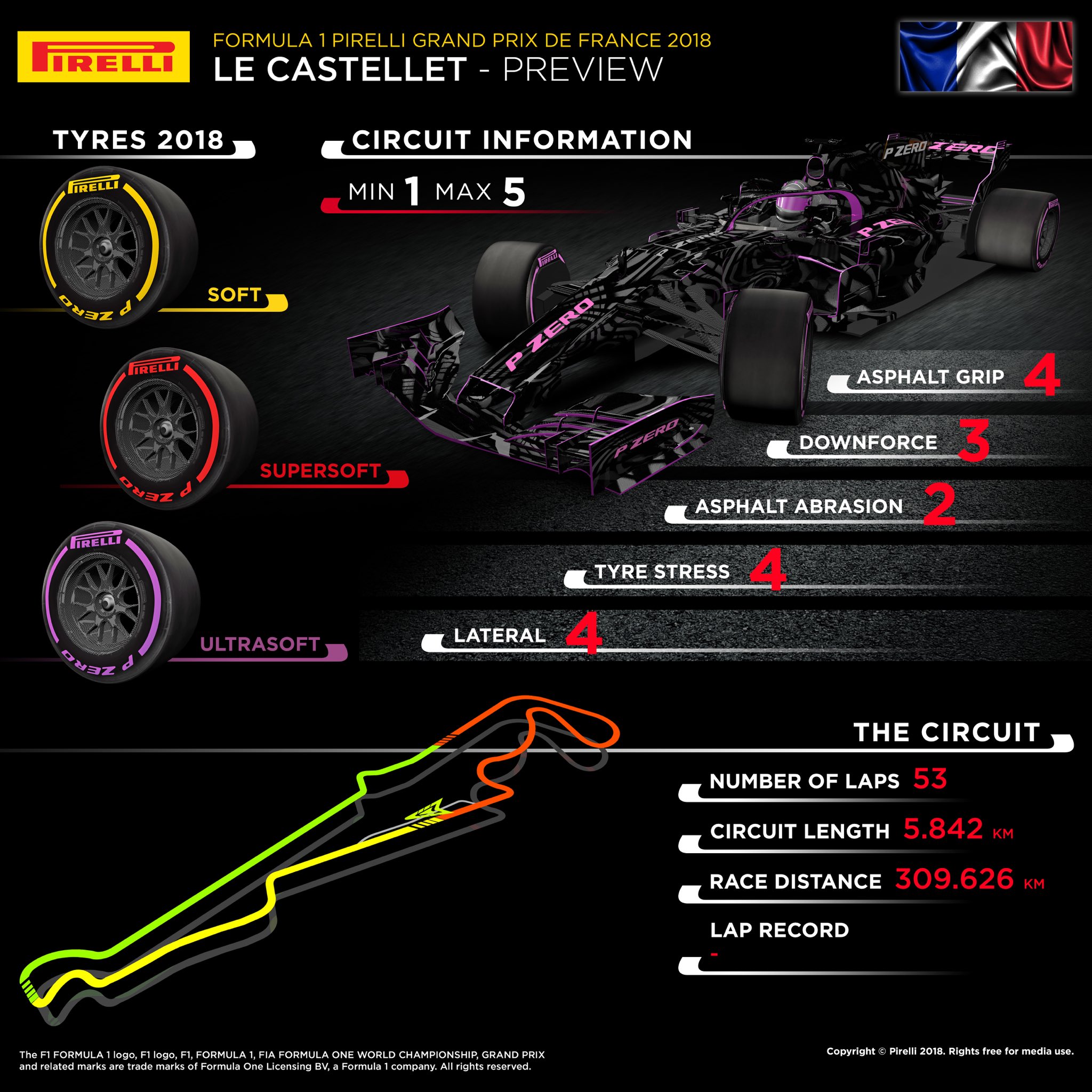
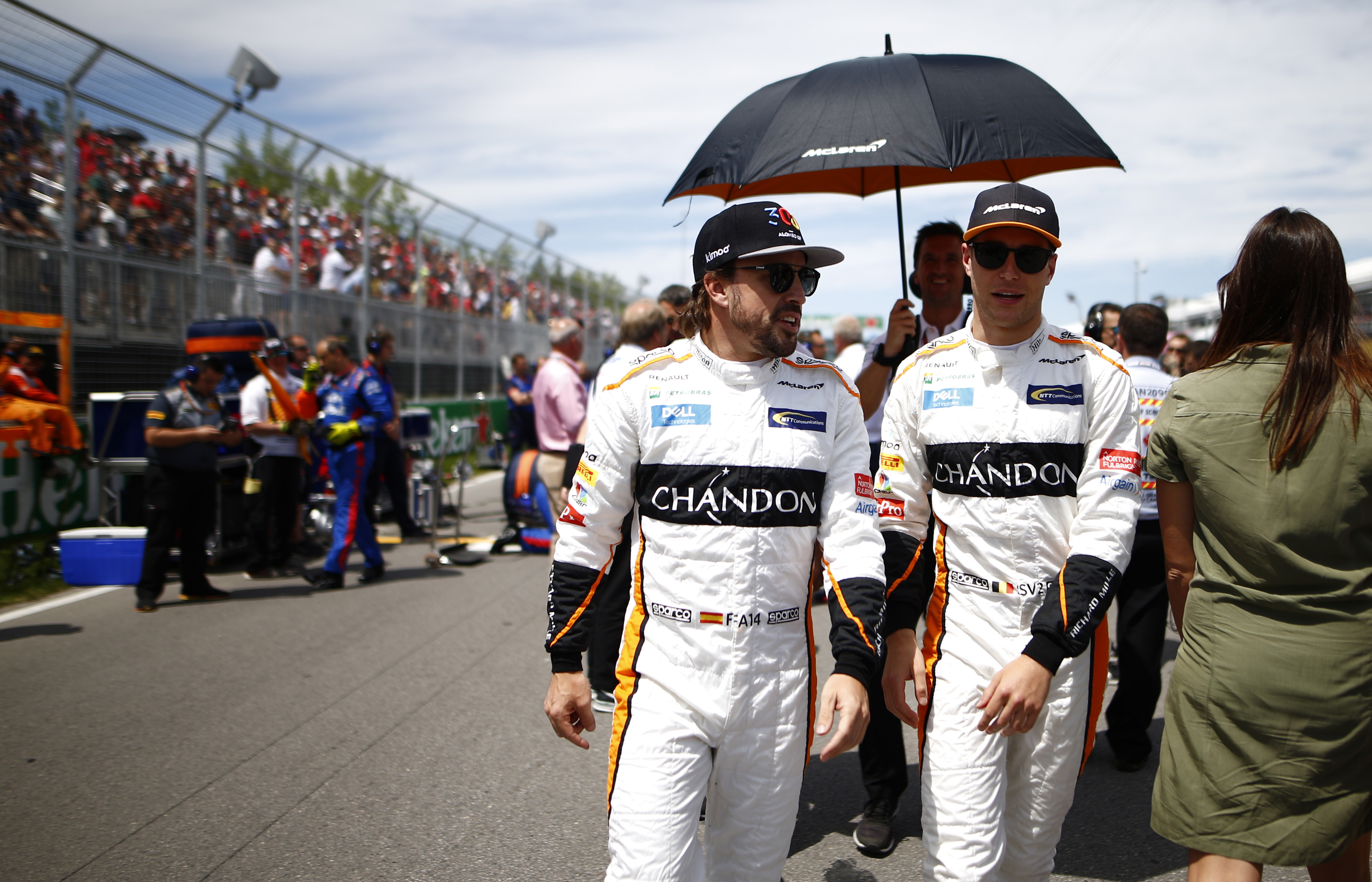
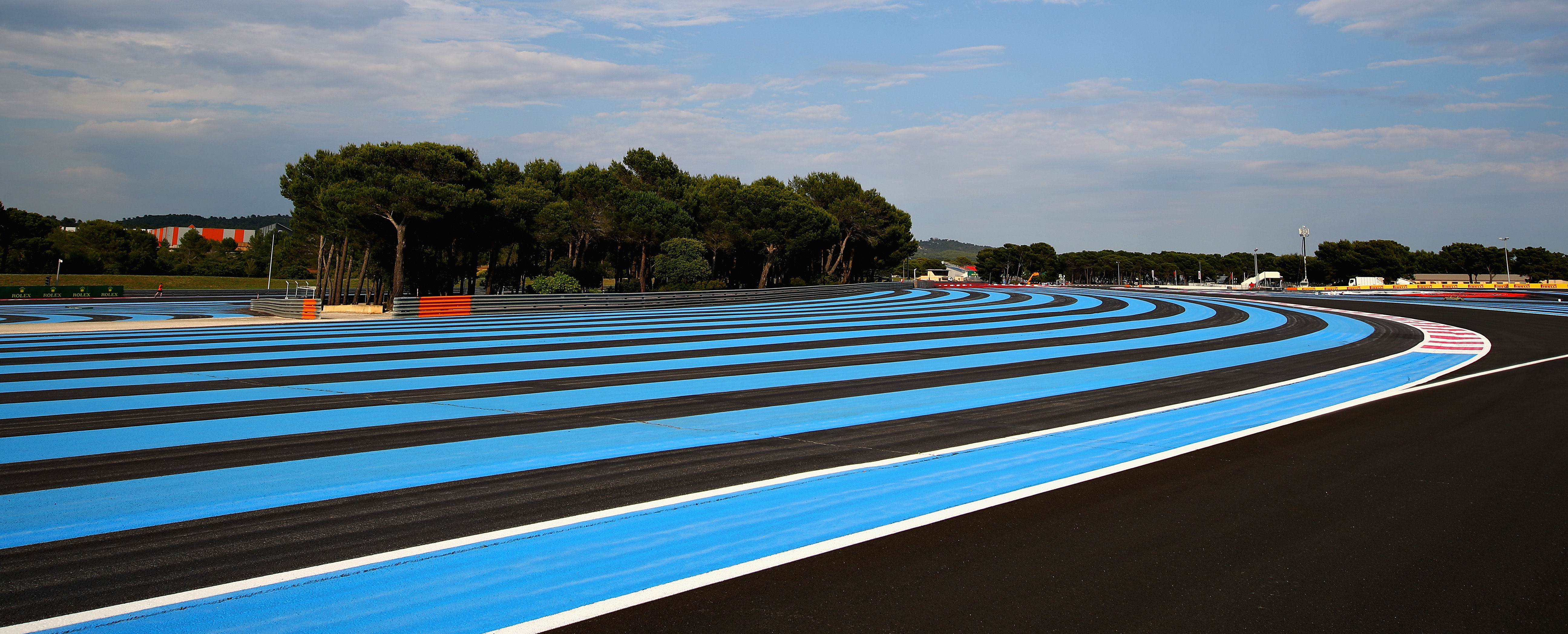
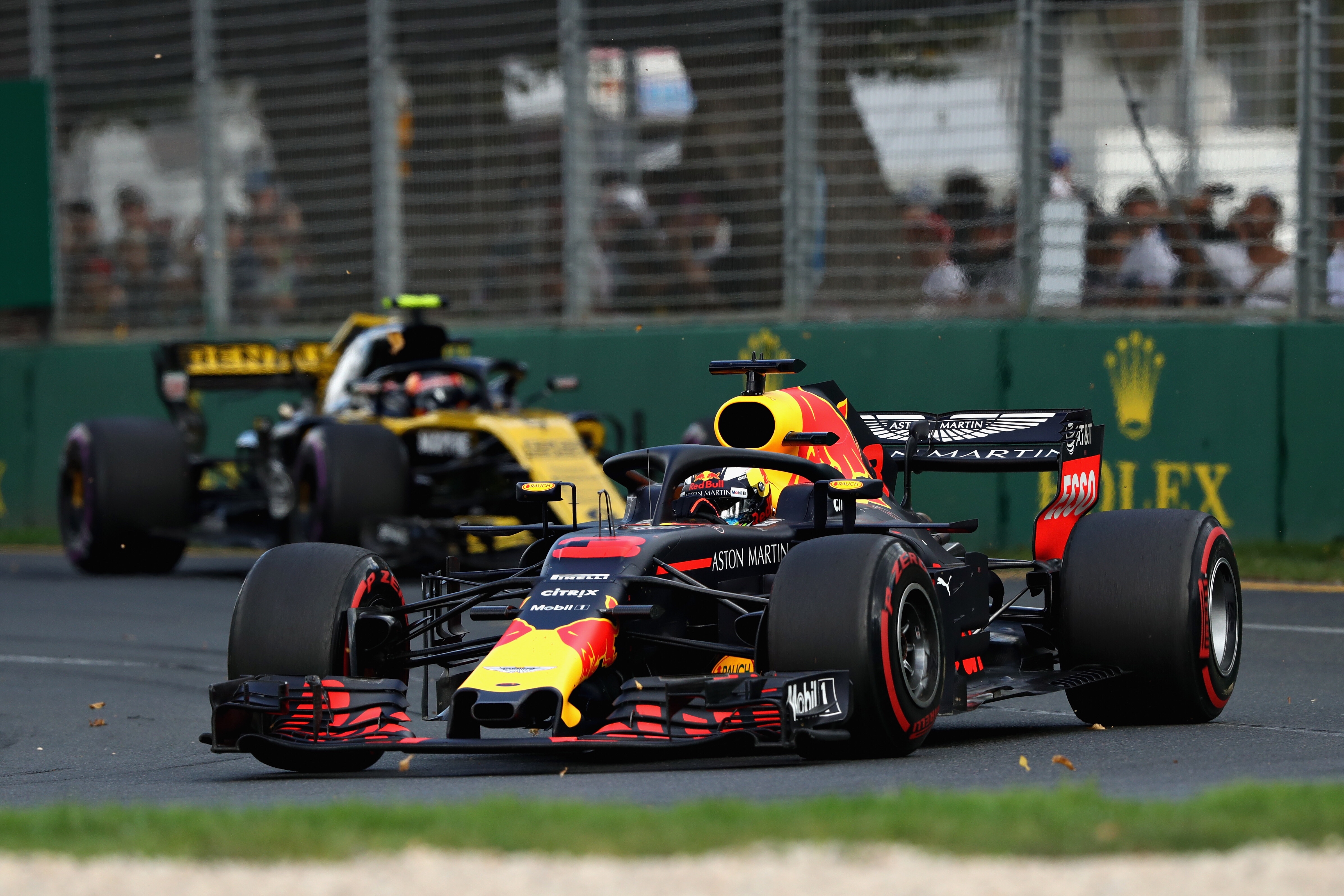 image courtesy of Red Bull Content pool.